Pollan has a tendency to talk himself into pretty weird conclusions, namely that because we can treat an animal well and give it a good life, killing it and consuming it before it naturally dies is somehow good. There is this made up notion that the animal is almost a sacrifice for us: in exchange for a peaceful safe life, it gives us its blood and flesh.
But remember, never willingly. It never wants to die. It can never agree to that trade. Killing an animal that does not want to die when we don’t need to do it to survive is always wrong, whether or not you gave it safe a life. I can’t raise my puppy up as a loving family member and then one day bludgeon it to death once I’m ready to consume (as is often done to pigs. See: “thumping”).
Pollan get so much right and the article is worth a read, but let’s be clear about two things: killing an animal that doesn’t want to die when we don’t need to do it to survive is always wrong, and ridding this planet of factory farms and replacing them with the idyllic farms he mentions towards the end still requires a MASSIVE cultural shift away from the amount of animal products we consume. We can’t meet current demand for animals products with those idyllic farms, so step one is massively reducing how many animals we consume. All vegans are saying is that we may as well shoot for as close to 0 as we can.
We raise chickens, turkeys, ducks and geese completely free range. Our homestead doesn't really even have fence on all sides and most of it is virgin forest. All these sepecies can survive on their own in the forest here, although not in the same population density that they have on our homestead. We feed them, we take care of them when they are sick, and we provide some protection from predators... we also have dogs, and the dogs presence alone helps quite a bit with that. We also take some of their eggs, and sometimes we kill some of them. The birds know all of this, yet they stay, because life is better here than in the forest. Actually, some of the ducks (Moscovy ducks, they are fully native here) do leave, but they do so mostly when there are too many males and they end up fighting a lot.
The bottom line to me is this... we keep the birds for eggs and fertilizer (and because we like them), we really eat very little meat, but we have to manage the population. When we let it get too big they suffer more, there's more disease, more fighting, etc. In fact, sometimes when the population has gotten rather dense, there has been murder and infanticide among them! They can't solve the population problem non-violently on their own, but they do like the benefits of food and safety, so we have to solve the population problem for them. I'm not rationalizing, I love these animals and don't like killing them, and I have gone long stretches of time without eating any meat and don't mind that. But I kill them, because when the time comes it's the right thing to do, and after I kill some I eat them because that's also the right thing to do, not because I want to eat meat.
So you might say: well then don't keep animals! Maybe, but keeping them is the most ecological way to maintain the soil fertility around our homestead (poor tropical soils) and the food we can produce because of this reduces our overall ecological footprint. I think it's a win-win for us, the animals, and the planet.
You’re talking about justifying killing these animals to solve problems that are caused by farming the animals to begin with, which you even say yourself.
I can’t say anything about maintaining soil fertility because I know nothing about it, but what is about chickens that preserves the soil, and why can it only come from those chickens?
Something about nutrients in the soil I imagine, right?
Since we plant things that we eat and sell (or give away) we are removing nutrients from the soil. Someone has to put them back. We could do that with industrial NPK fertilizer, but that's not very ecological. Chicken manure is a more complete and natural fertilizer, and for the most part the chickens even spread it around for us. They also engage in some pest control (the ducks are especially good at that, without them we'd have a problem with some foreign snails that have invaded around here).
We're not really "farming" the animals. We're more co-habitating with them. The birds and humans here are part of a society, an ecosystem that needs both and in which humans play a role of both caretakers and occasionally predators. Predators are necessary in a natural system and what we're trying to do is to imitate nature as best we can. This all may sound a bit pretentious, but, like I said, the birds are actually free to leave, and generally they don't, so it would seem they agree. In fact, a couple of times wild ducks have even voluntarily joined our little society!
Also, I'm not trying to "justify" anything. What we're trying to do here is a live a bit closer to nature than people generally do, reduce our ecological footprint a bit, and treat nature and all life with a bit more respect. And what we've found is that you can't be close to nature without facing death in various forms every day.
So ultimately, I don't think that Pollan's conclusion is "weird" and I don't think that "killing an animal ... is always wrong". I think treating nature with respect and letting sentient beings live their life in a way that respects their nature is more important than simply "not killing".
There are alternative models, such as biocyclic veganic agriculture, or in the future, foods created through fermentation [1] (this almost require no arable land). I recommend checking them out if you are interested in cycles in nature. Using animal manure, opposed to "plant manure" from nitrogen fixing plants, it also has its downsides because of the high levels of ammonia it kills most of the soil creatures such as worms, and more tilling and maintenance is required (which releases more carbon).
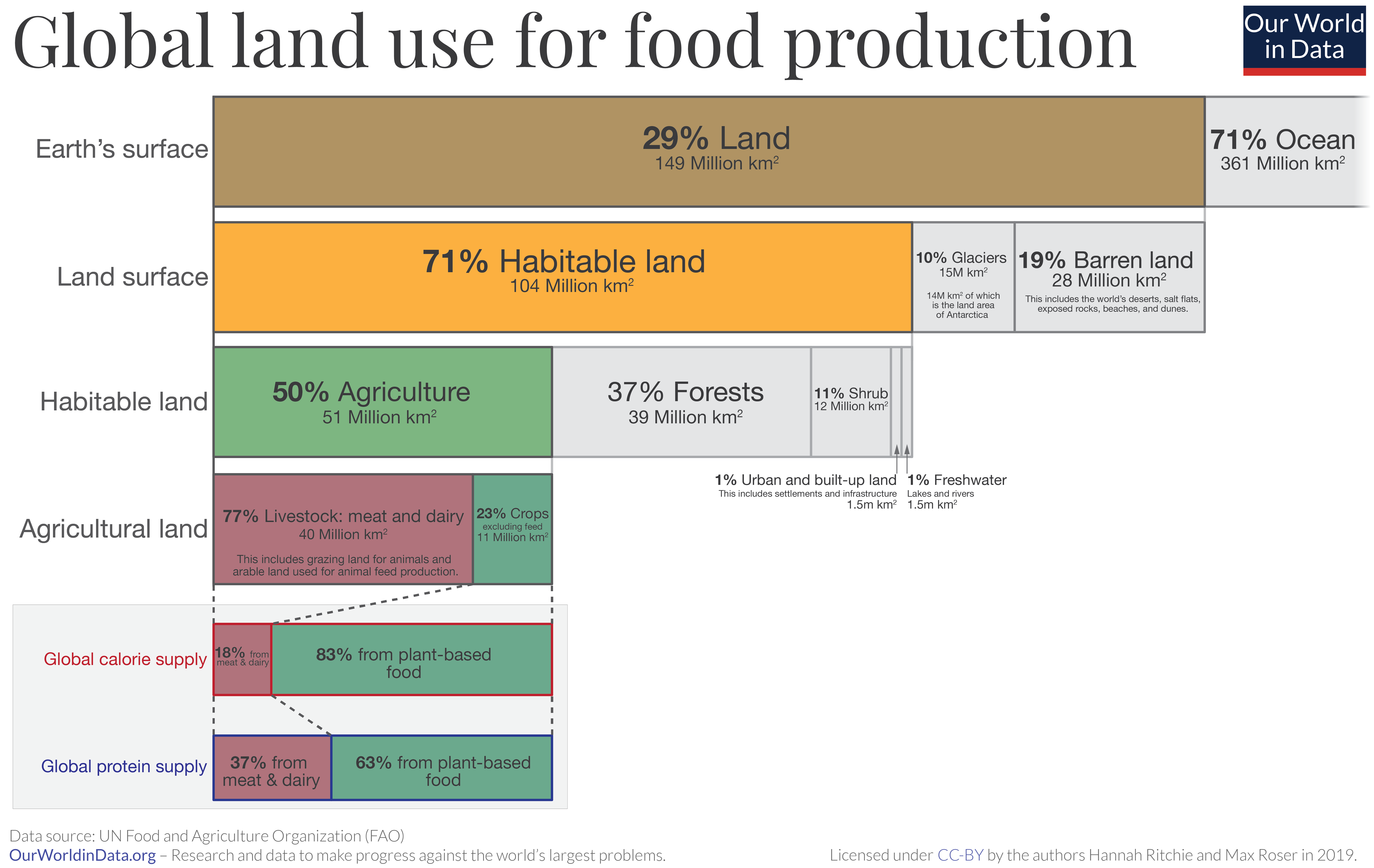
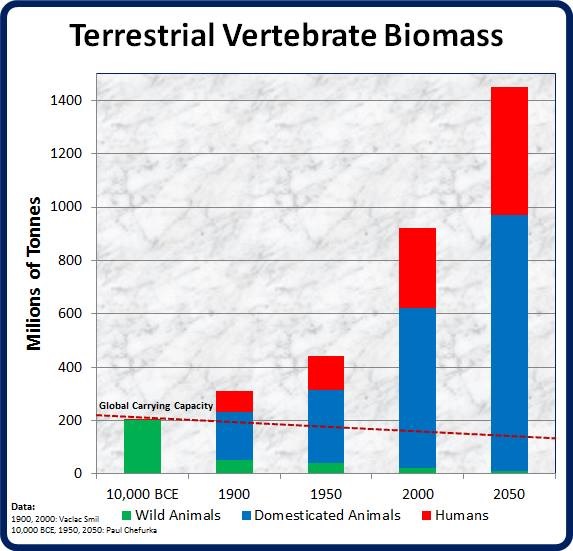
Personally I don't think that using livestock is living with nature, but is its antithesis. Since the earth is (at this moment) bound by the amount of biomass available through photosynthesis there is a limited carrying capacity for biomass. What we have done specifically is reduced the biodiversity by using more and more land mass for livestock and its feed. Of all habitable land, 50% is used for agriculture and 77% of that is used for livestock (while only providing us 18% of calories and 37% of protein) [2]. This has drastically reduced the number of wild animals and biodiversity, which I consider "nature" [3].
Ultimately, using livestock kills living beings (primarily in nature) somewhere else. If you're goals are living closer to nature, and reducing your ecological footprint, and your definition of nature is: "the phenomena of the physical world collectively, including plants, animals, the landscape, and other features and products of the earth, as opposed to humans or human creations.", then living closer to nature would mean rewilding your land and perhaps be a steward of that land. It would be a great means of treating nature and life with more respect :).
> I think treating nature with respect and letting sentient beings live their life in a way that respects their nature is more important than simply "not killing".
But isn't the best way to respect these animals is to avoid killing them when we don't need to in order to survive? I've talked to so, so many people who keep animals and ultimately kill them that talk about this reverence for the natural world, and they talk about how death is an intrinsic part of that natural world.
Sure, that's true, but that doesn't mean we need to contribute to that death (and suffering, naturally), when it doesn't need to take place. Will there always be gruesome, painful deaths? Of course. Will there always be animals that eat other animals? Definitely. But that doesn't mean it's totally fine for us to decide when animal lives or dies. An animal that has made no deals with you, has not agreed to any sort of symbiotic relationship which ends in it's death in order to feed you. Sure, the animals are treated well, and sure the birds at least can decide to leave, but them deciding not to doesn't mean they are agreeing to get slaughtered.
> and I don't think that "killing an animal ... is always wrong"
You left out the most important part of what I said in that quote, and mischaracterized it. I don't think it's always wrong to kill an animal. I said its always wrong to kill an animal when we don't need to do it in order to survive. That last part is really, really important.
At the end of the day, I'm not saying you don't care about animals, or want to live in harmony with them. You do, and I do as well. All I'm trying to do is get you to consider that maybe we can do that and also understand that animals don't want to die for us, and they don't need to. That's it. You want to live closer to nature? Hell yeah, that's great. You provide a safe place for animals to live and prosper and enjoy life? Amazing, I'm so in support of you for doing that. But then let's continue that respect and peace by deciding to simply not kill the animal.
> I think treating nature with respect and letting sentient beings live their life in a way that respects their nature is more important than simply "not killing".
In situations that are not life and death, i.e. you are not in a sitation in which you must kill one of these animals in order to survive, how are "treating nature with respect and letting sentient beings live their life in a way that respects their nature" and not killing them not the same exact thing?
Because if I don't control the population things will get ugly... overpopulation will bring disease and conflict and much greater suffering than killing. I try to control the population first by taking eggs, but the hens get very unhappy if I take all eggs, so we always leave 3 or 4. That's enough for the population to climb pretty quickly.
Also I don't know that your "killing only when necessary for survival" is really a tenable argument. When exactly is it necessary for my survival? When there's a deadly pit-viper in the house, should I kill it for my survival? For our dogs survival (they are at greater risk because they think its their job to attack the snake)? I generally don't kill it, I capture the snake alive and take it away, at not inconsiderable risk to my life. I think that killing to maintain a well-functioning ecosystem is more ethical than a somewhat vague "killing to survive".
Well yeah, again, I think what I’m saying then is that the solution is to not use animals to achieve your goals. If you need to kill animals to ensure the optimal amount of them on your property then that doesn’t sound like you’re really living that close to nature. You’re trying to maintain the animals in a state of disequilibrium.
And yeah, we basically never need to kill animals to survive. Situations in which that is the case are extremely rare.
I don't see how you can string together such a consistent argument and still be so incredibly wrong. Killing animals for food is not wrong and never was. Killing for the love of killing is wrong, but killing e.g. a pig is as moral as plucking an apple from a tree. You bring up a curious point about dogs - eating dogs is not usually practiced, though there are existing cultures who do it and we have records of past cultures who did it. Western society has decided that the dog is a beloved companion, but a person who did not grow up indoctrinated to think that way would have no qualms about eating one, save for the fact that you get a lot less meat out of one than what you put in, plus the fact it can probably serve you better alive. You can see a similar parallel in people's attitudes to eating rats - some may be revolted at eating such a dirty animal (similar to how some cultures feel about pigs), some would be aghast at eating a beloved pet (similar to how you feel about dogs), and some wouldn't really mind it.
At the end of the day, every living thing on this planet - every tree, every plant, every mushroom, every fish, every insect and every mammal dies and is eaten. I absolutely agree with you on the factory farms though - humanity should strive to not cause other creatures to suffer.
As you state, plucking an apple for food is morally fine - few would disagree, and anyone who does is likely to get quite hungry quite quickly. Meanwhile, killing people for food is obviously wrong, yes? Morally abhorrent, in fact!
But there's a spectrum between those two extremes. To set a boundary, you need to determine the reasons why one is acceptable and the other is not. Maybe you intuitively draw the line right next to the apple, eating plant life only - no fish, crustaceans, shellfish - or maybe you draw the line adjacent to humans, contentedly eating tool-using, communicative, emotional, social, familial, intelligent gorillas without feeling guilt.
But what makes it abhorrent to eat a person, and acceptable to eat a plant? As Bentham wrote, Singer quoted, and the article cites, I would agree that it has something to do with the animal's capacity to suffer. One might add positive capacities for joy, or broader ecosystem health needs, or other questions of relative utility for the victim and the farmer, but the point remains: A pig is a remarkably human-like animal. Not as intelligent or as emotional as a human, perhaps, but it's far closer to a human than that shrink-wrapped package of hot dogs in the grocery aisle might lead you to believe.
What qualities does a human have that a pig or dog does not? What metrics can you use to measure those qualities, and how do you set a threshold for where it becomes moral or immoral? Identify those, and you'll have a much more solid argument for why killing a pig is moral.
This conversation triggered memories of hunting for my first time as a teenager: I shot a beautiful doe with a black powder rifle using iron sights.
Observing the forest with my eyes and ears, waiting in still silence for hours in chemical and visual camouflage, lining up with its chest, making a slight sound to get it to pause... You feel a certain focused hunger as you gaze down the barrel, that you've never felt before. But the way it feels... It's something you know. Something that is deeply ingrained in you. The moment feels like forever, as you release a deadly projectile from your species' 'advanced technology'. Then, gutting it in the forest, dragging it out, hanging it up on the gambrel, cutting all the meat out, seasoning it, grilling it, and eating it...
Probably the most powerful, self-realizing, humbling, spiritual experience I have ever had. For the first time in my life, I actually felt like an animal! A real animal!
Did I have to kill that doe to survive? Absolutely not. I could have driven down the road to McDonalds and had a burger in my stomach in under 10 minutes.
Once I found the doe on the ground, I sat with it for a couple minutes in silence. I felt very thankful for it. "My God! I just killed this thing!" (I'm agnostic.) There is a certain realization - that we are all simultaneously frail, and immensely powerful. In that moment, you feel your place in the hierarchy.
I have a feeling that many among us today choose to actively fight this innate reality. People implicitly reject the concept that they are animals. They don't like the idea that they exist today because their ancestors killed things. Did things we now consider immoral. It can manifest in to a sort of self-hatred that is reflected on to others.
"Why do we even eat meat today? It's not necessary." Absolutely true! But to that, I say, because I enjoy it, and because I can. No other support is needed. My species has clearly evolved to enjoy consuming it, and to devise technology to acquire it. Become comfortable with what you are made of, animal spirits and all.
But above all, with great power, comes great responsibility. Hone your sense of morality, as we are in a position privileged to do so. Thanks for reading my rambling. :)
> Probably the most powerful, self-realizing, humbling, spiritual experience I have ever had.
I'm sorry, you felt it was self-realizing to kill an animal? What the hell? There's nothing sadder and messier and more harrowing than having to kill an animal and you actually found it a "spiritual experience" to kill one when you didn't even have to? What kind of culture do you come from? I can't think of anyone from the western world ("your species 'advanced technology'? Not a native hunter, then) that seriously thinks it's cool to kill.
I feel like this comment accuses me of fetishizing killing, and that disgusts me.
I had something long typed out, but it's just not worth it. When I (rarely) comment, I am usually reminded how debilitating it is. It's probably an indication that I should just stay silent, so I think I'll stick to that more.
I'll try though: People eat meat their whole lives, but never feel the act of killing and consuming first-hand. I find that rather sad, like they have lived their life never emotionally acknowledging this innate drive that enabled their existence. If anything, the act forces upon you greater respect and compassion for life and what it means to be an animal.
Hunting in my part of the US is very common, and over 160,000 deer were taken in my state last season. The deer population is doing well, and the act is well-regulated by government. I don't see anything wrong with killing for sustenance, even though it's no longer remotely necessary.
Yes, many people in industrialised societies have lost the connection to their food, not only the animals whose meat they eat but also the plants. But what does that have to do with killing an animal being "self-realizing"? What part of yourself are you "realizing" by killing an animal? You can't eat an animal without killing it, so you kill it and be swift about it and make it as painless as possible but to find the experience "spiritual"? That's ... just as lost as thinking that eating meat is wrong. It is a kind of thinking that comes from exactly the same place of disconnect with the world of animals and the need to kill them and eat them, even after you have raised them and cared for them from babies as veganism. It is the left hand of veganism. It is madness and derangement to derive pleasure from killing an animal and if you think there's any pleasure in that, you should go back to basics and learn to appreciate life all over again, is what I think.
Or, since you think the way you think about the connection of people with their food, maybe try to live on a farm for a few years and care for animals and then slaughter them, and see how "self-realizing" that feels, to kill a lamb that you stayed up all night to help give birth to, and nurtured and fed with your own hand. Try that! And tell me about the "spirituality" of killing something that feels like your own child.
Not as much as an animal, but we are learning that plants are far more sophisticated than we've traditionally given them credit for, and do have ways to detect damage (which we call "pain" in animals) and can even alert other plants to danger (which could be called "fear")
The common retort to this argument (“plants feel pain too”) is to imagine that you call the fire department because your home is burning down, and unfortunately your pet is still in the house. When the fire fighters arrive, you tell them hurriedly that your pet is inside and it needs to be saved. Without hesitation the firefighter plunged into the flames and emerges minutes later, but not holding your pet, but instead your aloe plant.
You exclaim in a panic, Why didn’t you save my pet!? To which the fire fighter says, Well plants feel pain too you know! And we’re learning a lot more about how advanced they are and how they communicate.
Do you really think you’d stand and their and consider, Hm that’s a good point, there is no relevant difference between my pet being saved and my plant?
No one who has ever made the argument that plants and animals deserves equal moral consideration due to this capacity to suffer has ever, ever meant it.
Whether or not the plant "feels pain" (and therefor whether or not it is morally wrong to do nothing while it dies in a fire) is immaterial here. People are more likely to build and maintain emotional attachments to their pets rather than their plants because their pets exhibit behaviors that are easier to identify and personify.
People want the fire fighters to prioritize saving whatever has the most value to them personally. That may happen to be house plants. Or perhaps photo albums. Or (likely most common) pets.
Okay then, let’s consider an alternate scenario then.
Let’s say that you’re a bystander at the fire, and you watch the firefighter rush into the flames. You walk up to your neighbor, whose house it is engulfed, and you ask, What are they going in for? Your puppy? to which your neighbor responds, Actually I have a really sentimental baseball glove that my dad gave me when I was a little kid. I couldn’t imagine losing the glove, but the puppy I could take or leave.
Would you understand the position, and agree that it’s better to safe the glove because it has more value to the neighbor? Or would you be appalled that your neighbor is opting to let a sentient animal burn to death in order to save a baseball glove? Albeit, a very sentimental one.
The better angle to take here would be to point out that taking an apple from an apple tree does not harm the tree. From the plant's point of view this is actually beneficial. It wants animals to take away its seeds. So this is more alike to taking milk from a cow.
Taking milk from a cow is in no way like picking an apple. Apples are intended to be eaten by any species that wants to, as a kind of quid pro quo for spreading the seeds. Cow milk is for baby cows only. Humans keep cows lactating by forcibly impregnating them, and then taking the resulting calf away. Much suffering is involved, physical and emotional.
> At the end of the day, every living thing on this planet - every tree, every plant, every mushroom, every fish, every insect and every mammal dies and is eaten.
Except humans. Humans cremate their corpses.
While we might get into a debate about whether some forms of life somewhere on Earth technically consume your scattered ashes, it's quite the distance from hitting you on the head until you die and then chewing on your flesh.
Some cultures (some nations) cremate their dead. Others bury them. Some bury them in the soil, where they are eaten by soil organisms, some bury them in the sea where they are eaten by fish and some bury them in the air, where they are consumed by scavenging birds:
Relatedly, animals still kill many humans every year:
> Philadelphia, February 28, 2018 -- A new study released in the latest issue of Wilderness & Environmental Medicine shows that animal encounters remain a considerable cause of human harm and death. Researchers analyzed fatalities in the United States from venomous and nonvenomous animals from 2008-2015. They found that while many deaths from animal encounters are potentially avoidable, mortality rates did not decrease from 2008-2015. The animals most commonly responsible for human fatalities are farm animals, insects (hornets, wasps, and bees), and dogs.
Though most of the humans killed this way are not even eaten, which is arguably a waste. One reason is that many of the killer animals are herbivores, particularly cows:
I prefer for my body to be eaten by other living things, big or small, and ideally in a way that doesn’t pollute the land and water too much (I accept the heavy metals and other toxins I have built up over the years will leech one way or another).
I have no problem separating the dead body from the previously-living being, and I hope more people can adopt this view. This doesn’t mean I will stop handling dead bodies respectfully, at least as far as I see it. When I kill a fly or an ant I own the act, matter-of-fact without performative solemnity, and put the body in the compost to fuel further life. When I ask the vet to kill my dog I will be sad as this family member dies in my hands, and eventually the dominant emotion will be love and joy at all the good times we had together.
I would assume based on your comment that you're already aware of these [0] but if not, consider reading up on "Towers of Silence". It may interest you.
Cremation is relatively recent in human history (oldest record dating to 17,000 years ago), the vast majority of which we buried our dead who then decomposed/were eaten.
Nature doesn't deal in morality, right or wrong. Nature deals in balance. A fox that kills all the rabbits one year will die of hunger the next. The question isn't whether the fox has a moral right to kill rabbits or not, the question is whether the fox maintains the balance needed to maintain the ecosystem that it is part of. Act too unsustainably and break the balance by too much, and you disrupt the ecosystem, and your place within it.
What we need to do isn't to anthropomorphize animals and project our morality onto them. What we need to do is acknowledge our place in the ecosystem and start acting like an omnivore that knows how to maintain balance instead of taking a saw to the branch we're sitting on.
Rubbish. By this logic, we can just say that we shouldn't upset the "balance" of the slave owners -- they were able to to "maintain the balance needed to maintain the ecosystem that it is a part of".
Um, no. Humans do have morality, and can and should apply it to one another - and can expect and even demand the same in return from others. We can't do that with nature, and nature does not need or want that in return from us.
Humans are both animals, that need to fit into an ecosystem, and social creatures, that need to fit into a society. Both domains require rules for how we interact with and fit into them, but those rules are not the same.
I think the only flaw there is that our morality came from nature and therefore is one of the things we use to fit into our ecosystem. There's nothing to say we shouldn't apply it to other members of the system. If nature didn't "want" that we wouldn't be capable of doing it.
Given how far up the food chain we are it could be argued that our morality exists precisely for this purpose.
What on earth makes you think that? No, I don't think humans are super-natural. But in addition to being creatures sprung from nature, we are also something else (indeed, the very definition of something being anything other than natural, i.e. cultural or artificial, is that humans have had a hand in its creation).
Slaves were (are!) humans. Slavery has nothing to do with killing or not killing non-human animals, because it doesn't affect non-human animals, it affects other humans.
There is just no sensible comparison that can be drawn between what we do to other animals and what we do to other humans and once more I'm struck by the surrealism of the positions taken in this kind of conversation. It's as if the obvious has to be stated at every turn: non-human animals are not human. Humans are human. We live in a civilisation built by humans, for humans, that only makes any sense (in asmuch as it does) to humans, not to other animals and it makes no sense to try and treat non-human animals as humans, any more than it makes sense to try and treat humans as non-human animals.
You are perhaps misunderstanding what animal welfare advocates are up to. No one wants to give animals the right to vote. We don't want to treat animals as humans in every respect. We just don't want, for example, for animals to be considered property (meaning anyone can abuse the shit out of an animal with no repercussions).
Reflect on this yourself, do you think it should be permissible, in our modern society, to buy a dog in a store, lock it up in the basement, and beat it to death over the course of several weeks?
Wow, that escalated quickly: from buying a dog to locking him or her in a basement and beating him or her to death over weeks...
Can I think that one of those things is permissible, but not the others, or do they necessarily come in a package?
And I don't understand what you mean that if animals are considered property "anyone can abuse the shit out of an animal with no repercussions". There are laws against this in many places around the world -animal cruelty laws. In most jurisdictions where there are laws against animal cruelty, laws also consider animals as property, so it's clear that both can work together.
> You are perhaps misunderstanding what animal welfare advocates are up to.
I don't. It's the animal rights advocates that are confused about what is meant by "rights". Animals have no concept of rights, theirs or others, so it's only humans that can choose what animal rights laws should exist. But those are not really animal rights, they're human rights: rights that humans have, or don't have, to behave towards animals in certain ways. For example, I have no right to abuse an animal (and that's as it should be) but that is not a right that an animal has, it's a right that I don't (as I shouldn't).
Rights only make sense as laws of human socieities, but how are animals part of human societies? How can they participate in human societies, if they can't own property, vote, work to support themselves, etc? The absurdity that is obvious in granting animals such rights, that they can't even understand, let alone benefit from, makes it clear why the entire idea of "animal rights" is absurd.
Legislation to protect animals is welcome and much more of its kind is needed, but "rights"? That's "nonsense on stilts".
Attention: Downvoting me? You should respond instead or at least additionally. I don't care if my points go to 0. Don't turn this place into a Reddit hivemind.
This appears to be your logic: It's OK if we destroy our planet with global warming and create conditions where a good percentage of humanity could be harmed because portions of humanity have previously created harm and exploited others throughout history.
This seems like "two wrongs make a right". The end result won't be a right.
We are unique in that we have the ability to develop morality. We will not throw that gift aside just because the rest of nature can not.
We can and we should judge our actions by our morality. And nature itself is not exempt from judgement by that morality. It is entirely valid to ask ourselves if nature itself is morally wrong.
It is not a stretch to make an argument that it is, in fact, not. Nature is built around massive, unending cruelty. Just because it has existed for a long time, or because we can out of that chaos, is no reason to accept it as a given.
This documentary is worth watching: https://www.youtube.com/watch?v=LQRAfJyEsko (Dominion, released in 2018, unfortunately requires signing into youtube due to age retrictions)
Peter Singer's Animal Liberation (1975) is a must-read book. Almost 50 years since its publication, it's still relevant - provides a solid argument in favor of reducing one's meat consumption.
This is my opinion and it's definitely not steadfast set in stone: while I think people who don't consume meat are potentially more morally virtuous than omnivores, I don't think it is a moral obligation not to consume meat.
I think there is much to be desired in terms of changes to mass farming practices, but the fundamentals of my beliefs are that we are not in the same moral and social contracts with animals as we are with other people. There are significantly different ramifications for squashing a bug, a dog, and a person (for example, but not as rationale).
Is a pig, cow, chicken, or ANY given sentient creature able to comprehend and abide by the rules of morality we enforce on each other? Does a bear think about the moral ramifications of mailing a hiker? If a creature can demonstrate this an a willingness to abide by our morality, it should be brought into the fold of our social contracts and be given rights on par with humans.
This doesn't mean it is morally justified to 'needlessly' kill or 'uncessesarily' reduce the well being of animals (what is needless or unnecessary are highly contextual and loose terms). Torturing of animals is a pretty clear example of something unnecessarily harmful and immoral without clear benefit.
Ideally, animals unable to abide by moral codes are still granted certain minimal rights and protections, but are not privy to the set of rights and protections we grant each other.
I agree with your comment and others have made that point: animals don't have any concept of rights, or wrongs, or duties, which can only be understood, and bestowed upon animals by humans. There are rights recognised to humans, like the right to own property or the right to vote in democratic societies, that animals would not be capable of exercising even if we granted them those rights and that alone makes absurd the idea of granting rights to animals modelled after the rights of humans. And even the basic rights, like the right to life, that it would make sense to grant animals, are not anything that animals themselves would be able to understand, or uphold, and they would immediately violate those rights by killing other animals, as cats will kill birds and small mammals without any consideration of their "rights" or any kinds of wrongs.
Of the arguments Pollan presents for why it's okay to kill animals for food, the most persuasive is that domesticated animals evolved in symbiosis with humans — that they essentially made a deal with humans whereby we would take care of them in exchange for their "products" and their lives:
"[...] domestication happened when a small handful of especially opportunistic species discovered through Darwinian trial and error that they were more likely to survive and prosper in an alliance with humans than on their own. Humans provided the animals with food and protection, in exchange for which the animals provided the humans their milk and eggs and–yes–their flesh."
The problem with this argument is two-fold. First, only one party in this "deal" has a full understanding of what the deal consists of and the endless cruelties and indignities inherent in it. Second, the terms of the "deal" have changed tremendously for both parties since it was first "signed" (that is, when humans and animals first entered into the symbiotic relationship of domestication).
The way in which the terms are different for animals is obvious (e.g. CAFOs), but the terms for humans have also changed tremendously, including in the past 20 years since the article was written. An Impossible Burger is so similar to a beef burger that when I first tried one, I thought perhaps the restaurant had screwed up my order and given me beef accidentally. It is, for almost all intents and purposes, meat: with the exceptions that eating it doesn't serve the interests of the cruel and planet-destroying agriculture business, and it doesn't involve taking the life of an animal. (His argument that ruminants are ecologically beneficial is also very outdated; raising cows in particular is a major environmental problem.)
What this means is that it's increasingly difficult to claim that eating meat is anything other than a gastronomic preference. There is no need for it, but if we feel we must, we have "meat" that doesn't come from animals with which to satisfy that desire. He writes,
'[...] we should at least acknowledge that our desire to eat meat is not a trivial matter, no mere “gastronomic preference.” We might as well call sex–also now technically unnecessary–a mere “recreational preference.” Whatever else it is, our meat eating is something very deep indeed.'
Just like birth controls means we can have sex without procreating, plant-based meat allows us to eat meat without killing. If we wish to satisfy the "deep" desire to kill and eat animals (I find this silly — scarfing down a burger is hardly a spiritual or evocative practice), we can.
The world has changed: the terms for the "deal" we made with domesticated animals are no longer relevant and ought to be renegotiated.
There's a problem with these conversations about eating animals that is frequently hard to articulate. I think it's related to the famous quote:
“You cannot reason a person out of a position he did not reason himself into in the first place.”
- Jonathan Swift?
The argument against is detailed and seems logically consistent. Most people who are in favor of eating animals simply won't engage though. Those that do engage generally make a poor showing.
My theory is morality isn't logical so arguing morality is simply a lack of self awareness. People who share your morality follow the logic and possibly change behavior, but without a shared sense of morality the argument is just a collection of empty words on par with a solved sudoku puzzle.
Of course morality can and does change with time, just not via a logic based argument.
To me the main argument around the morality of killing animals for food has to do with the natural life cycle. You absolutely can have a self-consistent position that killing animals for food is morally evil, but only if you also consider all carnivores as morally evil. I believe Hinduism for example holds this position.
But I don't think you can consider a human killing a lamb morally evil while thinking that a tiger doing the same is morally neutral.
I'd also note, as I have elsewhere, that the way we sacrifice animals is much, much nicer than how they usually die in nature.
Unfortunately, the way we raise animals is often incredibly cruel, much worse than necessary and much worse than we generally used to do it historically. I feel this is mostly the same as other horrible practices that savage capitalism has brought and that will hopefully end one way or another because of global warming.
Applying questions of the morality of eating meat to obligate carnivores makes no sense; there can be no moral question if there isn’t an option between two paths. Obligate carnivores MUST eat meat, so whether or not they “should” makes no sense to ask.
Humans are not obligate carnivores, though, which is morally relevant. We can hold human beings to a standard (don’t eat animals if you can avoid it) but not carnivores to the same specifically because we have a choice and they do not.
Well the first part of what you said seems just completely untrue. I don’t think if someone was starving and they needed to eat an animal to survive that anyone would say they acted immorally.
As to your second point: no. Those animals lack the moral reasoning ability to make a choice between eating meat and not eating meat. We don’t, though.
If I ever meat a bear who is able to make nuanced moral considerations like the ethics of eating meat, and who has access to a plant based diet on which they can survive, then sure I’ll hold them to the same standard as you and me.
I don’t think Im ever going to meet a bear like that though.
What about if someone were starving and they needed to eat a human to survive? (Because there wasn't anything else, shipwreck, etc)
You're trying to apply the same standards to animals as to humans with respect to killing them being morally wrong, but then you make an exception that seems to place humans into a completely different category again. I don't like your exception because things are basically never that clear-cut... there's always another way. If you want to be so absolute about the morality of killing, then stick to it and don't make exceptions. If you don't want to consider animals as food, then don't consider them food, even if it means starving to death. Just as I don't think I would ever consider another human as food, even if I'm starving to death.
> What about if someone were starving and they needed to eat a human to survive?
Yeah, what about it? I don't understand the relevance of the thought experiment.
> If you don't want to consider animals as food, then don't consider them food, even if it means starving to death
Why can't I consider them food when there is no other option? Why can't I try to preserve animal life as much as I can, unless my very own suffering and death are at stake?
How is it so controversial to simply say that we should avoid suffering so long as we are not sacrificing our own life? If I'm well off and healthy and have everything I need to survive, then the suffering caused by my killing an animal seems super unnecessary and pointless, no? But that same act (killing and consuming the animal) when I need to do it to survive is _not_ unnecessary or pointless, thus rendering it not immoral. That's all.
> I don’t think if someone was starving and they needed to eat an animal to survive that anyone would say they acted immorally.
Sure, just like most people don't view killing an animal to enjoy its taste as immoral either.
But as a general principle, the ultimate moral good is sacrificing your own life and happiness for another. Killing someone else to save your own life is not usually praised (as long as we're not discussing self defense, which is another matter).
Still, reading your other replies, I understand your position to be that there is a hierarchy of life worth - human > animal > plant[...], you just draw the line differently on killing than most people. I have to agree that this is also perfectly coherent.
> Those animals lack the moral reasoning ability to make a choice between eating meat and not eating meat.
But how can you say that? You can't know what choices an animal makes or doesn't make. In fact, if you have pets or been around animals for some time, it would be blindingly obvious that animals absolutely make choices between whether to eat something or not, be it meat or anything else.
For example, the cats in the farm where I live have no compunction about eating humans' food (for example, one of my cheeses that I foolishly left within their reach), but the dogs will never touch it.
And make no mistake: those are absolutely moral choices. The dogs know it's wrong to eat food that is for humans and that there will be repercussions if they do so. The cats don't care and only mind when they're caught.
Your caricature of animals as unthinking feeding machines is unrealistic and it is not based on any close contact or detailed knowledge of animals. Please re-examine your beliefs because they are unfounded and uninformed.
All I'm saying is that I don't think non-human animals should be expected to need to comprehend the nature of suffering in sentient begins. You're saying that's unfounded and uninformed. I don't even know how to respond because I almost feel like you're messing with me.
> The dogs know it's wrong to eat food that is for humans and that there will be repercussions if they do so.
No, they know they get scolded when they do it. This is why dogs only stop pissing on the floor when you make it clear they can't. Not because they had some sort of moral realization that it was wrong to piss on their owners floor.
> You're saying that's unfounded and uninformed. I don't even know how to respond because I almost feel like you're messing with me.
Yes, I appreciate it's difficult to understand why not everybody automatically agrees with everything you say.
Just out of curiousity and my apologies if I'm prying, but, do have a personality disorder? I mean, have you had a diagnosis and all? I don't want to be unfair to you.
Not at all. I'm asking whether you have a diagnosis of a personality disorder because in all the conversations I've had with you and in all the conversations I've seen you have with others you seem to be incapable of seeing the other person's point of view even just to disagree with it and you don't seem to appreciate how the most disurbing parts of your interaction come across. That, to me, speaks of an uncommon state of mind compatible with a personality disorder.
As I say, I don't want to be unfair. If you do have a personality disorder there's no point in me being upset at your behaviour.
> First, only one party in this "deal" has a full understanding of what the deal
consists of and the endless cruelties and indignities inherent in it.
These "endless cruelties and indignities" exist in one way of farming only, the
factory farms found in modern industrialised nations and spreading slowly like
a rot throughout the world as we speak because capitalilsm is a disease that we
don't know how to cure, like cancer.
But for most of our history, there were no "endless cruelties and indignities
inherent" in farming, as there aren't any still in much of the world today.
Below are a few examples.
Goat farming in Chavignol (to make Crottin de Chavignol AOP):
Those are from European countries that I'm more familiar with but you can find
similar practices in most of the world, although they constantly at risk from
large agribusinesses that want to take over the farmers land and business.
More importantly, we have only been able to domesticate the animals we have
because of their character and because of our character, and while there was no
formal agreement, because a formal agreement can only be made between humans
(because it needs language that only humans posses) it is very wrong to say that
animals entered their contract with ours unwillingly. We have only been able to
domesticate animals that allowed themselves to be domesticated: we have not
domesticated zebras, for example, or tigers, or hippos. And we have only been
able to domesticate animals because we ourselves, like our domesticated animals,
are a gregarious, sociable species, that is kindly disposed towards other kinds
of animals and has a natural instinct to care for them and tend to their needs.
A lion could not domesticate sheep: it would just slaugther the entire herd. A
weasel could not domesticate chickens: it would just strangle the entire flock.
We were able to do it because we are, by our nature, as a specias, capable of
caring for other beings than ourselves, even for beings of another species than
ourselves. Which I think is most clearly seen in ideas like "animal liberation",
albeit taken to extremens.
> Second, the terms of the "deal" have changed tremendously for both parties
since it was first "signed" (that is, when humans and animals first entered into
the symbiotic relationship of domestication).
This is true. Absolutely, 100%, heart-breakingly, infuriatingly, shamefuly true.
But again this is because of the modern practices of factory farming that
threaten to destroy our bond with our domesticated animals, this "mutualism"
that Michael Pollan speaks of. Rather, to dig deeper still, the name of the
culprit is capitalism and it's the result of the extreme distortions that it
causes to the very mechanisms that sustain life on the planet, themselves. That
is where the shame and the crime and the horror come from: capitalilsm. And the
sooner we realise the mess we're in because of this inhuman economy we have
created, the better we'll all be. Unfortunately, before this happens, everything
we have achieved as a civilisation and as a species will be destroyed.
No need to apologize, I appreciate the thoughtful (and passionate) reply.
To clarify one of my points: when I said the terms of the deal have changed I didn’t mean just for animals. The existence of plant-based alternatives for every type of animal product has also changed the terms for us. We no longer need domesticated animals, even if we maintain our agricultural ways.
I also agree with you about unfettered capitalism but I am not sold on the idea that the treatment of animals outside the capitalist system is a utopia. I have seen how animals are treated in developing nations (Cuba and Morocco come to mind) and it’s ugly: scrawny donkeys whipped by their masters. Live chickens bound to one another by their feet next to a heap of dead chickens in a market. Etc.
When it comes to the kindly attitude some farmers have, yes, I’ve seen this myself. My family still eats meat, I ensure we buy it from local farmers like that. I think many of these people feel sad about killing the animals when the day comes, but they justify it with rationale like, “well, there’s no way around it”, or, “that’s the natural order of things”, “people need to eat”, or whatever. But today, in 2021, those rationale are not accurate. There are ways around it, there are other options, and humans are no longer part of the natural order.
You're right that animals are not only treated inhumanely in CAFOs, I have seen
that kind of thing too. Even simple things, like killing a chicken before
cutting its throat seem to never cross some peoples' minds. It's a different
problem that has to do with education and generally standards of living and I
think in the end it all loops back to the main reason that some people lack
basic education, not to mention many other material needs: capitalism, again
(and now I sound like a broken record). But again that's not the case
everywhere. It is possible to raise animals without causing unnecessary
suffering and it does happen, around the world.
I think we agree on the need, or the want even, to minimise suffering. Maybe we
disagree on what that entails? I think that small-scale farming can achieve
this, which of course means that much of the world will need to eat much less
meat and even (gulp!) dairy products than currently.
I don't agree that we're not part of the natural order, but that's a bigger
conversation I think.
Yeah, thanks for the level-headed discussion also.


But remember, never willingly. It never wants to die. It can never agree to that trade. Killing an animal that does not want to die when we don’t need to do it to survive is always wrong, whether or not you gave it safe a life. I can’t raise my puppy up as a loving family member and then one day bludgeon it to death once I’m ready to consume (as is often done to pigs. See: “thumping”).
Pollan get so much right and the article is worth a read, but let’s be clear about two things: killing an animal that doesn’t want to die when we don’t need to do it to survive is always wrong, and ridding this planet of factory farms and replacing them with the idyllic farms he mentions towards the end still requires a MASSIVE cultural shift away from the amount of animal products we consume. We can’t meet current demand for animals products with those idyllic farms, so step one is massively reducing how many animals we consume. All vegans are saying is that we may as well shoot for as close to 0 as we can.