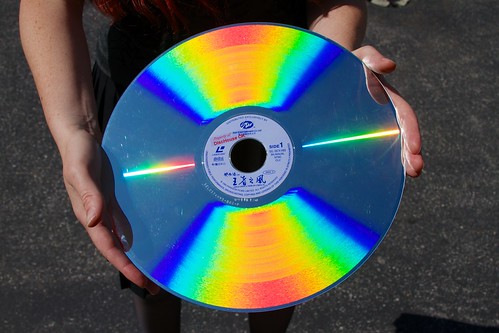
FWIW, over the past ten years I've pieced together the largest collection of MCA DiscoVision LDs in the world.
My goal all along has been to digitally preserve it for all.
I have a background which lies at the intersection of embedded programming, broadcast engineering, and video restoration, so I definitely have the technical chops to do so, but what I lack is time since I have three young children at home.
It's somewhat stressful having what would otherwise be a neat retirement project hanging over your head in your 30s, but I feel fortunate enough to possess so many rare pieces.
I just wish I had someone passionate about it to share it with in order to give me drive when my drive is low.
The use of multiple copies to remove dropouts has been interesting there too. Think MAME just added some of the games in a couple of months ago that have been thru this process. So even if they have a copy your copy could be of use.
Not just dropout: the disc stacker will set each pixel to the median (if there are enough copies) or an average (if there are just two) so even slightly off pixels on one disc of three, will be caught/fixed. (You can do the same thing with VHS, but not with their stacker software. You'll need to resort to VapourSynth or Avisynth/Avisynth+.)
how would one get in touch with you regarding this? i worked on a site that never took off archiving DJ mix tapes as I had several professional cassette players. the main reason it didn't take off was from DJs not following through with sending me the cassettes. also, nobody wanted to fund the site, and nobody wanted to deal with potential copyright crap.
we have similar, but different, backgrounds. i was in film/video post house at the transition from film to digital, from analog tapes to digital tapes, built a couple of machine rooms for different companies, made a career for knowing the film-to-video stuff that's no longer taught nor properly understood. being able to code is the kicker
I can't help you for this, but it feels good to have passionate/crazy people out there doing what they like. My only advice would be to take care of your family first, take your time, and have fun. Never be in a stressful situation because it's not worth it, you're supposed to live your life after all.
Oh man, let's be friends! Hit me up if you wanna nerd out about LaserDiscs — m@rkchristian.ca. I have a pretty decent collection (https://markchristian.org/files/laserdiscs.txt — around 200 or so, no specific theme other than "movies I would like to have a copy of").
Have you got a setup going for digitizing these things? I've got a pitch reel on LaserDisc for a 1991 interactive TV startup that I'd love to preserve before it bitrots.
I'm there. My username here is just [first letter of given name] + [surname] and my surname is pretty unique, so if you search for it there you'll find posts I've made in the past.
I remember them being comically large and making fun of the loading process. Meanwhile we are just throwing VHS tapes across the room to someone else and they plop them into the player.
> LaserDisc had several advantages over VHS. It featured a far sharper picture with a horizontal resolution of 425 television lines (TVL) for NTSC and 440 TVL for PAL discs, while VHS featured only 240 TVL with NTSC.
Even still, there is no arguing that Laser Discs looked comically large and are an awkward dimension compared to VHS tapes.
Analog video resolution is only measured vertically, as lines.
Measuring horizontal resolution gets fuzzy (literally), though it's not hard to believe that the LaserDisc's extra bandwidth gave it more horizontal resolving power than VHS.
No, the vertical resolution was fixed and imposed by the TV standard: 525 lines for NTSC, 625 lines for PAL and SECAM, interlaced of course. All the analog video recording systems like LaserDisc, VHS or Beta have exactly the same vertical resolution.
What changes from system to system is the horizontal resolution, but as they are analog and use composite encoding, it is difficult to give an exact number.
As an American, I’m equally confused. I will say that based on my experience, the tristate areas I often see referred to are around New York and Philadelphia.
Tristate is used in things like radio where you are covering 3 states. "Here is the news/weather in the tristate area". They mean specifically the 3 states that the radio signal reaches, which is clear to everyone. Since they reach 3 states there is no other name that can be used for their coverage area. The people in question regularly cross state lines.
It isn't a useful concept to bring up when you are not physically in a tri-state area.
passthepopcorn.me has an 'archive team' with a lot of redundant storage available and they also have 'encoding teams' with quite a few passionate, motivated people each with decades of experience in video restoration. They've got the free time that you lack and generally would be quite happy to learn new techniques from you and take critical feedback into account.
Correct. I imagined GP could chat with them over IRC and quickly establish both rapport (with encoding nerds) and value (rare, impossible to find source media) and get an invite.
Technology Connections has a decent five video series on the history of LaserDisc. It's some of his earlier work so the production quality isn't quite where his newer videos are today but it's still worth a watch.
Back in about 2008 I found a huge load of UK CED discs for sale, plus about 10 different players. As someone who'd been fascinated by vcd, I was interested in this other appendix media - sadly I didn't buy it all, but for the best, looked like a massive lot!
I just watched that about 1/2 an hour ago. I had no idea that was what killed RCA.
Seems like a classic sunk cost fallacy to me. They had a decent idea. But as it got harder and harder do they never pulled the plug. Adding bandwidth for color must have been a big issue.
VHS had been out for 4 years in the US by the time CED came out. Betamax for 6.
Time shifting was the original killer app until movies became affordable, and CED didn’t have it. Tapes were much hardier and held more video without interruption. Both tape formats already had an install base and were competing so adding a third option was never going to be easy.
I find LaserDisc to be a fascinating format. The base format is analog, but the surface of the disc only has two possible states: a pit or a land, just like CDs. To make this work, the various analog signals (composite video, left analog audio and right analog audio) are frequency modulated with different carriers. This moves all the information into the frequency domain so the amplitude is no longer significant. The combined RF signal is then used to determine which areas should be a pit or land based on whether the signal is above or below zero.
The way digital audio was added is also interesting. It's based on audio CD technology which is a purely digital format using EFM (eight to fourteen modulation) to encode bits on the disc as pits and lands in a way that can be reliably recovered (direct encoding is problematic because you need a sufficient number of level transitions in order to do clock recovery and probably for some other reasons I"m not aware of). It turns out that there is a bit of unused RF spectrum below the lowest carrier of the analog signals. On NTSC discs this gap is almost big enough to fit CDDA EFM when viewed as an analog signal, so they basically just reduced the sample/data rate slightly to make it fit and then mix in the EFM to the analog RF as if it were another analog FM signal. On PAL discs, the gap was too small so one of the analog audio channels is sacrificed to make room.
Last year I found a laserdisc player on the sidewalk in San Francisco in 100% working condition. I took it in and got a few discs at local record stores.
It was the second time I saw a discarded laserdisc player on a San Francisco sidewalk. I can't recall when the other time was, maybe 2019ish.
Edit: If anyone reading this is in the Bay Area looking for a big laserdisc haul, the owner of the Video Room in Oakland is retiring and has a large inventory that you would need to contact him privately for. I spoke to him once. He said he opened the store in the early 80s as a LaserDisc rental place, and he has thousands of discs in his garage.
The article glosses over LaserDisc's use in arcades and videogames. It probably would've been worth mentioning its use in the popular arcade game, Dragon's Lair:
I still feel burned about how I put a hard-earned loonie into a Dragon's Lair machine and immediately died. At least at Street Fighter I got a few rounds in.
Dragon's Lair was beautifully animated, innovative, and absolutely not for me. I'm not sure if it's a game, to be honest. :) It's fun to look back at old tech, seeing the ideas that didn't quite land.
Gauntlet was the first simultaneous multi-player game I remember. The first time playing it with 3 other friends was "one of those things" growing up that I'll never forget. Something different about it with all four people crowding around the same screen vs playing with many more people isolated at home across a network
My family had a laser disk... while we had some of the standards (Star Wars) there was one that we had that took the media to an interesting place. I want to say it was "Kids Disk" but I could be wrong.
It had many chapters that you could jump to with different things. Some of them were things like "learn to dance the Irish Jig". That chapter had music in one channel and instructions in another - so you could turn one of them off and get just the music, or music and instructions, or just instructions.
Another chapter was jokes (and another was puzzles) where you could step frame by frame (it used constant angular tracking if I recall right) and fit dozens of them in a few seconds of time.
It was one of the "I wish they did more with that format."
The Star Wars one I later used in a computer graphics project in college with another guy in the lab. We were able to get the frame by frame video capture of the Death Star blowing up and then use that to map to a user controlled rotating cube. The key thing was getting a frame by frame image capture since we didn't have the compute to be able to capture a live stream and capture off of VHS would have resulted in inconsistent durations for each frame.
Ahh yes - that is indeed the cover that I remember. And in finding a copy of it on YouTube... yes, that's it. However, it doesn't have the magic of it being on a laser disk. The flag game for example, I can't step by step through YouTube... nor turn off an audio channel from the Irish jig.
I worked at the Arch Mach at MIT for a very short period in the very early 1980s. The Arch Mach was the predecessor to the MIT Media Lab. I made absolutely no impact there, but I do recall one of the successes of the lab was a kind of prototype of today's Google Maps Street View, where you could drive around Aspen, Colo on the computer and look at image taken from a car driving around the town. You could choose to drive forward, then turn left or right at an intersection as desired. You could thereby explore the entire town via the computer. It was regarded as extremely cool at the time. It's clearly the inspiration to today's Google Street View. Although I didn't work on it myself, I was able to play with it.
The images were stored on a laserdisk, and as you drove down the street the laserdisk player would pull the appropriate images off the disk and show them to you on the computer monitor. The images were stored on laserdisk because they were large files and at the time the only way you could store a lot of such large files was on a laserdisk since it was designed to hold video. For the 1981-1982 time-frame the Aspen exploration system was very forward-looking, but I do recall a delay between the time when you'd hit the button to move ahead, and the image would appear on the monitor. The delay had to do with first seeking, then reading the image off the disk.
I just looked around the web, and found this link describing the system:
I see a bunch of names I recognize in the Wikipedia article, so here's a shoutout to all the folks I worked with while I was an insignificant undergrad.
Also double-sided. AFAIK there weren't any single-sided LDs, which meant the unused side had to be filled with something else, like this memorable graphic: https://www.youtube.com/watch?v=QwTDdyZTX48
The dead side of A Video Standard [0] was white opaque plastic. Still a physical side, but not a readable one obviously. Closest I’ve seen to a single-sided disc.
Aside from very early prototypes, there were LD singles which were thinner and made more like CD's. Mostly 8" but there were a few 12"s made by Sonopress in Europe.
Same. When I was born, optical storage did not exist in any form. It was vinyl, cassette tapes & floppy disks. Lasers were SoTA things that scientists worked with. Not in consumers' hands.
Then (besides LD & VHS) came the CD, which has gone a bit out of fashion lately.
Then the DVD. Which was popular in its heyday, but also over the hill.
Then Blu-Ray. Not to mention a truckload of recordable & rewrite formats, DVD-RAM, MO discs & what have you. On the computer side, flash & TB hdd's for cheap.
Disclaimer: and I'm not even that old yet! Neither retired or owner of a gray beard.
Same. We never had LD, though an elementary school I went to got one through a tech grant program. I remember watching some science class thing on it and the movie Hook. Though watching things on a 15 inch TV mounted up in the corner of the classroom by the ceiling from a desk somewhere in the middle doesn’t exactly let you see the full picture quality.
Outside of that my only experience was seeing them at Blockbuster or in stores before everyone gave up. I don’t remember if I ever saw the teacher holding the laserdisc, but the racks of them in movie stores let you see how big they were.
There's a small, CD sized version of the LaserDisc called CD Video (also a related format called Video Single Disc). I've always wondered whether it would be possible to use CD-Rs to make one. Could CD burners somehow be coaxed to write the analog data for the video? It can only fit 5 minutes of video but I think vaporwave artists would love it, and it could keep the format 'alive' with the first new content in decades.
Way back in the early 2000s before DVD burners were cheap my buddy downloaded what appeared to be a handicam rip of the Fellowship Of The Ring off limewire (or kazaa or whatever was popular at the time) and burned it on 7-8 or 8 CD-Rs which we could watch on his DVD player in the living room. The quality was poor but watchable, but I think this had more to do with the clandestine source than the medium. He had above average computer literacy but probably just used a common program in a way I've never used before to do this. DVD burners became cheaper later and I never saw or thought much about this stunt again.
I believe they were MPEG-1 instead of the MPEG-2 used in DVDs.
I seem to remember reading that they were far more popular in Asia. There were add-ons for the PlayStation and the Saturn to be able to play them.
The only time I ever remember seeing them were on a spinning bargain rack thing at the front of CompUSA in the mid to late 90s with things I had never heard of on them. I don’t remember what, maybe foreign movies or something.
At the time I owned a tv capture card and recorded a number of super video cds (SVCD) encoded in MPEG-2.
The good thing is it was better quality than VHS and DVD while still using cheap CDR and it was readable by most DVD players.
The bad thing is you would only store ~30-40min in a single disc, so sometimes multiple discs were needed. But it was still significantly cheaper than buying a dvd recorder and DVDR medias.
I have a Pioneer LaserDisc player and 200-300 discs in my garage. Hate to throw them out but also no interest in dealing with shipping. I live about an hour west of Boston. If interested email me at the address in my profile after June 1. Address in profile. No charge but ask you to make contribution to an open source project of your choosing.
Hopefully not inappropriate but seemed a good forum to rehome.
I put my player and collection out for bulk pickup and labeled it as to what it was and that it worked. It was picked up by some random stranger before I got back from walking the dogs. I really hope they enjoyed it.
I’ve had good luck with furniture and non-functional lawn equipment. I’m in a semi-rural location but at the end of a long driveway off a fairly busy road.
Ah. You have to put in your about box. To keep it fair wait for June as I’m out of the country and don’t want to shut off inquiries for a month because someone said they were interested.
I started collecting Laserdiscs a few years ago after having grown up with them as a kid in the 90s (we only rented them, because new laserdiscs were expensive!) - With the inflated cost of used Vinyl these days, it's been fun collecting Laserdiscs of my favorite movies for their artwork and form factor to display alongside my record collection at a fraction of the cost of Vinyl. Also it's a weird hobby that I find hilarious to tell people and see their reaction. Most people don't even know or remember what a laserdisc is/was. Anyone else love Seinfeld's Laserdisc joke on the last episode of Curb? Who says Laserdiscs aren't cool?
I dont remember many, if any mom&pop video stores carrying them. Was it Blockbuster?
And I had a friend with a small LD collection and Pioneer player who shit-canned the whole thing when he moved few years back. I told him why didn't he ask if anyone wanted them and his response was it was worthless junk...
There were a number of smaller rental shops in the Chicago area that carried them. Family Video comes to mind. I don't believe the Blockbusters by us ever had them.
I still have my laserdisc player, they are becoming a harder to find item for reasonable prices for sure.
Not long ago, maybe 5-6 years, a friend moved and in the process canned his small LD collection including a working Pioneer player. He said it wasn't worth keeping them and didn't think anyone would want them :-( I forget all the titles he had but they included GoldenEye and Terminator 2.
I'm surprised there's only a single mention of RCA's Select-A-Vision. Basically a video record encased in a hard plastic sleeve that used a needle to read the analog data.
Clever concept, but doomed to failure by digital formats.
My uncle had a big laserdisc collection unfortunately it succumed to laser rot. The discs were breaking down over time. He bought them in the 70's or 80's and by the 2000s they were deteriorating.
I see bots still posting this comment on every platform when optical media comes up. Disc rot is extremely rare and only happens with discs which had manufacturing defects. I have HUNDREDS of Laserdiscs and HUNDREDS more CDs. The only ones which rotted is Alien, which had a known manufacturing defect.
I have a similar relationship to MiniDisc. I will never sell my collection and I still use it now and again when the urge strikes me.
I remember in the mid-1990s a friends brother was a big film buff, he showed us RoboCop on LaserDisc - the original directors cut. I remember being very shocked at the scene of Clarence Boddicker and his cronies shooting up Officer Murphy. But on the upside, I do remember being impressed with the sharp picture and Dolby Surround mix compared to VHS tapes.
And just such a pointless distinction - why not allow regular audio MDs to also store arbitrary data, and then push the format as a competitor to Zip disks?
I loved the early experiments with interactive laserdiscs. Murder Anyone? is a title from 1982 with some recognizable actors that has some complicated track navigation:
I remember as a kid seeing a neighbor showing off his LaserDisc and at the time thinking "This is really cool, but we just got rid of records.... surely this can be done better and soon."
Soon wasn't very soon, but it was certainly one of those very capable, very cool, and yet tangibly not exactly what it could be type of technologies.
It's interesting how sometimes there's tech that absolutely is very cool and yet seems to just not quite be there just yet.
> The VCR’s recording function also served to lower media costs for those willing to borrow and copy a neighbor’s tape of Back to the Future.
Lol, only if you had a dual tape VCR, which almost no one did. VCR recording was mostly used to record TV shows or movies (and you'd try to remember to pause the recording during commercials). VCRs were also quite useful for camcorders, that would record on tape. The form factor of a laser disc was impractical for camcorders, although much later mini DVD-R discs did see some adoption for this.
p.s. David Paul Gregg was a real hacker, what an impressive story. I like how he stuck to his guns and accepted termination rather than give up the patent to his employers, first Westrex and then again at 3M/Mincom.


My goal all along has been to digitally preserve it for all.
I have a background which lies at the intersection of embedded programming, broadcast engineering, and video restoration, so I definitely have the technical chops to do so, but what I lack is time since I have three young children at home.
It's somewhat stressful having what would otherwise be a neat retirement project hanging over your head in your 30s, but I feel fortunate enough to possess so many rare pieces.
I just wish I had someone passionate about it to share it with in order to give me drive when my drive is low.