Wind speeds and live fuel moisture level are the critical measures of fire risk in chaparral. Fuel moisture levels have been approaching critical this season in Southern California and, due to lack of rain, didn't follow the seasonal pattern:
https://fire.lacounty.gov/wp-content/uploads/2024/11/All-Are...
I looked at your first link. The 2024 curve is incomplete but roughly follows (but is above) the average of the 1980-present average curve. The 2023 curve similarly.
Your other link is research saying that statistic matters for fires. I can believe it does but your other graphs don't show fuel moisture as even slightly below average. Maybe the last two months of no rain indeed put fuel moisture well average. But, this is California - rainfall varies widely. LA has had many winters without rain, I grew up there.
I can't claim to climatological understanding of the situation. But I variety of narratives that don't make sense and impulse is to say that these are a response the LA fires being almost entirely a sudden and a unpredictable event, an effect not of trends but of the situation of global warming overall, something people simply don't want to admit.
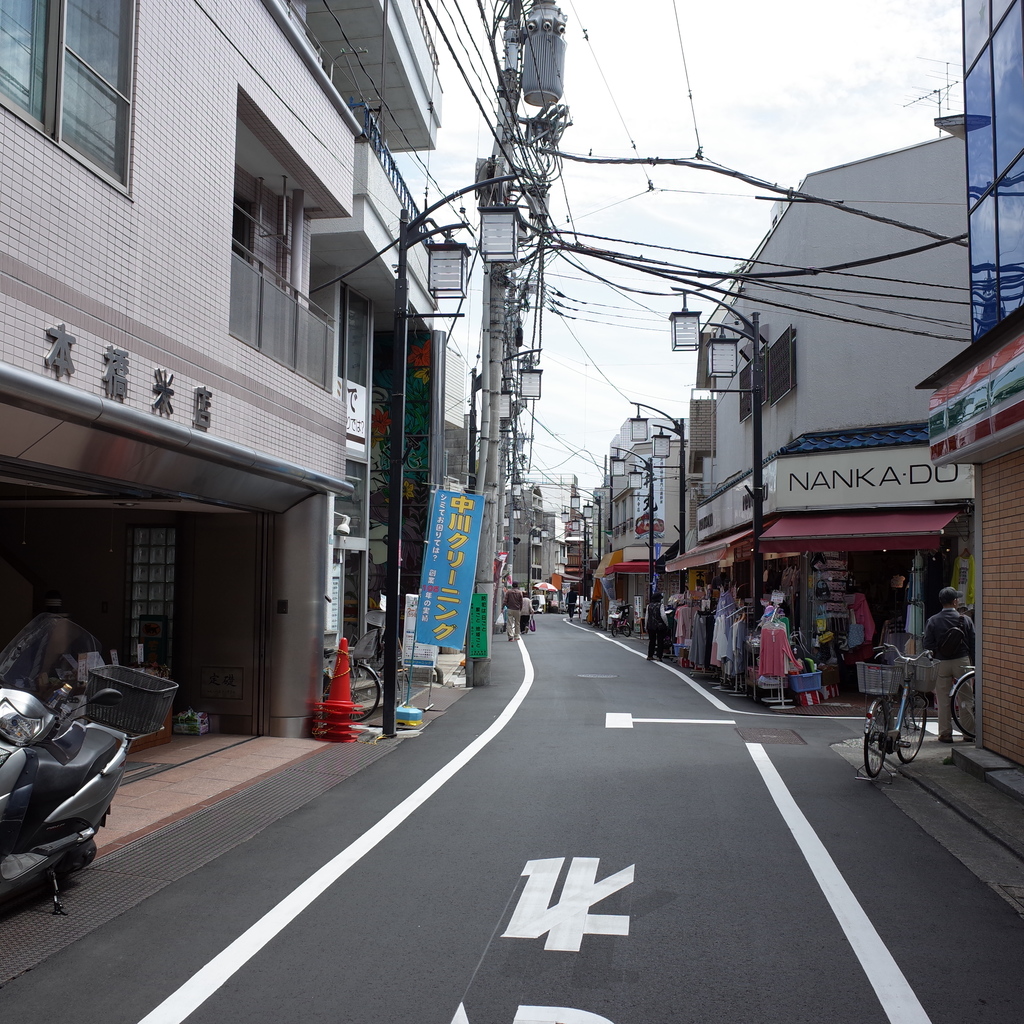
London and Tokyo are two examples of very walkable non-grids, which I prefer to American grid-based city planning — the random connections fuel serendipity.
I think the problem in modern suburbs is really fortress-like unconnected developments, which also appear in urban form as overscaled block+ monoliths. The Metreon in San Francisco is a good example, or the ugly “italianate” Geoff Palmer apartment blocks around downtown Los Angeles.
To prevent a tragedy of the commons in street parking spaces, Japan has an excellent system, the shako shomeisho, though looking at how hard it's been to push through a congestion tax in lower Manhattan, I doubt it'd be politically viable anywhere in the US:
"Under the regulation in Japan... all private owned automobile must have a specific parking space. Parking by the roadside is prohibited. The width and length of the space should be sufficient for your vehicle and must be within 2 km from your registered residence address."
The condenser unit on my Miele heat pump clothes dryer just went out after less than two and a half years. It's a $1500 out of warranty repair on a $2K dryer, and the part will take a month to arrive.
Could be bad luck, though I see a fair number of similar complaints online. I wouldn't buy again.
Medical evacuation (unrelated to method of travel) is specifically one of the benefits of an Amex Platinum card, as long as you’re more than 100 miles from your address. Maybe worth $700/year, maybe not.
If you travel a lot every year, I can see it being more affordable than buying insurance each time. Typically when I buy travel insurance it's $50-200 per trip.
Too lazy to look up whether Amex provides for problems during the trip (beyond evacuation), as opposed to merely during travel.
" In a recent survey of French restaurants, more than a third fessed up that they serve industrially prepared, and often frozen, food. Fast-food outlets, mind you, weren't even included in that poll, which was conducted by Synhorcat, a French restaurant trade group. "
You need a immigrant community large enough to be cooking for their own palate.
Los Angeles, for example, has a population of ~30K Thai, ~180K Japanese, and ~5M Mexican origin (numbers from Pew).
Plenty of options in LA for northern, Isaan, central and southern Thai between Western Ave and Thai Town, and pretty good ramen, soba, and sushi in Sawtelle, Little Tokyo or Torrance. Perhaps not best in the world, but not at all catering to American tastes and could rank above average in the origin country.
The food can exist, but you need to really search it out. That is different then if we had a strong food culture, this food wouldn't be hidden away in ethnic ghettos.
Sure, good example of that is r 3.4 out of 5 on the Japanese restaurant review site Tabelog is miles better as a signal of good food than any number of 5 star yelp reviews in the US.
My larger point was that LA and NYC (and specific communities in other cities —SF, Houston, etc) have a subculture that celebrates true renditions of various cuisines as cooked by an self-sustaining immigrant community large enough to not require external validation by Americans lacking in food culture to stay in business. You have to get lucky in most of the rest of the states.
I don’t agree with the article and its definitions, it seems poorly sourced and to be advocating for English towns as the apex of civilization. That said, the photos provided and the descriptions focus more on the style of the buildings than urban form: “monotonous straight lines of modernist architecture” vs “historical architecture such as ‘Church’, ‘Castle’, ‘Tower’ and ‘Cottage’ made places look more attractive and get better ratings for their beauty.”
A "walkable" city has everything you need within walking distance. A "beautiful" city is devoid of modernist architectural monstrosities. A "lively" city is full of people.
I would argue there is no strong correlation here. A city can be walkable and ugly, lively and unwalkable, beautiful and unwalkable, beautiful but not lively...
When most people say walkable they mean safe to walk in. The trains don’t make it unsafe, and other than commuting you can do a fair amount using just walking or a bike because of the preponderance of small businesses that are safe to walk to. And you walk to and from the train station.
This is mostly meant to contrast to non-walkable spaces, where to walk to a store in an American suburb often means walking in a 3 ft wide path next to 55mph traffic and the crosswalks for said road are a half mile apart, if you’re lucky. The safe paths are circuitous if they exist and the pedestrian signals, if you can get a green one, may take minutes to cycle to and give you thirty seconds to cross 6+ lanes.
I think most people mean walkable to be more than maybe a half dozen square blocks of restaurants and small stores that aren’t really connected to anything else though. Bunch of examples in Silicon Valley.
Sure, bigger than a mall. The main point is that transit enhances walkability, they don't really compete in the absence of other factors (like transit in a highway median)


Here's a relevant interview with the author, Robert Jackall: https://anso.williams.edu/files/2015/07/Jackall_interview_Ch...