In my neck of the woods, the vast majority of the beef we eat is grass fed for most of their lives, but then grain finished. They only eat grain for the last month (out of 8 or so), but they put on most of their weight in that last month.
Here in the UK, pretty much 100% of cattle are grass fed. In the winter, when there isn't enough grass, they're fed on silage (which is basically just grass cut and baled while still green, which turns it into kind of grass sauerkraut, which smells exactly like you'd expect) and "draff" or "spent grains" (depending on where you are) which is the stuff left over from brewing beer or the pot ale that goes to make whisky.
It's all a pretty delicate balance, but ultimately what happens is you end up growing a bunch of things humans can't eat so that cows can shit solid gold all over the fields and chop it into the soil with their hooves.
We eat because there's six inches of earth on the ground, it rains, clover grows, and cows (and pigs) shit solid gold.
Yeah the Rails and Django models seem better to me too, but as far as I understand they do rely on effectively charity work from open source maintainers and from what I've read a lot of them are getting burnt out really fast, so maybe that's not the perfect model either :/
yeah keeping it vague makes sense to protect the place if it's still online but the whole thing doesn't really make sense?
The timelines mentioned are weird - he spoke to them before they built it? Or after? It's not that clear, he mentions they mentioned watching a video.
> The entire application was a single HTML file with all JavaScript, CSS, and structure written inline.
This is not my experience of how agents tend to build at all. I often _ask_ them to do that, but their tendency is to use a lot of files and structure
> They even added a feature to record conversations during appointments
So they have the front-desk laptop in the doctor's room? Or they were recording conversations anyway and now they for feed them into the system afterwards?
> All "access control" logic lived in the JavaScript on the client side, meaning the data was literally one curl command away from anyone who looked.
Also definitely not the normal way an agent would build something - security flaws yes, but this sounds more like someone who just learnt coding or the most upvoted post of all time on r/programmerhorror, not really AI.
Overall I'm skeptical of the claims made in this article until I see stronger evidence (not that I'm supporting using slop for a medical system in general).
I don't know what to make of the article. First I thought it seems like a made up LinkedIn story, it seems too crazy while talking about it in such a casual manner. Ultimately I don't know, maybe it was vague for a specific reason. I guess one thing I'd find odd is that whoever developed it, that they didn't run and get stuck with CORS issues, if everything was done client side to those services and that they managed to get API keys, subscription stuff everywhere while still making mistakes like this. And no mention of leaked api keys and creds which UI side there must have been, right?
> Everything that could go wrong, did go wrong.
Then this claim seems a bit too much, since what could have gone more wrong is malicious actors discovering it, right? Did they?
Maybe I have trouble believing that a medical professional could be that careless and naive in such a way, but anything could happen.
I guess another thought is... If they built it why would they share the URL to the author? Was author like "Ooh cool, let me check that out", and they just gave the url without auth? Because if it worked as it was supposed to it should have just shown a login screen right? That's the weirdest part to me, I suppose.
> The timelines mentioned are weird - he spoke to them before they built it? Or after? It's not that clear, he mentions they mentioned watching a video.
I took that all to mean she had explained the history of it to the author, but it had already been written and deployed. It is worded a little weird. It's also translated from german, I don't know if that is a factor or not.
> The timelines mentioned are weird - he spoke to them before they built it? Or after? It's not that clear, he mentions they mentioned watching a video.
Yeah although I didn't comment I found this weird as well. Chronology was vague and ill-defined. He went to a doctors office and the receptionist mentioned vibe coding their patient records system unprompted?
> A few days later, I started poking around the application.
What!? How... was there even a web-facing component to this system? Did the medical practice grant you access for some reason?
Yeah I'm back to calling bullshit. What a load of crap. Whole post probably written by an LLM.
Having experience working with medical software, I call BS on this article as presented, unless it was some minimal support app. When you deal with patient records, there's so much of local law, communication, billing rules and other things baked in that you CANNOT vibe code an app to handle even 1% of that. Your staff would rebel and your records would completely fall apart. Even basic things like appointment bookings have a HISTORY and it's a full blown room scheduling system that multiple people with different roles have to deal with (reception and providers). It takes serious time to even reverse engineer the database of existing apps, and you first have to know how to access the database itself. Then you'll see many magic IDs and will have to reverse engineer what they mean. (yes, LLMs are good at reverse engineering too, but you need some reference data and you can't easily automate that)
I have decompiled database updaters to get the root password for the local SQL Server instance with extremely restricted access rules. (can't tell you which one...) I have also written many applications auto-clicking through medical apps, because there's no other way to achieve some batch changes in reasonable time. I have a lot of collateral knowledge in this area.
Now for the "unless it was some minimal support app" - you'll see lots of them and they existed before LLMs as well. They're definitely not protecting patient data as much as other systems. If the story is true in any way, it's probably this kind of helper that solves one specific usecase that other systems cannot. For example I'm working on an app which handles some large vaccination events and runs on a side of the main clinic management application. But accidentally putting that online, accessible to everyone, and having actual patient data imported would be hard-to-impossible to achieve for a non-dev.
For the recording and transcription, there are many companies doing that at the moment and it would be so much easier to go with any of them. They're really good quality these days.
I don't think you read the article very carefully, the timeline is that he met a person, and that person told him that they made vibe-coded an app after having seen a video. He then investigated the app.
> On my last visit i actually casually discussed their IT system with a doctor.
Oh right, cool. Did it have a public-facing web-portal that you were able to "investigate" and that "Thirty minutes in, I had full read and write access to all patient data".
The level of credulity in these comments is immense.
No, they were complaining about using expensive, overly complicated third-party system that they need like only basic features like keeping text records about visits, and prescriptions and sending invoices to health insurers.
And in some practices you get direct access to your data as a patient.
I mean the story might be fake obviously, but is definitely plausible.
Yeah sure, as a matter of rule, every time I visit any health provider I am always discussing with the medical receptionist: the software they use, the challenges the business as a whole faces, the tensions between insurers and third parties.
Things that absolutely 100% happen everytime I - a tech guy - experiences when I go to the doctor/phyiso-therapist etc... etc... These are discussions that are happening.
Yes in good faith I will one hundred percent no-lie wire you 100AUD if you can prove beyond doubt that you had a discussion like that with a Swiss health provider. Not one that you contrive now after the fact - one that happened before this wager.
Spoiler: you didn't mate and you are full of shit.
It's a sad story and a fun-looking project but I think Google 100% did the right thing here. Most people have no idea how much information is included in photo metadata, and stripping it as much as possible lines up to how people expect the world to work.
You can probably get around this problem by compressing the file and uploading it in a .zip. Google Files allows for making zip files at least, so I don't think it's a rare feature.
I think the linked spec suggestion makes the most sense: make the feature opt-in in the file picker, probably require the user to grant location permissions when uploading files with EXIF location information.
yeah it does sound kind of dodge that there's no option even for advanced users to bypass this, I would guess mainly a moat to protect Google Photos. I wonder if online photo competitors are finding a workaround or not as searching your photos by location seems like a big feature there
I don't know when Google's EXIF protections are supposed to kick in, but so far my photos auto-synced to Nextcloud still contain location information as expected.
I don't think this has anything to do with Google Photos. People fall victim to doxxing or stalking or even location history tracking by third party apps all the time because they don't realize their pictures contain location information. It's extra confusion to laypeople now that many apps (such as Discord) will strip EXIF data but others (websites, some chat apps) don't.
> It's extra confusion to laypeople now that many apps (such as Discord) will strip EXIF data but others (websites, some chat apps) don't.
You've given me a lot of sympathy for the young'uns whose first experiences on the web might have been with EXIF-safe apps. Then one day they use a web browser to send a photo, and there's an entirely new behavior they've never learned.
> Then one day they use a web browser to send a photo, and there's an entirely new behavior they've never learned.
The article is actually about Google's web browser stripping the EXIF location-data when uploading a photo to a webpage, and the author complains about that behavior.
This is not an implementation of the browser itself. Android Chrome is behaving in that way because the app didn't request the required permission for that data from the OS (which would ask the user), so the files it receives to upload already has the data removed
Thank you! Meant my comment for anyone who's not on the very latest version, anyone who experienced Android or another OS with disparate privacy-related behaviors as long as that OS has been around. Yes, now, the issue I'm talking about is solved for the general public on the latest Android devices! At reported cost to power users.
Just to add some more context: The change was applied in Android 10, which was released in 2019.
On OS-level there is no reduction in functionality, the implementation just ensures that the user agrees on sharing his location data to an app, and until that has been agreed it is not being shared (as to not hinder any normal app-operation).
Now the fact that the Chrome app doesn't trigger to ask the user-permissions is another topic, with its own (huge) complexity: If the user disagrees to share his location-history to a webpage, and Android can only ensure this for known media file types (while i.e. Windows cannot do this for ANY filetype, and on iOS I believe the user cannot even decide to not have it stripped), Chrome actually cannot commit to any decision taken by the user.
It's a known dilemma in the W3C, the Browser should ensure user privacy but for binary data it technically can't...
You're replying to someone who is talking about a native app, but the overall issue here is about web apps. Chrome and Firefox don't request the appropriate permission (which, as things stand right now, is probably the safer choice), and there's no way for a website to signal to the browser that it wants that permission, so that the browser could prompt the user only for websites that ask for it, and persist the allow/deny response, similarly to how general location permission works via the JS location APIs.
Seems to be quite simple, an App which wants to access this info just needs to set the permission for it.
Chrome doesn't seem to request that permission, so the OS doesn't provide the location-data to the app. So Chrome rather ended up in this state by doing nothing, not by explicitly doing something...
If your app targets Android 10 (API level 29) or higher and needs to retrieve unredacted EXIF metadata from photos, you need to declare the ACCESS_MEDIA_LOCATION permission in your app's manifest, then request this permission at runtime.
That's not sufficient. We need a standardized attribute on the HTML form to request the permission as well. If Chrome requests the permission, great, but that's not fine-grained enough for a web browser.
Well yes, agree, but as stated Chrome didn't end up with this behavior because they did something, the Browser behaves like this because they didn't implement any logic for this permission.
A standardized attribute on an HTML-form would be difficult to define, because in this context the page just requests/receives a binary file, so a generic "strip embedded location information" decision from the user would be hard to enforce and uphold (also, by whom?).
In this case Android only knows the file-structure and EXIF because the file is requested by Chrome from a Media Library in the OS, not a file-manager.
W3C keeps thinking about this data-minimization topic repeatedly [0], so far they managed to define the principles [1], but enforcing them technically is quite hard if any kind of content can be submitted from a storage to a webpage...
If google really cared about privacy, they wouldn't have moved maps away from a subdomain. now if I want maps to have my location (logical), I need to grant google _search_ my location too.
It's not all-or-nothing; sometimes some people at Google push for some things to improve privacy. Rarely happens when revenue is at stake.
Android used to ask you "do you want to alllow internet access?" as an app permission. Google removed that, as it would stop ads from showing up. Devastating change for privacy and security, great for revenue.
People act like Google products are a charity that had been free forever, and then this mega-corp called Google came along and started harvesting the data of innocent people who just want to get directions to Starbucks.
For those of us stuck on normal android, is there a way to achieve that? I know it used to work with some firewall apps but nowdays they all require root access.
It looks like you can't revoke the internet permission, but you can use the firewall via ADB. Settings are lost on reboot, but you can use an automation with Tasker or similar to set them on boot:
Or you can set your DNS resolver to dns.adguard-dns.com and it blocks almost all ads. You can search "private dns" in Android settings app and set it there.
iOS allows this, but only on mobile data, which is pretty infuriating. Why should I not be able to also restrict apps from dialing home/anywhere just because I'm on a Wi-Fi network (which isn't even necessarily unmetered)?
It's really annoying. I have a sudoku game on my phone, works great but give it internet access and it's suddenly full of sketchy adverts.
If I'm playing it on my commute, it's usable with mobile data disabled for the app. But when the train stops in a station long enough to auto-connect to wifi, immediate full screen adverts :(
Then don’t use an ad supported app? I have one as supported app on my phone - Overcast. The developer created their own ad platform and serves topic based ads based on the podcast you are listening to right now. Ironically enough I started to pay for a subscription even though it didn’t give me any real benefit just to support him until he started having ads.
I’m gonna be That Guy for a minute: if you enjoy using a Sudoku app, isn’t there one available on more acceptable terms, e.g. a single purchase or a IAP that removes the ads from this one? I’m not saying you have to pay like $3.99/week for a scam one, but more like pointing out that if you don’t like ads (as I also don’t) why not support the developers who believe in selling software to you for a few bucks rather than selling your annoyance to Google via Adsense?
Google doesn't care about privacy, but its easier for them to keep collecting your data if they can also keep it from getting unintentionally leaked to others.
The last thing Google wants is for people to start thinking about the amount of data they're handing over.
You can lock down their usage. Limit it to three months storage and minimize sharing. They still report an old address for home and work for me since I dialed up the restrictions years ago. They have the data but it is less exposed.
I honestly don’t understand the scenario you’re defending against. Google still knows where you actually live and work trivially. If you don’t trust Google you should just de-Google completely.
If you think it's trivial you must not be paying attention. You cannot keep your data from Google. Government websites include google tracking. Google drives past your house to take photos and sniff your wifi traffic. Your employer hands your data over to google. Your doctor hands your data over to google. Your bank hands your data over to google. You can limit how much you actively and voluntarily give them, but you can't free yourself from them entirely and still function in society.
Trivial? Ha! Way to say that you never tried it. Either that, or that you don't care for things like push notifications. Yes, most of the things work, but not nearly all of them.
Not GGP, but I suppose the general idea is: Granting permanent location permission to maps.google.com seems a bit more privacy preserving than granting it to *.google.com, assuming one opens maps significantly less often than e.g. GMail, search etc.
Seems to be quite simple, an App which wants to access this info just needs to set the permission for it.
Chrome doesn't seem to request that permission, so the OS doesn't provide the location-data to the app. So Chrome rather ended up in this state by doing nothing, not by explicitly doing something...
If your app targets Android 10 (API level 29) or higher and needs to retrieve unredacted EXIF metadata from photos, you need to declare the ACCESS_MEDIA_LOCATION permission in your app's manifest, then request this permission at runtime.
100% agreed; people generally don't realize how deanonymizing EXIF data can be.
I remember one of my cameras or phones including a "seconds since device startup" counter; together with the exact time the photo was taken, this yields a precise timestamp of when a phone was last restarted. This by itself can be highly deanonymizing out of a small to medium sized set of candidate phones/photographers.
This kills an entire class of useful crowdsourcing web apps though. Just off the top of my head, contributing to OSM is much easier when you can just take a bunch of photos and see them displayed on a map.
Seems like such a shitty thing to victimize the potential victim. But… if you didn’t know that images you took had metadata… maybe you shouldn’t be allowed to use a computer. I mean. I’m going on decades of knowing this. Feel like there is a mid 90s X-Files episode that even like breaks this down. If not NCIS or some shit.
Even people who know it, don't think about it and don't connect it with the potential consequences of uploading a picture to a website. And why would they? It's not visible, there's no warning, it's just not something that's going to be top of mind.
I said that people who already know don't think about it. That's not something you can solve by educating them more. When I'm sharing a photo, I am going to think about what I can see in the photo as a data risk, not the invisible stuff that I might intellectually have heard about. It's just not going to come to mind.
People who know about phishing get got by phishing attacks, too. How well has however many years of "cyber awareness training" gone?
Agree. That's also the dilemma with asking the user for his permission, it is very difficult to frame a concise question and get an educated decision there. So, better to only ask if the App explicitly requests that permission sounds reasonable.
The prior threat-model was, that e.g. a camera/gallery app which may/may not have a permission to a users current location, also has access to the history of a users' locations just by scanning the images when showing the camera roll.
It frankly makes sense to create a separate permission just for this location metadata AND strip this data when no permission was granted, I believe everything else would be MUCH harder to explain the user...
I assume Google are very hesitant to add additional permissions, and any additions get very carefully thought about. Having too many prompts can lead to popup blindness, which defeats the entire purposr of the permission system in the first place.
I'm sure I recall much older Android versions presenting all of the app's permissions at install-time. I'm very willing to bet that most users didn't actually read any of it. Overall, it seems like a very interesting problem to solve.
You're right - this is a shitty view on this. It's incredibly opaque that images secretly contain the GPS coordinates of where they were taken. There's no way that's obvious or intuitive.
I think the 'ideal' thing to do would be an opt-in toggle for sharing "location and other extended info" for photos when selecting them, but I'm sure you can understand why a dev team took a shortcut to solve the immediate pain for most users most of the time.
When you upload the photo, at risk of great confusion they could essentially watermark the photo or add a banner showing the location and perhaps some of the other key details, like camera model, right on the photo so it would at least get across to the user that there is an association between these two things that needs to be disabled.
To dismiss the banner you'd have to click a dismiss button which would ask you to confirm that you want to get rid of the location data completely. Then there would be a tiny little button that says “hide this location inside the photo, where I can't see it easily, but everyone totally could”. (But less stupid.)
It would be terrible because there would be huge support threads on why it's trying to share an image with an overlay, but it would get it across. Would be a different failure mode for user privacy than what you would have with a text prompt or an interstitial or whatever.
Sounds fun, but in this case it's actually the OS which is stripping the meta-data before fulfilling the file-access request to the app.
Now an app maybe just wants to set the image as wallpaper, send it to a printer or set as an avatar, so it requests to read it from storage. The OS injecting a watermark here or adding some UI would break decades of apps...
You do realize that Google only cares about user privacy when it doesn't affect their own business model to do so, right? And also, like in this case, where not caring could end up creating some nasty headlines that hurt their reputation?
Meanwhile, Google probably has one of the most comprehensive databases on the planet of user behavior, gleaned from tracking their users all over the internet. Surveillance capitalism at its finest. But hey, they protect people from accidentally sending their photo geolocations to random websites, so good job Google, pat on the back for you.
True, but isn't it irrational to continue operating something you know could cause harm to you when used wrongly, despite not knowing how to use it correctly?
The hypothetical person we're considering does have an entire life, too. Their rationale may have emerged from careful risk analysis and weighing of opportunity costs.
I agree with you. The next steps should be to disable the internet nationwide like North Korea. People have no idea how much bad things are there. Also I don't like fun things.
I started with a boilerplate but AI has been huge at letting me get what I want in terms of frontend building when I was never talented at design or css.
I built https://bridge.ritza.co (demo@example.com username and password if you don't want to sign up) as a trello/linear replacement without looking at a single line of code and it's both good enough for me and doesn't have the obvious AI frontend 'look' as it was copying from the starter.
Highlighted text "no per-seat pricing" is unreadable in dark mode on the home page (dark blue on black). It's surprising for me to see someone use this as an example of decent design because I'm somewhat sure this front page text coloring was never seen/reviewed by a human.
58 Minute reading time. I read the first dozen pages or so and I'm not sure what the goal of this thing is, why they wrote it, who they wrote it for? Is it aimed at European governments? Or companies? Or people? Or something else?
> This playbook provides a clear, actionable framework to position Europe as that powerhouse, accelerating AI development and adoption, attracting and retaining top talent, simplifying regulation without sacrificing values, and mobilizing public and private investment to build homegrown AI infrastructure. Only with it, Europe can ensure AI is not only developed in Europe, but for Europe and on Europe’s terms.
playbook for what?
> This document is not a theoretical exercise. It is a practical playbook
Seems quite theoretical? A lot of random statistics, and all the sections start with abstract empty claims in 'not x, y' slop format "Artificial intelligence is not an abstract promise. It is a tool that fulfills its potential when embedded in the real economy."
I'd love an executive summary of this for anyone who has AI tokens to spend (I've got some other stuff to get done with what remains of my quota this week). I'm not saying this report is bad, I'm just saying it didn't do enough to convince me to read it, and it has some patterns that would make me guess it's bad.
They essentially want a bunch of stuff and most importantly funding from the EU and using the FOMO angle to get them to act. This of course is not on merit. They see that no other lab in Europe really exists and are trying to seize an open opportunity.
I hope one day soon EU politicians ask themselves why it might be that there is only one single domestic AI lab that is basically an also-ran at this point.
I had the same experience, now I just have a simple claude code session running with the new channel feature so it can take input and give output via a telegram bot.
It's not as fun with SOUL.md etc but so far much less janky.
You realize that SOUL.md is nothing more than prompt injection, right? It's not a magical configuration file that gives an LLM a "soul". It's just anthropomorphizing a part of the prompt. It's also an expanded burn on tokens and, potentially, your money.
But if you think you need an agent framework to use a prompt you're going to love this one simple trick...
It's often found alongside natural gas because the rock structures that can trap methane can also trap other gasses, but the original source is different - thermal decomposition of organic matter for natural gas and radioactive decay, mostly of uranium and thorium, for helium.
I agree that the "accumulation over millions of years" is similar (and similarly a potential problem if we burn through all that accumulation).
Helium will leak out of some structures that hold methane. Shale will trap methane and let helium escape. Layers of salt trap both. Thus horizontal drilling and fracking to recover oil and methane from shale produces very little helium.
Which is exactly 100% of Earth's helium. Every single helium atom we use is a result of alpha decay, as a very good approximation there isn't any primordial or stellar helium on or in Earth.
I really enjoyed this oddlots podcast episode that covered similar points and had a lot of "wat" moments for me, including the US selling off its strategic helium reserves at a loss because politicians labeled it "party baloon reserve", and how long it takes to produce naturally and how hard it is to find, process and transport.
Part of the reason there's a shortage is because the US was the main supplier. There was no market incentive for anyone to invest into helium extraction.
It'd be like if the US used it's strategic oil reserve to supply the US with oil at a low price at all times.
A strategic reserve isn't supposed to be used as a supply. The existence of a strategic reserve shouldn't have an effect on the supply of helium except in an emergency. The fact that selling the helium reserve could create a shortage should tell you that it wasn't being used as a reserve but as a supply.
The US was, essentially, artificial subsidizing the price of helium. What's happening now is that people are actually paying the real price of helium.
The US government decided (maybe correctly, IDK) some years ago that their strategic helium reserves were too high (and thus expensive).
There were several announcements, a lot of discussion, and a long process before they started selling it. It was also a temporary action, with a well known end-date (that TBH, I never looked at). It had a known and constant small pressure over investments, it wasn't something that destabilized a market.
It wasn't. It was injected into the porous rock at the Bush Dome Reservoir [1], which acted as a natural container of helium. The strategic helium reserve was "expensive" because buying helium for storage was funded by treasury debt, but it was expensive purely only on paper.
I answered that. It wasn't expensive. Building up the stockpile was expensive (but only on paper; financed via treasury debt), but once stored, it required very little maintenance because it was all held underground in porous rock. The only real expense was maintaining the wells.
It was a penny wise and pound foolish political move to pretend to be financially responsible and reduce the deficit by some tiny rounding error on top of a rounding error amount.
Basically political bike shedding so elected officials could avoid making any hard or controversial decisions that would have a material impact but maybe upset some folks due to raising taxes or reducing spending.
I suppose I'm neutral on the topic of strategic helium reserves; but what aspect of this is supposed to be pound foolish? What exactly is the buffer meant to be for?
A strategic petroleum reserve makes a lot of sense, petroleum is part of the food supply chain and it'd be stupid to be in a position where a short disruption could cause people to starve. Not to mention the military implications if an army can't zoom around because the petrol stations run dry for whatever reason.
I don't see anything on the list of uses for helium that looks particularly time- and helium- sensitive in the way that a strategic stockpile would help with.
The article for example mentions MRI macines, aerospace engineering, fiber optics and semiconductors, so I guess it depends on if you want those things to still be available in a crisis
That does sound kinda minor? A worst-case scenario of a month or two without MRI machines or "aerospace engineering", whatever that means doesn't sound particularly scary. And that is making some pretty unrealistic assumptions like there is literally no helium, hospitals don't have private reserves that can last a few months and there are no replacement gasses or alternative options of any sort. And people can make do with limited fibre-optic or semiconductor manufacturing. We have crisises in various computer components every few years (I can think of HDD, RAM & GPU supply shocks over the last few years). Doesn't seem to be a major problem. A couple of months of disruption isn't a strategically interesting event.
If you're worried you can keep your own helium reserve? Then if there is an emergency and it turns out that you don't need an MRI you can sell the helium to whoever does and feel really good about your foresight.
I'm not seeing any need for a strategic reserve here. There aren't any strategic issues. It is a bit far-fetched that a helium shock will even lead to the end of MRIs.
Everyone also could keep their own supply of gas and their own batteries for electricity but it turns out that is not expensive and foolish compared to centralizing such backups.
A lot of people die every month. We're talking about a probability near-0 event where I imagine it'd be difficult to pick that deaths out from general background mortality - admittedly just based on the fact I don't recall anyone I know who needed a life-saving MRI but I know a few who died. That isn't much of a justification for a strategic helium reserve. Some level of risk just has to be tolerated, we can't afford to have a contingency for every possible hypothetical.
AFAIK, it was created to fill airships in case of a war. So the original intent is completely outdated.
Also, last I knew about it, the reserves were only reduced, and the US still has some. I have absolutely no idea on the cost/benefit of it, but I don't think any other country keeps a large reserve of Helium.
> The existence of a strategic reserve shouldn't have an effect on the supply of helium except in an emergency.
Is there a widely-accepted definition of "an emergency" in the context of strategic reserves?
[Thinking of the SPR] "Oil/gas prices are currently higher due to geopolitical events, my [potential] voters are getting increasingly unhappy, and there is an election soon" would probably constitute an "an emergency" in the mind of a typical politician and his/her advisors.
Whether eg the SPR was created to (indirectly) help politicians keep their jobs is debatable.
An unexpected and/or temporary change in supply or price.
The reserves are there to soften any quick price spikes or avoid them entirely, they aren't there to set the price in the long term. To my knowledge, the oil reserve has generally been used that way, even when the price change is self inflicted.
> What's happening now is that people are actually paying the real price of helium.
If they're not paying for the negative externalities that come from the methane extraction that comes along with it they really aren't paying the real price at all.
Despite all the online rhetoric, and the popularity of mis-naming political movements, sometimes I think the people who hate America the most and want it to fail are Americans themselves.
Nah; last but one job I had an Iranian coworker, and I asked if the way the regime calls Israel and the US the "Great Satan and Little Satan" was serious or a quirk of translation.
Apparently the regime is quite serious about the US being the actual devil.
Specifically, the US federal government. Just like most Americans don’t hate the people of Russia or Iran any more than the folks the next town over, I’ve never met someone from Iran, Afghanistan, Syria, Pakistan, or pretty much anywhere else who hates all Americans. I’m sure they exist, but probably as a small minority. There’s plenty of reason to hate our government though, especially if it has threatened to destroy your entire civilization.
I don't know about the percentage of the population, but everyone who leaves Iran and learns English (or German) is much less likely to be a fan of the Iranian regime than those who never left Iran in the first place, so you'll definitely have a sampling bias.
Growing up in the Southern US, I met plenty "Let's bomb all the savages in the Middle Easy and take their oil" types. Some of them grew up to be self-proclaimed Nazis.
These people are racist against non-whites living in their own communities, whom they have spent their entire lives with. Meeting a dark-skinned stranger in a turban is a chance for them to confirm and bolster their biases, not to reduce them.
And even if they go through some kind of traumatic experience with a stranger from the Middle East and call them friend, it wouldn't stop the racism. I know plenty of racists with "black friends" who will tell you all about how "there are black people, and then there are n**rs". Some of their black friends will even parrot this kind of propaganda.
I'm not sure I agree. Given that the area in question here is the southern United States, and considering that racism is alive and well there, indeed with people groups they have met (and who speak English), I'm not convinced that exposure to non-whites speaking Farsi will somehow fix their attitude.
Yeah, buy Americans are not target of Russian aggression and violence. Russia is kinda abstract ennemy far away. Feelings get stronger when the country is actual target of bombing.
God is documented as being rather keen on genocidal smiting. That is part of the exact problem. I googled two relevant examples:
  1: God commands King Saul: attack the Amalekites and totally destroy all that belongs to them. Do not spare them; put to death men and women, children and infants

  2: When the Israelites entered the Promised Land, they were often commanded to carry out total destruction against the Canaanite nations. "they utterly destroyed all that was in the city, both man and woman, young and old, and ox, and sheep, and ass"
I'm not into religion, but it has had a massive influence on my culture (NZ) so I pay some attention to it.
Holy books seem to be buffets that people just pick their favorite dishes from, for the most part. At least, in the western world. I can't speak to elsewhere.
1. While approaching the land, the Amalekites had attacked them, preying on the weak. God had said that they would be destroyed. Now, probably partly as a test for their first king (he failed, didn’t eradicate them), God said, get on and do it.
2. God had promised the land to Abraham and his descendants, but said they’d only get it in four hundred years’ time, because “the iniquity of the Amorites is not yet complete”—they still had time to choose God’s ways. Only once they were irredeemable were they to be destroyed.
Lots of people who claim to be Christian still quote Leviticus as justification.
Not all of it, banning mixed fabrics (19:19) and having land ownership revert every 50 years including houses outside walled cities (25:31) and animal sacrifice (all of chapters 1 and 3) would reveal how disconnected such people are, possibly even to the speakers themselves, so it has to be selective.
Literally the devil. Not metaphorically a bunch of bastards, the actual devil. And not as performed by Tom Ellis.
There's a reason why I asked the guy.
And I asked him a few years ago now, so "what the US did" that the regime found objectionable has more to do with the US support for Israel and all the consequences of that than it has to do with any direct attacks by the USA against Iran; for direct action I think you might need to look at the 1979 revolution to undo the 1953 CIA- and MI6-backed coup?
Just because someone hates you and calls you the devil (or loves you and calls you an angel) doesn't mean they think you're literally the physical embodiment. Especially when you're not even a living being but a country or a government. I'm pretty darn sure you can assume it's a metaphor and that your coworker doesn't have evidence to the contrary.
What is more important than proclaimed words is to evaluate actions of the said government.
The Iranians have been pragmatic and relatively restrained, while USA and Israel have repeatedly escalated.
Iran has been helping USA dealing with Al Qaida in Afghanistan and Isis in Iraq. As a payback, they have been included into the 'Axis of Evil' and subjected to heavy sanctions. Just one of the cases...
> Trust me, we, Ukrainians do mean that in relation to _anything_ that is to north-east of our country. A good rule of thumb is to always say for yourself.
Leaving aside that I am skeptical millions of Ukrainians sincerely believe the devil has been launching missiles at them from the northeast (regardless of what you write here)... it's rather hypocritical to speak for millions of Ukrainians and then tell me to only speak for myself, don't you think?
> sometimes I think the people who hate America the most and want it to fail are Americans themselves.
That's because the US (and the UK) are about the only countries in this world that haven't had the entirety of their legal, economical and political system completely revamped at least once in the last 100 years - most countries average more than that.
At the same time, such a revamp is desperately needed - the issues with the status quo are reeking - and everyone knows that it is highly, highly unlikely to get that done by ordinary democratic means due to the sheer inertia of hundreds of years of fossilized bureaucracy and individual/party interests.
And that is why so many people tend to vote for whoever shouts "destroy the country" the loudest - and not just in the US (MAGA) or UK ("Reform"), but also in Germany (AfD), Spain (Vox) or Italy (Salvini/Meloni), where economic inequality and perspectivelessness has hit absurd levels. Let it all burn to ashes, burn everything, even if one goes down with the fire, eat the rich, and try to build something more sane this time.
Would like to add Vox is nowhere near the other's popularity, and has received substantial donations from... Hungary. A total of 6.5 million euros during the 2023 elections.
> That's because the US (and the UK) are about the only countries in this world that haven't had the entirety of their legal, economical and political system completely revamped at least once in the last 100 years - most countries average more than that.
I usually get downvoted when I make an observation along these lines, but I will go for it again -- IMO some of the reason Europe has pulled ahead in infrastructure and policy is because a couple world wars last century reduced much of it to rubble, including the systems of governance. The UK mostly escaped that, and the US escaped nearly all of it. Which is one reason we can still have a lot of old electrical infrastructure, for example, that is pushing 100 years old, and a Constitutional system 250 years old.
I think a major problem with the system in the US is the difficulty changing it. There is a balance, and a lot of room for differing opinions on how flexible it really ought to be, but I suspect there is broad agreement that it is too inflexible. We rely too much on changing interpretations rather than changing the fundamentals.
Perhaps we really do need to risk a second Constitutional Convention. Or we will end up with a worse alternative.
If Europe has "pulled ahead in infrastructure and policy" then why do they have nothing to show for it? They can't even protect their own sea lines of communication.
On the other hand: The US can't even build a single proper high-speed rail line, hasn't figured out how to electrify its railways, doesn't understand that bike lanes are good for car people, hasn't managed to solve four-way intersections yet, doesn't have anything even remotely resembling a free market for critical supplies like power and internet, and is in general going bankrupt due to excessive urban sprawl.
I could probably go on for another ten pages. Europe definitely has its flaws, but let's not pretend like the US is a paradise where everything is perfect and nothing ever went wrong.
Thats funny, most of the places that I've visited in Europe don't have any of that stuff either. It's a big place with a lot of diversity in infrastructure and economic development.
There are a lot of metrics, take your pick. But if you can't obtain reliable supplies of energy and other critical resources then none of the other metrics matter.
> eat the rich, and try to build something more sane
The tragedy is that right wing parties are sponsored by the rich snd serve primarily them. Economic grievances of ordinary people are exploited to make them vote agains their interests.
I love my country quite literally to death. Death plays a strong role in the concept of freedom in American philosophy: Give me liberty, or give me death (yes, I know the real context of this quote), etc.
And so when my government wants to destroy my country, its land and its people, divide us, commodify us and our life experiences, and also export this kind of systematic industrial exploitation across the world, through colonies and coups and political assassinations; yeah, I hate that government a lot. I hate it to death. The American government has been an enemy to America, and an enemy to Americans. Since the beginning, with our treatment of the natives.
You'd do well to separate the land, people and government of a nation; confusing them only further serves State propaganda. We force children to say a pledge to our country in school, but it's really to our government. It's political brainwashing. I have refused to say the pledge since becoming politically aware enough around age 7. I cannot tersely express the amount of institutional abuse I suffered for this position. Teachers would ostracize me, bully me, punish me, attempt to physically force me to say it, write me up for detention, get my guardians to abuse me at home over it, etc. Like I said, the American government is a psyop.
The pledge is not to some painted cloth or the current government but the community of people you are part of and the decision of who leads them, made thru free and fair elections.
I really thought about its meaning as someone that chose to come here and join this community out of my own free will. IDN, Perhaps people that are taught to memorize it as children simply regard as mantra and never think about its meaning.
PS: There is no country on Earth that doesn't have some sort of pledge, most often to fatherland/motherland or even a King or Tyrant.
I would love for you to explain how the U.S. Pledge of Allegiance is not a form of youth brainwashing.
I've already discussed how I was personally targeted in my scholastic years as they only person in my schools refusing to participate, so you already knows what happens if you exercise your first amendment rights.
> made thru free and fair elections
Where? What does "free" or "fair" mean here? It is not a secret that the US is a failed democratic republic that looks more like an inverted totalitarian state today. It's hard for things to be "fair" when there exists a vast capital asymmetry between those writing the law and those "voting" for it. Lobbyists, state actors and NGOs deploy billions of dollars into brainwashing the public about the US's image and actions, both domestic and foreign.
We are a neoliberal colonial state, that even in this exact moment are actively attempting to expand our colonial reach.
> PS: There is no country on Earth that doesn't have some sort of pledge
And my grandfather used to say, as he beat me viciously, "This is nothing, you should have seen what my father used to do to me." Historical presence does not justify anything, and never has.
Well as I explained children reciting the pledge, few really think about its meaning like you did. They simply reciting a memorized line, as dry and boring as the arithmetic table.
Yes lobbying and money in politics is a problem, but people are not as gullible as you seem to believe. The California wealth tax passed, despite billions spent against it. On the other end, Harris outspent Trump by millions and was still effectively crushed.
Often grass-roots movements are far more effective then big-money campaigns.
What America has are Client-States, Countries that are subordinate. but this is nothing unusual, and can be beneficial for a country with little power of its own. In-fact many former colonies have ended up becoming Client states to their Former European masters. In contrast Colonies are directly controlled with imposed Governors, backed by a military force of the Colonial Master.
> few really think about its meaning like you did. They simply reciting a memorized line, as dry and boring as the arithmetic table
I was raised in the Catholic church and it's the same style of blind, rote memorization -> brainwashing. And to that point, sneaking "under God" into the pledge was a disgusting move that weakens a core tenet of American philosophy and law, the separation of Church and State. Each and every further recitation weakens it further, and all who participate are complicit in weakening our democracy.
> people are not as gullible as you seem to believe
Not sure where any notion of gullibility was discussed prior to this.
> Often grass-roots movements are far more effective then big-money campaigns.
How often? Want to share some numbers that paint a different picture than 250 years of American history? Our treatment of the natives? The centralization of wealth and power accelerated by the Industrial revolution?
The authoritarian ratchet of American politics is well-studied and frequently discussed. Temporary wins have not prevented the overall trend towards the US government increasing federal power and becoming an inverted totalitarian colonial state.
> What America has are Client-States, Countries that are subordinate. but this is nothing unusual
It is not what the spirit of the United States was about. The federal government was never meant to be this powerful. It has been twisted and abused into something considered "normal" but it is in no way the intended state.
> In-fact many former colonies have ended up becoming Client states to their Former European masters. In contrast Colonies are directly controlled with imposed Governors, backed by a military force of the Colonial Master.
Yes, that is neoliberal colonialism. Just ask Greenland how they have been doing. They ended their status as a colony in 1953 after establishing a Constitution. A few years later, Denmark began systematically castrating women in secret, a common tactic for preventing a nation from attaining real political sovereignty and power by controlling their population levels.
I'm not even going to go into what else Denmark has done to Greenland, or what has come out of other such relationships between "former colonies" and their political masters. The occasional outlier is an exception to the rule, not proof to the contrary.
We can look at how the US treats colonies right now by looking at colonies such as Puerto Rico or Guam, which are historically oppressed through social and financial means. And we can examine our current foreign meddling in dozens of countries, or our history in participating in non-democratic regime changes in other countries. The bottom line is that the US government is a psyop and anyone who is a patriot to this country, its land and its people should understand the US government is an enemy to those things.
And the pledge is meant to convey allegiance to a symbolic flag and government, not to its land or people. Again, this can be evidenced simply by observing the routine punishment I received for not participating and comparing the pledge to other cult rites. This is Hitler Youth level shit. I was lucky enough to eventually go to a high school with a principal who refused to do morning pledges for my final scholastic years.
> One objection is that a constitutional republic built on freedom of dissent should not require its citizens to pledge allegiance to it, and that the First Amendment to the United States Constitution protects the right to refrain from speaking or standing, which itself is also a form of speech in the context of the ritual of pledging allegiance.
> Another objection is that the people who are most likely to recite the Pledge every day, small children in schools, cannot really give their consent or even completely understand the Pledge they are making.
> Another criticism is the belief that a government requiring or promoting the phrase "under God" violates protections against the establishment of religion guaranteed in the Establishment Clause of the First Amendment.
It is not a matter of hate or love. But the fact that people in charge doesn't give a fuck at any other thing beyond their personal interests.
But this problem is not exclusive to America.
I don't want "the other side" to fail, and I absolutely don't wan the U.S. to fail when they are in power. I want the U.S. to succeed, and for "the other side" to be competent and fair.
One side is clearly interested in helping others simply because they need help. The other is clearly interested in help others that they can relate to (look like themselves) and have earned the right to help (such as believing in the right god.) or only helping people that can help them back.
There's a fundamental disagreement among people on what "help" really is.
Giving money to someone who could otherwise work is very different from giving food to a single mother who is already working 10 hours a day. Giving needles to a drug addict "helps" them in a certain way, yes. But it also enables their addiction to continue.
Yea it's easy for everyone to say "I believe in helping people!!". But which side of the fence you sit on in the US is non-trivially determined by what you believe "help" looks like in practice.
Giving needles keeps someone alive potentially. Until they can get more help for the addiction. Long term. Keeping the needles away makes increases the chances the druggie will die. Short term.
The needles is really a distraction. It is a very narrow special case.
Let’s talk healthcare. One side believes everyone should have the right to at least a minimum level of help regardless of who that person is. The other side believes everyone should receive at most the minimum level of care commiserate with the ability to pay. (Earned the help.)
It's scary how blind people are to this. The right wing wants to help people in the long term and the left wing wants to help people in the short term. Both approaches seem obviously wrong to adherents of the other because they both disadvantage the group that the other wants to help.
Approximately nobody is just bad and wants to harm people. That's a characterization both sides use against each other because they refuse to understand each other.
> The right wing wants to help people in the long term
That sounds overly generous. It seems more like the right believes in social darwinism and feels like it benefits society overall by ridding us of lower quality people. The left believes there should be a fundamental minimum standard for existence that all members of society are entitled to.
> The right wing wants to help people in the long term
> Approximately nobody is just bad and wants to harm people
Garbage. Mitch McConnell was on-record as saying during the Obama years that Republicans would be blocking any legislation from his administration that they could "even if it benefited the American people in any way" (his words, not mine) just so they could say it was a "do-nothing Presidency".
If there are ANY people the right wing wants to help, it's rich people and grifters, and "long term" to them is like 3 months. Sorry, but the current admin IS "just bad" and DOES want to harm people - see ICE.
Try thinking of honest examples. If you can't, you're not competent to have thoughts about the topic because you will only be able to feel emotions and pretend they're thoughts.
Quite a few on one side seem to want to "help others" so they can demonstrate publicly how awesome and righteous they are. And we can even falsify this hypothesis a bit... such people would, I speculate, be more interested in the appearance of helping than in the substance of helping. They'll tend to arrange the help in such a way as to garner the most publicity. And, most of all, they'll allocate their efforts such that they're vocal about how they're the good guys doing all the helping more than they're actively helping. Just to make sure everyone notices.
> Quite a few on one side seem to want to "help others" so they can demonstrate publicly how awesome and righteous they are
Being awesome because you help those in need? How horrible!
> more interested in the appearance of helping than in the substance of helping
This is a common and tired talking point: "virtue signalling". It often comes from people who are less helpful than others, and resent how more helpful people receive accolades. Their own personal judgement about whether something actually helps isn't authoritative, and is usually motivated reasoning anyways.
> their voters prioritize making people they don't like suffer over their own comfort.
> That probably doesn't seem rational but remember loads of these people think the Bible is a true story.
Those are the (sizeable) subset who are obsessed with a literal interpretation of the Old Testament rather than the turn-the-other-cheek teachings of Christ, who is little more than a totem for these fundamentalists.
Arguably there is less harm in believing that Christ's ministry was historical than believing that Sodom and Gomorrah were historical.
"Two thousand years ago there was this dude saying 'Be excellent to one another'" is certainly less dangerous, but to be fair the same dude described in the Bible does likewise say:
"I have not come to bring peace, but a sword."
Which like, you don't need to twist that very hard to get to a place where you're going around "bringing the sword" to people who you think need it...
The Old Testament is big on genocide though, "We should definitely murder these children" has a lot more justification at the start of the book, or if you're batshit and think that stuff about Revelation, right at the end is a concrete prediction of future events then maybe that too.
That might be the noble aspiration that lives only inside their head, while outwardly the sentiment seems to look more like "make the government harmful so we can justify making it smaller."
Which would be laudable if that was what is actually happening. In practice it looks more like DOGE: setting every part of the government you don't understand or emotionally dislike on fire. Meanwhile, large corporate sponsors are allowed to do immeasurable harm without any oversight whatsoever.
Last I checked, corporations can't even exist without government blessing them into existence. If you have a problem with corporations, maybe you should dig into the root of that matter.
How does your second sentence follow from the first?
The root of the matter is the malicious harms committed against society by a given person or company or corporation.
The fact that people and companies and corporations are, in a general sense, "allowed" to exist by the government, seems vaguely tangential to the matter.
This is a bit like saying a hangnail and a gangrenous amputation are "not equally bad but they are both very bad". One is literally chopping things off to permanently alter them. The other is, at times, uncomfortable and frustrating.
The false equivalence of doing the "both bad!" song and dance serves to so radically under-emphasize the absolute wanton, orders-of-magnitude-worse levels of corruption and evisceration of norms of one side by reducing it to "more bad than the other but they're both very bad." It allows the window to shift to normalize the sort of destruction of systems we're seeing by hand waving away how "the other guys aren't great, either!" It's borderline discourse malpractice at this point, and should be called out as such.
The enlightened centrist take is not entirely wrong, though. The left definitely has some blind spots, among them their purist dedication to perfect morals and a willingness to tell anyone who does not perfectly agree to piss off.
While the right is comfortable holding their nose when white supremacists hang around because it gets them a bigger coalition, the left will excommunicate someone for saying out loud that they think trans women are not exactly equivalent to biological women. This shrinking of the coalition is how we ended up enduring another Trump presidency.
Not to mention the complete fiasco that was the 2024 presidential race. We should have thrown out the entirety of DNC leadership several levels deep for letting that happen.
There’s a bit of a duality about perfect agreement within the voters for the party’s candidates and somewhat within the party membership itself. Yeah, there’s a lot of telling each other to piss off. There’s a lot of jockeying for the platform and the primaries. But come the general, it’s a minority of the voters who will sit it out or vote for a minor party. Sometimes it’s a large enough minority to hand things to the Republicans, though.
A massive problem in the US is that the completely broken two-party system has essentially killed the political spectrum. People more-or-less vote against the party they dislike more, not for the party they want. To see any form of change you need someone like Trump to completely take over a party in one go and kill the old one from inside.
From an outside perspective the US does not have a political left. The policies proposed by the Democrats are roughly in line with the mainstream right-wing parties in the rest of the world. A mainstream left-wing party would look an awful lot like someone like Bernie Sanders - and we all know the Democrats would rather platform a wet paper towel and lose than see him gain any kind of power!
To be fair, the decision to get sell off the strategic helium reserve wasn't a single point in time, it happened little by little, and the original idea came at a time when helium didn't really have a strategic purpose. The last major use for it was military spy balloons sent over western europe to keep tabs on the USSR... Yeah that USSR. They couldn't have anticipated that it would suddenly become ultra-useful for post-2010 semiconductor lithography.
The overall amount of helium in the atmosphere is still more than enough for the foreseeable future, and it could be extracted (albeit at high energy cost) by augmenting existing air separation units (ASU's). Of course natural gas wells currently provide an easier to extract source, seeing as the concentration there is way higher.
Helium is only 5ppm in the atmosphere. Extracting useful quantities of it that way will probably never be economically viable. In other words, if for some reason we can no longer get helium from natural gas wells then it will be cheaper to just let patients die instead of doing cryogenic distillation of helium from the atmosphere to run MRI machines.
MRI could switch to LH2. Yes, it's explosive and higher boiling temperature so would not support as high field and incompatible with currently used semiconductors. But it's doable. Plenty of other important uses (i. e. semiconductors and lasers) where it is much more irreplaceable.
In a world of extremely cheap solar electricity pushing grid prices negative, a lot of things might be a lot more economical then conventionally thought though - particularly when you factor in the desire to get a full return on industrial manufacturing of panels.
For me personally, this is one of the most promising aspects of solar that I hope to see in the future. There are many, many things we could do but currently do not because the energy cost is not worth it. Push the energy cost to zero, or even below, and it will be interesting to see what new things become abundant.
CO2 capture from the atmosphere, turning it into hydrocarbons. All the solar panels/wind farms combined have quite large surface that might be useful for the capture. Just need to figure out the mechanism to do it. Easy-peasy, right? :-)
We are already separating out the majority elements from air via ASU plants, so we should compare the abundance of helium in what is left from typical extraction. And that looks quite technically viable, if obviously uneconomic at present.
Oxygen, nitrogen, CO2 and argon make up 99.94% of the atmosphere. The remaining 0.06% has 5ppm is nearly 1% helium. That's up 200x from the original concentration and is well above the 0.3% that is sometimes quoted as the limit for economic extraction of helium (and well below the 7% of some natural gas).
Furthermore, the leftover gas is also already cold. It is absolutely true that 85K isn't very close to the boiling point of helium, it is a lot closer than starting at the temperature of gas at the well head.
The gotcha is almost certainly going to be that an ASU probably doesn't liquify most of the gas it takes in. That means that the exhaust gas will only be slightly enhanced.
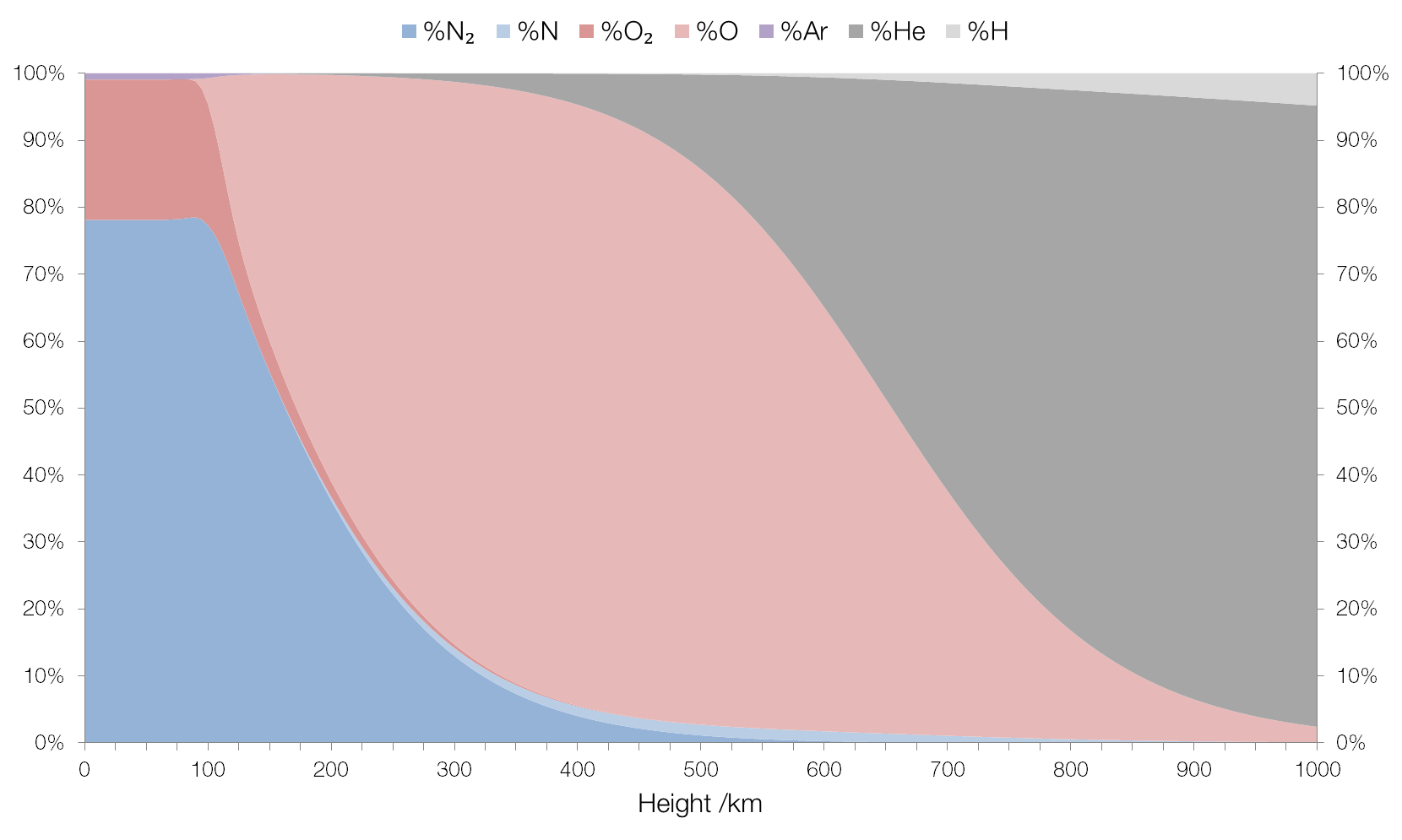
observe that where Helium becomes a significant percentage, there is also Hydrogen and (monoatomic) Oxygen.
if one were driven by purism or vanity for stoichiometric exactness, then at a height of 1000 km theres 2 Hydrogens per Oxygen atom, so this could be reacted to water, and the energy used to power compression of the Helium, the water would freeze.
without this vanity, helium becomes a significant fraction at much lower heights... and thus higher densities.
The energy to compress becomes nearly insignificant at low pressures.
if humanity ever builds space elevators, this will be one of many benefits of having space elevators.
I'd believe it. Wikipedia has a similar one [1] but it shows a bit more hydrogen than helium at higher elevation.
Awesome graph! Worth stating that the increase in the relative fraction of He isn't so much because there's a lot of He out there as because there's a lot less of everything else. Overall density falls off roughly exponentially but lighter elements have a longer tail.
So once you get out to a few earth radii quite a bit of what you see might be ionized helium but that doesn't mean you can do much with it.
> There is no practically usable helium near the top of the atmosphere.
The context of this discussion and the fourth word in that sentence is important. Something existing isn't the same as something being practically available. That graph isn't wrong, percentage wise, but it's missing both density an cost per liter that makes it relevant to this discussion.
Agreed, but there's a reasonable bounds for that future context that sets what's "practical", at the time these reserves would run out if not replaced (this discussion), with that context partially dictated by todays practical alternatives (which also happen to be the exact same as the original source of the reserves!).
For an idea of the difficultly, compared to not bleeding helium into the atmosphere (as the petrol companies do now): the atmospheric pressure at those elevations is around 1/10,000,000,000,000 of that at sea level. To fill one party balloon, you would need to capture something like 5,000,000,000,000 party balloons of that atmosphere. Note: math might be a relatively negligible couple orders of magnitude off.
If by “free” you mean “very very expensive” then i agree with you. It would cost a fortune to even just attempt a pilot project proving feasability. Then we would need to send up regular replacements to the “sending the harvest down” hardware at the minimum. Just imagining the cost of a tank which can be launched into space, autonomously dock with the collector sails, then deorbit and land makes my head spin. And then doing that at scale, paying people to launch it, paying people to operate the system.
It could be free if we imagine some crazy advances in autonomous self-replicating spacecrafts. But by then we live in the post-scarcity diamond age probably.
I meant some semi permanent harvesters (which would cost a fortune to build and deploy).
Sending the harvest down could maybe happen inside plastic containers built in place, made with the abundant sunlight, some Co2 and water (not sure if there's CO2 this high though. In retrospect we'd need also some metals to print some sort of the antenna reflecting radar frequencies (for the ground stations tracking them on the approach)?
And with the hundreds of small containers (carefully balanced so they don't smash in the ground but slowly rain onto the area) maybe it'd be easier.
I don't know. I think it's hard sci-fi, achievable within our lifetimes :)



reply