Nice writeup Walter. One of the more useful things about a static landing zone is that the head isn't moving over a surface as it does on a traditional center landing zone. Both Seagate and WD drives have had issues with drives "kicking up" contaminants from the LZ which cause a head crash later as those contaminants migrate across the surface of the disk.
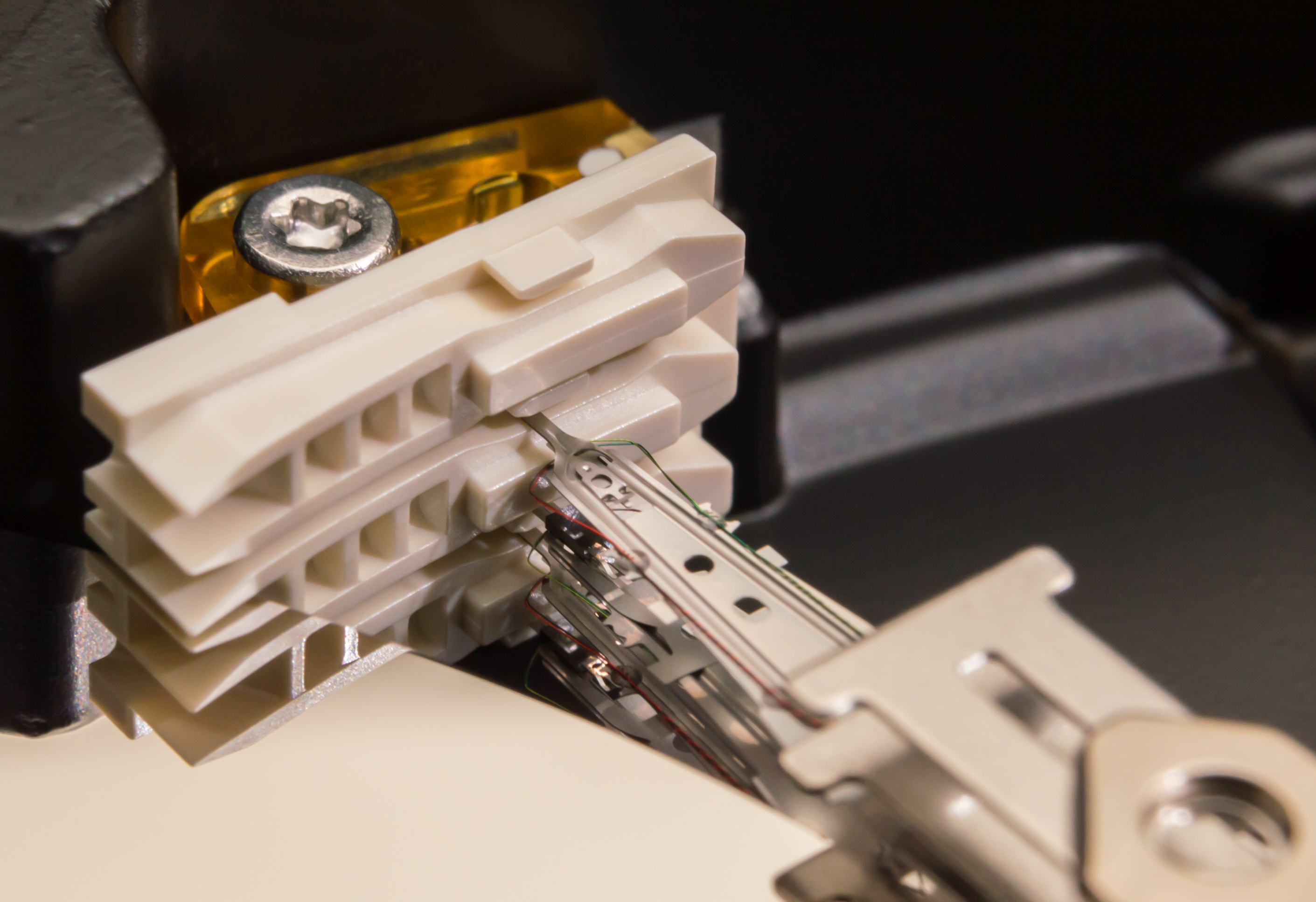
As for lifecycle, I'm with atap who questions the limits on this plastic. Basically there isn't anything to "wear out" as far as I can see on the landing zone.
If there is any wear then I think it is microscopic. I had a Green disk die after 45000 hours of spin time, over 1.5 million load cycles. I could not visually see any defects on the loading ramp with a 5x lens. I think the failure mode of this WD10EACS was one head started going bad.
5405 RPM? I'd like to see a source on that. I did a search, and was irritated to find only people on other websites parroting that number. The Wikipedia article has it, but the citation is WD's own spec sheet which doesn't mention any number.
Did someone take a non-contact digital tachometer to a (presumably dead) opened one and measure it? 5405 is only 0.093% more than 5400 and within the tolerance of the measuring device (and the HDD spindle motor also has its own rotational speed tolerance.)
Edit: found this benchmark using a software that appears to estimate spindle speed, and it basically shows it as being a 5400RPM drive:
Eliminating drag. Because the head uses air pressure to keep itself off the platter, that air is also going to be pressing against the drive, causing friction, and requiring the motor to work a bit harder. By parking away from the platter altogether, you're eliminating that source of drag and friction. Regarding the orange widget, the damage happens over hundreds of thousands of park and unpark cycles -- a little wobble and a little rubbing after each one, which will eventually be enough to get things out of alignment and thus, broken.
The difference between near the rim and near the spindle is that air pressure. If it's near the spindle, it still has that drag that's making the motor work harder. Near the rim, that pressure is gone.
It just seems strange that there needs to be an orange widget to act as a "landing zone" at all.
Why not park the heads hanging in free space? Ostensibly the plastic widget is probably a guide rail to prevent head crashes, when the head unparks onto a platter spinning at full speed?
There's a short whitepaper published by HGST (now part of Western Digital) which discusses the history and benefits of the ramp load-unload mechanism [1].
The heads (the one above and the one below the platter) would crash into each other if there is nothing to keep them apart, and then you could not put them back on the platter.


As for lifecycle, I'm with atap who questions the limits on this plastic. Basically there isn't anything to "wear out" as far as I can see on the landing zone.