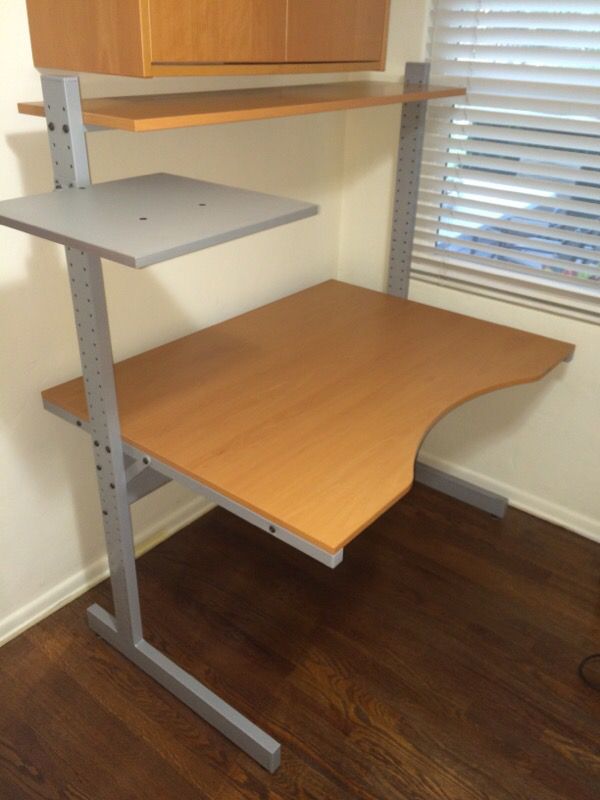
I love IKEA but these choices are not structurally-equivalent substitutes. They'll start becoming trash the (second) time you try to rebuild them when you move. It's the same garbage that Walmart has been selling.
Yes you buy something for 1/3rd the cost of something made of real wood but it'll last 1/20th the time.
What is particularly irritating is when you try to insert a cam or a screw and it totally mutilates the particle board rendering it useless or at least severely compromising the structure.
I'd rather see prices stay higher (so I'm screwed in a way that I'm aware) instead of getting screwed in unknown ways.
IKEA has always fallen apart when you try to move it, none of these changes alter that. The main example in the article is replacing a wooden veneer with paper foil. That is totally non-structural.
And IKEA stuff costs a lot less than 1/3 of finished solid wood furniture.
There are a lot of people who consistently move apartments every 1-3 years and don't even want to take their old stuff to the next one, because it makes no sense in a new layout. I have 3 Billy bookcases in my current apartment to fit precisely the width between two pillars in the wall, and when I move they'll go straight to the curb. I had a totally different set of bookcases in my last apartment because the layout was totally different.
Maybe you want prices to stay higher, but I and most other people sure don't.
I have a few very nice expensive non-IKEA pieces (couch, bed, kitchen table) that last and which I take from apartment to apartment. But everything else is "modular storage/surfaces" (bookcases, cubbies, side/end tables, dresser, bedside table, desk) which is for the current apartment only because it fits it specifically. I want it to be cheap and disposable. IKEA fills the need perfectly, and I want prices to stay as low as possible. I don't want to spend more so any of it would last a move.
(And many times moving isn't even an option. Because you move in with somebody else so you toss all your old furniture, or you move across the country and you'd rather cheaply send a few boxes via post, rather than hiring an expensive moving service.)
> IKEA has always fallen apart when you try to move it, none of these changes alter that.
This keeps getting repeated.. but when I was studying, I bought used IKEA furniture, moved it around several times to different apartments, and then sold it again when I moved from that city.
I've also renovated my house recently which involved disassembling and reassembling some IKEA furniture. They're still fine.
It depends on the type of furniture of course. Yes, there are some specific ones that are harder to disassemble and move without breaking them. But not all.
> I want it to be cheap and disposable.
Isn't it possible to sell them on something like craigslist? I've bought and sold used IKEA furniture before, but I guess it depends on country/culture how willing people are to buy them.
> which is for the current apartment only because it fits it specifically.
I think this is an excellent point. We live in a home I intend to stay in for a long time. It's a bit on the small side, but we try to make the most of it by optimizing the furniture for that specific home. I've even customized IKEA furniture, cutting them to the right width etc. This lets us avoid moving to a new, larger home. That would certainly cost a lot and would be very resource intensive.
I can imagine the next owner would want to keep at least some of the furniture for at least the first few years too, depending on their life situation.
> but when I was studying, I bought used IKEA furniture, moved it around several times to different apartments, and then sold it again when I moved from that city.
I think this is kind of like how some people complain that Apple USB cables are pieces of crap that are always fraying and breaking after 6 months, while other people use them for years with zero issue.
It really depends on how you use it, how you assemble it, how you disassemble it, is it constantly swaying/weakening a little or is it securely mounted to a wall, do you constantly slam the cubby door or drawer shut or are you gentle? I think the assumption should be that it won't last a move, but that you can get lucky through a combination of chance and care.
I'm not that careful with my stuff, but I have some 15-year old Ikea desks that my wife and I have moved from the West Coast USA to the East Coast USA, then to an island in the Pacific, then back to the West Coast, then back to the island again. They are as solid as ever, and I don't foresee ever replacing them, honestly. I have no idea how people are so careless with their things, I have too many old cables so I have a problem where I never have the newest spec cable due to never having to buy new ones!
There is a vaaaast difference in quality across the Ikea range. I too had a bulletproof Ikea desk that lasted me over a decade and was still in excellent structural condition when I got rid of it. It was a single large slab of wood (not particle board) with steel legs that screwed into a steel frame with large steel screws. It cost $200 at the time but what with inflation and everything else would probably cost over $300 now.
I just looked it up and it was the Galant desk with T-frame legs, sadly discontinued in 2014.
This is correct. Some of the apparently crappiest particle board Ikea shit I've bought still runs strong decades later (glue can help!), and some of the "solid wood" stuff is so flimsily connected that it died instantly. HEJNE? Great. Love it. Wooden rack mount, strong and wonderful. IVAN? Absolute shit, falls apart, cannot be made to work.
I suppose you mean IVAR, but then I'm surprised as I have practically the whole IVAR assortment, coming mostly from when we had a move at work and renewed furniture there. The wooden racks, wooden cupboards, metal cupboards, I have them all and I love them. They have followed me through multiple house moves as well. They replaced basic pine racks that I got from some hardware store, that were not much cheaper and much less sturdy even though... well I still use them anyway, so I guess they're not so bad.
At one time I turned one IVAR metal cupboard into a growbox for tropical plants (the hollow space at the bottom and the mobile rack inside were pretty handy for running wires, pipes and placing the equipment) and it held very well the humidity, that was about ten years ago, I turned it back into a normal cupboard now and it's still as new. I now use a MILSBO cabinet as my indoor greenhouse.
IVAR is the one where the shelves clip on to little pegs? that used to be metal but now everything is plastic? For me they never clipped strong enough, so a slight bump caused shelves to fly off the pegs, even with the backing straps to keep the whole thing from accordianing down.
Your mention of cubboards might be the thing - you need to build it out around the cupboard instead of trying to just use it for shelves.
Maybe it depends on the country? The shelves in metal IVAR cupboards still use metal clips here in France and Belgium. The shelves for the wooden racks are held by metal brackets and metal bars (I don't use the cupboards mounted to the wooden racks, they are just standing on the ground. I haven't used corner pieces either).
I would expect wire metal shelving to be much cheaper than what you can find at Ikea of course, but also quite flimsy.
Now I'm no Ikea salesman but I always fail to understand what I read on HN (or other US-centric social media sites, as far as I can tell?) when the topic of Ikea comes around.
The wire shelving linked is "kitchen/factory" grade and rated for 650 lbs a shelf, I'd have no issues climbing to the top and jumping up and down on it. I'd be scared to death to do that on a 83" piece of Ikea furniture.
I still have my JERKER desk that is now around 25 years old. There is a clear degradation in quality (structural and cosmetic) over time for IKEA furniture and for me personally I am no longer buying many different furniture types from there. The better beds used to be good value for money, but it looks like that’s also about to end.
Yeah, one of the better things they've ever had, but ultimately it's just edge joined 2x2s, so depending on where you live you're likely to get some cupping/warping over time.
They probably still have similar wood countertops you can buy and use for the same purpose, though.
Nope. At least in the US, all the countertops are particleboard, laminate or quartz. There's a butcher block themed particleboard but that's the closest you'll get now.
I'm still finishing up an IKEA kitchen, but the last I checked there were no solid wood options any longer. Used to be for SEKTION (and the Euro equivalent) they even carried solid ash doors and drawer fronts, those were discontinued a couple years ago. There are solid bamboo fronts (but no doors).
The closest you'll get now are particleboard tops with "thick" veneer. VRENA and MÖLLEKULLA use "thick" oak veneer; KARLBY, BARKABODA, and PINNARP use a "thick" walnut veneer. Veneer being IKEA's choice of words, not mine. These have traditional laminate on the underside.
SKOGSÅ uses "thick" veneer on all sides but is still a particleboard core.
In general I've had good experiences with the office furniture from IKEA. My current desk is a custom oiled wood butcher block slab with (adjustable) IKEA legs, and the legs are perfect - easy to install, don't slip, stable etc.
Still have my Galant T-frame since 2011, survived a cross country move and several in-house relocations, and I use it every day. Still perfectly solid.
Yep, in my experience I’ve had the biggest problems when I overtighten their bolts. You really need to be careful not to tighten past the point where it starts chewing up the wood. But under tightening can have issues too if it makes the structure wobbly, which will also chew up the wood.
I purchased an Ikea Pax cupboard and joined it to its twin (same model) which Id been given by a neighbor. The old one was solid wood whereas the new one was not.
> I think this is kind of like how some people complain that Apple USB cables are pieces of crap that are always fraying and breaking after 6 months, while other people use them for years with zero issue.
Then they're very inconsistent, because I've had multiple Apple USB and power cables that were secured to a desk in cable runs and connectors, and sat on a desk with a cable organizer, and still managed to fray while being moved no more than a few inches to plug/unplug in their life.
I think there's a lot of variation within Ikea products, and it tends to be reflected pretty clearly on the price. In a lot of Ikea's furniture lines they now offer a pretty significant range of price points and there is a corresponding range of quality and durability, with the lower end being trash and the upper end pretty impressive for flatpack.
> This keeps getting repeated.. but when I was studying, I bought used IKEA furniture, moved it around several times to different apartments, and then sold it again when I moved from that city.
> I've also renovated my house recently which involved disassembling and reassembling some IKEA furniture. They're still fine.
Indeed, I still have all of my original IKEA furniture after 7+ moves - none have "fallen apart". They just require partial disassembly to move. My IKEA desk and Billy bookcases are >20 years old and in great condition.
I'm not quite sure how people manage to be so destructive when moving.
No, it's pretty common. Because movers are responsible for replacing your items if they damage them.
They won't dissassemble/reassemble IKEA furniture because it's too likely to fail and then they'd be on the hook for replacement cost, through no fault of their own.
Literally the first Google result for "will movers reassemble ikea furniture" states:
> "Though individual policies vary, most movers will not disassemble and reassemble IKEA furniture, and some even require their customers to sign waivers against damage."
Even if you sign a waiver, they still won't do it because of customer dissatisfaction -- bad reviews with "they ruined my furniture and wouldn't replace it" etc.
Why would one pay someone to assemble an IKEA furniture anyway? These things are so simple to assemble and rarely require more than a screwdriver and allen wrench. A six year old could put together pretty much anything in their catalog.
While it's not the cheap stuff and movers never actually had to disassemble anything more than the bed frame, I have never seen "we don't move IKEA furniture" or any kinds of furniture related wavers.
They're willing to assemble other furniture? In my experience, IKEA furniture is some of the best-designed self-assembled furniture. Other companies don't seem to give any thought to making it easy to assemble at all. Some of the assembly "manuals" are hilariously bad.
IKEA stuff is generally great at assembly -- once.
If the back of the cabinet is nailed on, it's never going to survive removal and re-assembly. It might not survive normal wear-and-tear if you use it a lot.
If the process involves wood screws that bear weight, those joints won't survive disassembly.
> I bought used IKEA furniture, moved it around several times to different apartments, and then sold it again when I moved from that city
IKEA furniture can mean lots of different things.
The Billy bookcase specifically (which this article is primarily about) is not super great at surviving moves. Infact I had to reinforce mine just to hold lots of hard-cover books.
I'm ok with that because the price was so low it still was cheaper that getting stronger bookcases, and because they look good.
Selling furniture on Craigslist is a nightmare in most places and hardly worth doing unless you're really desperate for cash. Buyers will nickel-and-dime you, ask for free delivery, flake on scheduled meetings, show up without enough cash, maybe even try to rob you.
On my last visit to the States I bought some Ikea furniture (Galant desk, a chair, a bed etc) and after 1.5 months tried to sell all that. Used furniture store turned me down. Craiglist banned my account for reasons unknown. Goodwill refused to send a truck to collect items for free. As a last resort, I arranged the items nicely in the garbage room in hope someone picks them up, but the garbage room manager sternly requested I break them up and put into garbage bins. Americans are too rich and wasteful.
My wife sells a lot of stuff used and has good luck dealing with the flakey-nickel-dimers (the same people are typically both) by giving them a price concession of $N if they show up in M hours, where N is typically 5-10 and M is 1-3
It is still my time and attention that is far more valuable for me than whatever I would get back for reselling Billy bookshelves and the likes.
It works for you, you have headspace and you are mentally well composed to deal with that crap.
I’m not, so much rather dump furniture on the curb/trash of course after checking with family and friends in case they would need or want to take it for free. If they take it and sell it off good for them.
I've learned that giving things away is much harder than selling them for a small price. If I want to give something away, I get a lot of interest, but nobody really shows up, nobody is committed. It's a lot of wasteful communication. If I sell it for 5€, it's a much nicer experience and it still goes to the target audience (people who couldn't afford to pay the full price).
Yes, I have moved with IKEA furniture. I would like to point out though that their older stuff was sturdier, and the newer stuff is essentially cardboard.
I have a couch that's moved twice and it is as good as it was when I bought it.
IKEA makes many products that are metal(I have a couple carts like that) and even some of their particle board furniture(two large dressers I have) do fine if you move them carefully.
My moves were from SoCal to the Bay Area and back, so not cross country, but not local either.
My Friheten sleeping couch has been through three complete disassembly processes, has been my daily couch for about three years (then relegated to a guest bedroom) and has been used as bed a few dozen times, but it’s still pristine. Plenty of other IKEA furniture has been through three movings too and it’s still good.
How you treat your stuff and how carefully you (dis)assemble it matters a lot.
> IKEA has always fallen apart when you try to move it
IKEA has different levels of quality, including amazing cardboard LACK.
IKEA also has a lot of solid wood furniture.
What pertains to the article, is that IKEA is keeping prices of the expensive stuff lower than competition... by pushing materials to their limits.
I had moderately expensive IKEA furniture and I had "designer furniture". IKEA isn't much different. I have Besta unit, that has moved multiple times thousands of miles over the last 8 years... still looks pretty good.
I have an IKEA dining table and chair set that's at least 15 years old, and we use it every single day. It's in its third dwelling. It's solid wood and would probably last another 15 years. At this point I don't even like the thing but with two kids now, it's great to have an old table. If it gets crayoned on or written on or glued on or gets food and gunk in the cracks, no big deal, it's old.
I have some other solid wood IKEA pieces that are nearly as old.
Other IKEA stuff has been chocked in the trash over the years but generally it's a good value for the money. I can now afford better than IKEA but alternatives often cost much, much more and I'd rather not spend that much for my kid's furniture that needs to last only a few years anyway. I do shop elsewhere for stuff I'd rather keep longer.
That's actually a bit frustrating, it feels like a lot of options will take more money from you and then not really give you a better, sturdier product. Your options for quality pieces get even fewer if you (or perhaps someone you live with) don't want furniture that looks old-fashioned.
Not necessarily. Remember that cheaper to make often also means less resource intensive. Some IKEA products are little more than very well engineered and carefully packaged cardboard without looking like it (the LACK table, for example, but also the newer wardrobe doors).
Sending it to the local waste-to-energy plant and buying new stuff, three times, doesn't necessarily have to be meaningfully worse for the environment than buying "solid" stuff once, then moving it twice over a long distance (in a relatively inefficient, one-off move rather than large-scale logistics).
I just move my Ikea furniture with me, I don't know why the only alternative is to buy heavy duty stuff. And I just ignore nicks and dents because it seems wasteful to replace a desk just because of a chip.
It's so easy to see a large piece of furniture in the trash and think "OMG so much waste" and to toss a 10-year-old Android tablet in the trash and think "no big deal," but of course I have no idea how much more metals, plastics, waste, etc. went into that old tablet. It just seems like less waste because the volume and weight is smaller - but the disposing user doesn't see how much the manufacturing process consumed. It would be interesting to see some sort of resource that compares waste in this manner.
Consider also the additional cost of moving the (bulky) furniture.
Consider if you're moving cities (lets say 250 miles) and going from a 10' van to a 17' van (with the assorted Ikea furniture) moves you from 12mpg to 10mpg - that's 20 gallons of gas to 25 gallons of gas. That's an extra 45 kg of CO2 emissions.
Buying new furniture at the new destination then is a smaller incremental cost of going to Ikea anyways.
And while I'll admit that this is a very simplistic analysis, the corresponding assertion that doing this is a larger carbon footprint may fail to take into account some nuances.
> IKEA has always fallen apart when you try to move it...
I've had the same Ikea Jerker desk since 1998. It still looks like new, and I've moved across the country with it several times. I even bought a few more when I could... they stopped making them 10-15 years ago. Best desk ever made. Totally modular, so you can canabalize other parts and mix and match to get exactly the desk configuration you want.
> I've had the same Ikea Jerker desk since 1998. It still looks like new, and I've moved across the country with it several times.
The important thing to remember here is that the structural members are entirely metal on that desk. As I recall, it's a full metal frame that doesn't use the tabletop as a structural member.
That right there is the trick to stable cheap furniture. If you get a metal frame it should be pretty durable!
Ikea in the 80s was pretty solid stuff actually. It was cheap but still made of solid wood that could be taken apart many times. My parents still have a lot of furniture from that era.
More recently, my GALANT desks have survived international moves just fine. Sadly they are now discontinued.
When I tried to move my KALLAX [1], the top row of cubicles lost its structural integrity. It was the best thing to happen because it made a great pot rack. I removed the top half of cubes and in the vacant space I put a black pipe across the walls. I can hang at least 15 pots and pans on the pipe using hooks, and in top shelf can go even more pots. KALLAX one of IKEA’s greatest hits.
Just to throw in my prospective, sure some Ikea stuff doesn't move well.
But for me the Billy bookcases have moved great. I have some that have now survived 3 moves and minus some scratches on the side (which isn't really anything unique to Ikea) they look and function like brand new. One of these even has glass doors on it.
Now I have never bought or tried to move a bed from Ikea, but I think their organization stuff like Billy, Kallax, move just fine.
I get that you don't want to take it with you, but why chuck it on the curb where it's likely to become waste when you could sell it cheap or give it away for free? This happens every month at my apartment building - perfectly good stuff that could be used by someone else, thrown away on the curb and often damaged by weather or vandals.
> And IKEA stuff costs a lot less than 1/3 of finished solid wood furniture.
Looking at beds (frames, not boxspring), it’s 1/2 to about the same (that one is partially solid wood) compared to what we paid for fully solid wood 2 months ago, far from "a lot less".
Anecdotally, I have moved across the country 3 times with IKEA furniture I bought nearly 10 years ago and nothing has broken. I'm not sure where this myth comes from.
>And IKEA stuff costs a lot less than 1/3 of finished solid wood furniture.
To put things into perspective, I ordered a desk from a local company. I had a lot of customization options, but basically I wanted a 60 x 30" top. The legs I ordered actually have height adjustment ... with a CRANK. Because it'll never break. So you have 60-inch long boards, maybe about 4-inches wide each, pressed together into a single board. There's attempt to match up the pattern, so at a quick glance most people would think it's a solid piece. Also not much heavier, because there's less adhesives needed to produce the single board.
With the top you had choices not only in the type of wood, but how that wood was engineered (or if it was a single piece).
* If I went with a butcher block construction, which is heavier, that was $1200.
* I went with a face-grain engineered walnut top. That was $2000 for just the top. Looks great, too.
* If I went with a SINGLE solid board, there was not only a real lead time, but the top was $6500.
And that was just for American walnut. I could've picked far pricier woods. Could've picked some garbage pine or something too, but note the spread there. I think for a 60x30, the total spread of options was $500 to $11,000 depending on the construction and the wood chosen.
This is because nature is really bad at producing large perfect boards, especially for a total area past a few square feet. Turns out. A lot of stuff we use even in modern construction is not just engineered, but often uses petroleum products. Plywood uses a urea formaldehyde, but lo-and-behold we figured out how to produce that out of oil! OSB is no different. It's why when 5-over-1s under construction (before fire suppression equipment is installed) catch fire, they go up very fast, and usually burn hot enough where the radiant heat damages nearby buildings.
When you get into large single pieces, not only are they rare, but you want to let the moisture release, preferably naturally. So you have all these boards, being stored in large climate controlled warehouses for months if not years, before they are used in a piece of furniture. That massive opportunity cost of literally keeping boards around is part of why you pay.
I have some short "entertainment benches" I bought many years ago that were made by Ethnicraft in Vietnam, I believe for Crate & Barrel. Engineered face grain, walnut, on a nickel-plated steel parsons style base. Got them over a decade ago, still look perfect, and at a glance, people think they're one piece. They're not, but again at a quick glance they do. All in they were $4500 for the pair. I could've got some solid ones from a German company named E15. The pair would've been over $20,000 then, and over $30,000 today.
-- -----
Meanwhile, you can get a similarly sized desk from IKEA, with legs, for $370. It's particle board with a glued on outer surface to protect it.
In Australia I got this 1800mm x 405mm (so 70" x 15") butchers block panel[1] for about US$50 and then used height adjustable legs from IKEA which were like $15 each. It looks great and is as solid as anything.
IKEA also has an electric height-adjustable desk frame for maybe $300 I think
Honestly I'd prefer a top made out of various pieces of wood glued together - you can make some pretty neat patterns! That said, that process isn't cheap either lol.
When I did mine I went with a jarvis frame and a custom glass top from a local glass company. The frosted (and tempered) 72x30x0.5 top cost me about $600, weighs about 100lbs, can easily handle a like 900lb load with no issue. Super durable. As long as I don't throw broken spark plugs at it or strike the edge with a hammer. And I put 2" radiuses on the corners so you can't break it by bumping something into it quite as easily.
I LOVE IT!
That said, every other person I've shown it to on the internet thinks it's tacky and I should've gone with a "more mature looking ikea butcher block" or something lol.
My son has had good luck with buying a set of adjustable legs from Monoprice[1] and an IKEA countertop[2] for the desktop. It's one of their laminiated wood models and can be trimmed, though he left his at the full 6 feet. He got the legs on sale for $200 and the countertop was $79.
Note that it's wood effect and not actual wood. Over time the veneer fails and starts to bubble or peel, and they can also warp easier with heavy loads
The correct way to assemble Ikea furniture is to apply wood glue (PVA or polyurethane) along every joint, in every screw hole, on every dowel, and along the edges of every backing board.
For extra points you can wipe polyurethane along any raw particle-board surfaces to seal them, like those on the bottom of a vertical unit.
It's about five minutes extra effort and $0.50 worth of glue for something like a large Billy bookcase.
This basically turns the entire piece into a single composite structure. It's incredibly durable. You cannot disassemble it to move but you can move it whole many, many times without anything breaking.
I have had to take a large sledgehammer to an Ikea entertainment center that I'd glued.
Walmart garbage does not respond the same way to this treatment. The Walmart (or Wayfair) particle board is a wooden oatmeal cookie. It crumbles from within regardless of how the joints are treated.
As far as I can tell, a lot of the more recent IKEA stuff we've bought is using that "wooden oatmeal cookie"[1] and honeycomb cardboard junk. I think some commenters are underestimating how much their materials have changed.
We've even have an older version of a shelf unit that is nice, solid pine, and gone and bought the current version and the current version has changed to that wooden oatmeal cookie[1] crap.
This is a worrying article because they had already seemed to previously squeeze all the quality they could have of their products.
In the past most of their table tops were solids, with only the cheapest ones being hollow. As they phased out those original tops and replaced them with identically priced updates, the vast majority become cardboard honeycomb filled.
When you're selling $200 cardboard filled table tops, I'm not sure how much more blood you can squeeze from the stone.
One thing I've kinda admired about IKEA is that they are super straightforward about what materials their products are made out of. Literally everything on their website says exactly what it's made of. If you want stuff that lasts longer, you buy the stuff at a higher price point that's made of solid wood, if you are on a budget or don't care about the longevity of it, buy the stuff made from particle board or compressed cardboard. It's not so much that the materials have changed, it's that people are buying the lowest end products and then complaining that they aren't as good as the higher end ones, when IKEA sells a whole range of different quality products. And honestly, their lower end products are usually cheaper and better made than the equivalent versions from other retailers. Those cheap IKEA bookcases are far superior to similar versions from Walmart or Target despite being essentially identically constructed.
I have a desk that's just a large Lack, and while it was too weak to hold up my monitor arm + 32" screen (yes, it was a dumb idea), it looks barely damaged after re-gluing the trim.
Wood glue is nice for Ikea stuff still made from reconstituted wood grain products. Unfortunately, they are starting to use a lot of the cardboard mesh hexagonal filler that doesn't respond well to glue at all. I used bondo to glue some of that stuff together, but its not very practical.
Ikea does sometimes use that low quality particle board for some things but at least they seem to be intelligent as to what materials they use where. Whereas Walmart just sells things entirely made of that shit.
I would do this, but I've misread or not carefully paid attention to Ikea instructions on probably half the items I've built. If I was unable to disassemble and undo my mistake the savings from buying IKEA else vanish.
I've noticed this with my wardrobe I bought from Ikea.
I have had to order replacement drawers and had issues with having to reattach it often, until I just glued it all down and now it's lasted and is completely stable.
For many types of furniture there are different price points at IKEA and you can pay for more quality. For bar tables for instance, you can go for a TOMMARYD and have a cheap flimsy table. But if you have the budget to spend over a hundred euros more you can go for a fully wooden NORDVIKEN.
What's interesting is that if your trying to build your own stuff is that the veneers and things are expensive, but actual wood is cheap.
Ikea, or someone else could probably make huge profits and great quality furniture where you buy the flatpack with hardware and veneers from them but it's design to add your own wood for massively improved stability. You could even have a few guys with miter and table saws chopping locally sourced 2x4s and plywood that fits the kit.
Interesting. I am always surprised that here in the US most (maybe all) of my pine Ikea furniture was made in Poland, considering how cheap pine is here in North America. Strange that you wouldn't have the same stuff considering how much closer it is to you.
We have a lot of solid wood dressers here, this is just a few:
Cutting your own pine boards to replace the particleboard shelves and side panels in your Billy bookcase is likely to give you ok-but-also-not-exactly-straight-and-parallel results without a lot of specialized tools and techniques.
Not really. Youtubers with sponsors sell this daft idea that you "need" a lot of power tools to do woodwork, but you can do most of it quite precisely with a couple of hand saws, a good chisel and a block plane. Though by the time you've replaced all the particleboard in a Billy you may as well just make a new bookcase from scratch and give it proper joints.
If you're going with hand chisel and block plane you're well out of the realm of "easy," if only time-wise.
I also don't think a hand plane will help you with warped boards much, and buying sizable not-warped wood is gonna likely add to your cost unless you get lucky at Home Depot. I've never had as much luck with the DIY fixes for that as others. I dunno what the hand version of a jointer is but I don't want to find out. ;)
You don't need a lot of power tools to do pretty cool stuff, but cabinetry is one of the tougher things to do precision-wise if you're unpracticed or don't have tools that make it easy to get repeatable results.
I've never tried a jointer to be honest. One of the many uses of the plane is taking out the gaps where bought wood's planed edges don't quite line up. I was a little unreasonable suggesting people could get away with only one plane though!
I make quite a lot of furniture from scrap or salvage - that's quite fun.
That would be pretty slow working. It's more entertaining than television and not bad exercise. And if you start with that attitude there is no helping you.
I've done quite a bit. (never tried a dovetailing machine tbh). It doesn't have to take a huge amount of time and a lot depends on exactly what you choose to do. Also you're moving the goalposts a bit there.
If you are doing that, then why are you even starting with IKEA furniture? My local home store sells various sizes of laminated furniture panels that you can use to assemble bookcases like LEGO. No cutting required.
You wouldn't want to use pine boards anyway, you'd want to use plywood, likely with a cabinet grade veneer for the outer veneer, unless you were going to paint it.
Pro-grade stuff, yes, but you can build decently nice cabinetry out of the affordable Alder or other whitewood boards at Lowes or Home Depot, especially if you're going for paint, not stain. Also, nice birch plywood has come back down to reasonable prices per sheet. (Use edge banding on plywood to give a pro look - it's easy to iron on and trim with a razor knife.)
Part of the trick to doing this on the cheap and easy is recognizing that many times (e.g., bookcases, or cases for cabinets (order doors from an Internet shop) the precise dimensions matter less than consistency between the pieces. I did a bunch of built-in bookcases a few years ago after my table saw died, and had Lowes cut all the 3/4 Birch ply down to about 9 inches. They won't do or guarantee precision cuts, but I just had them set up the saw once and rip out all the strips from several sheets of plywood at once, so all were identical width, which I could then easily cut to length with a power miter saw. I saved thousands of dollars over the quotes I got from local carpenters and cabinetmakers, and the result is very close to what I would have gotten from them. (BTW, another pro tip is General Finishes "Milk Paint", which is expensive, but worth every penny - put it on with a good brush and the stuff self-levels so well it looks very close to a pro sprayed finish, and comes in a wide range of colors.)
Whitewood boards are great and very cheap, but I would still opt for MDF.
Kiln dried whitewood still produces sap and dents easier than any MDF I have worked with.
By whitewood I presume you mean that mysterious asian species of wood, that dominates the market.
Byt here's my tip - for amateur woodworking, go to a speciality lumber yard that sells S4S. They have discounted and returned items at fairly low prices. I made two bedside tables out of warped, cracked oak shelving S4S boards at about 30% of the cost of materials. But... that was still a hobby project that I had spare time for. If I accounted for the average cost of a carpenter's hourly wages - those items would cost easily $2000 each in labor.
why would I want my furniture to last 20 years? My wife will cycle pieces after 5-10 because she wants something new.
We also have moved ikea couches multiple times and they are fine. It is easy to get replacement cushions when the kids spill stuff on the couches and when the wife decides she wants to get rid of it, it doesnt bother me. We have had our ikea for 6-7 years now, but before that we had very expensive louis shanks furniture and when her tastes changed to modern we got rid of it all.
She wants to change the dining room furniture, but at 1K per chair with 12 chairs that is not happening.
Probably because the marketing industry has tricked us into this way of thinking. The traditional model of buying good quality 'goods' and passing them through generations is not good for business. They even managed to sell bottled water and a lot of people drive SUVs to go to the shops. I bought a couch recently and I could not find one with washable covers. Companies love selling tacky shit that we'll have to replace in a few years and it's terrible for the planet. I feel there should be a tax on fragile, low quality junk or perhaps a 10 year warranty or disposal costs baked into the price. The external cost of the pollution (microplastics, e-waste etc) is not factored into the price of anything. I try to buy used if I can but admittedly it's not always easy to make the trades compared to buying from a retail box store.
> Probably because the marketing industry has tricked us into this way of thinking.
There's no trick about it. Lots of people like new things. Lots of people get new phones, new cars, new TVs, new clothes, new video games, and yes new furniture.
Almost nobody cares about the griping of a few curmudgeons complaining about what they think is tacky or terrible for the planet -- not even most self-proclaimed environmentalists you see flying around the world with the latest gadgets and expensive clothes.
> There's no trick about it. Lots of people like new things.
I think you missed OP’s point. Why do you think lots of people like to buy new things? They weren’t born with an instinctive desire to do something that happens to directly profit companies.
I didn't miss OP's point. Go back to before there was a marketing industry, before there were corporations even. People liked shiny things. Greed, gluttony, envy, these are all part of the human condition. We had these things inside us before we came down from the trees.
Resale of Ikea is close to zero unlike those 1k chairs. The only fool is the poor person unable to afford furniture that holds it's value. When you're ready for something new, you can actually sell the old gear for non-trivial amount.
People who know what a Knoll Wassily is worth and are willing to pay anything near what it's worth just buy a new one.
To everyone else, it's just that weird leather chair you see in every office because of knockoffs, and you'll be competing with knockoffs on pricing. The fact you put "ORIGINAL KNOLL" in your listing won't mean anything to them.
Around here Facebook Marketplace is chock full of furniture like that. While I was waiting for my furniture to be shipped across the chair I was looking for a temporary dining set: I ended up with $2,000 marble table for $300 because the owner had underestimated how long it'd take to sell and needed someone to pick it up in 48 hours.
This is very true, the bottom of the market for antique furniture has completely fallen out. Prices are 70-90% reduced from the peak around the early 2000s. Millenials hate the kind of dark, heavy, ornate wooden furniture that used to be top of the line. Even if they liked it, they don't have homes big enough for half of it.
BS. There is a thriving ecosystem of ikea furniture in this city that sells for half price. It actually gets better prices because models are well known.
I almost never see any particle board or similar fail in normal use except at the fasteners. If they would stop using those fasteners, things might be a lot more durable.
It's already repairable fairly easily with basic tools, and it's probably cheaper and easier to reinforce the points where it breaks with a block of scrap or something than to buy actual nice furniture.
Injection molding is cheap, I'm not sure why they don't use plastic inserts instead of bare wood on metal.
I'm also not sure why they try to hide screws so hard and avoid brackets and other hardware. Letting screws show and selling a matching line of tablecloths and mats to hide them would be a more complete implementation of the "Design to make stuff work without quality materials" philosophy.
The fake wood has potential. I still like it even though it doesn't have really value or quality, because... it works amazingly well for what it is, and there's still room to improve.
Some movers seem to be very good at moving Ikea furniture. Wrap it up, cinch it tight with straps. I've seen packed billy bookcases and garbage malm wardrobes moved this way without structural compromise. Saved a lot of time packing too. Bigger items need to be disassembled like bed I would pick something with steel frame that gets nut and bolted.
Moving companies typically exclude particle board items like these from their insurance coverage. I've successfully moved a few IKEA items, but if they're taking 90% of the wood out of certain parts, I have to imagine they're going to be even more fragile now.
Very different experience here. Bought a Billy, moved houses twice, the fucker is still alive and strong and grimly stands in a corner supporting two shelves worth of heavy books and a ton of paperwork.
The point of ikea furniture is that you can throw it away when you move. Moving furniture is more expensive than buying new ikea furniture. Just don't buy their couches.
Yes, that's what the market wants. Ikea win because they (1) have stock (2) have a short and known delivery window (3) have a functional website (4) have showrooms if necessary (5) have instructions people can follow (6) basically invented popular flatpack furniture (7) flatpacks fit in cars, up stairs and around corners (8) they provide nominal styling choices and height adjustment (9) have economies of scale.
Many customers don't care about tomorrow (when they are on their keens cursing putting the thing they ordered together) or the next year (when they move house and it falls apart). They care about now. Convenience is king. Ikea know what they are doing.
Yes, but it's better than the utter garbage at Wal Mart and Target (better made; better designed; easier [yes!] to assemble) and better than the fugly furniture at places like Nebraska Furniture Mart (cheaper; isn't trying and failing to make it look like your $200 desk belongs to a fortune 500 executive or your $300 couch is fine leather heirloom-quality furniture; made just as well)
You have to spend quite a bit more to consistently beat it. Or you have to be really into non-trendy (so, no mid-century-modern) used furniture.
Honestly, I haven't noticed any real difference in Ikea flat-pack vs Walmart Target Wayfair (or even random Amazon listings). It is all mostly cheap junk. If you are willing to pay for the most expensive items, then you start to get real wood, but that's not their bread-and-butter.
What I usually notice from Wal Mart and Target (and other discount big-box stores) are worse veneers (thinner, easier to damage), greater likelihood that the product is already damaged out-of-the-box, much worse assembly instructions (less-clear, often with badly-translated directions that I assume were originally in Chinese or something), greater likelihood of missing parts, and (to borrow a delightful phrase from elsewhere in this discussion) terrible, coarse, void-filled "oatmeal cookie" particle board that crumbles if you look at it.
Ikea's stuff is crap (especially their lower-end items) but it's, like, good crap, by comparison.
> If you are willing to pay for the most expensive items
With IKEA, anyway, once you get into their actual quality items, they start to get more expensive than other options at the same quality level. (A caveat: I don't shop from Walmart so I have no idea about their quality scale).
'fast fashion' is not the same as utter garbage unless you just want to be a snob about things. People buy stuff from Ikea non-stop and it is perfectly ok to have 'fast fashion'.
It's not a snob thing at all. Fast fashion is a euphemism for cheap disposable clothes. That part of the clothing industry is extremely harmful both environmentally and in terms of human decency.
It's the complete disregard for environmental (and labor) impact that defines fast fashion. Nobody would care if fast fashion was just about it being cheap or disposable.
You can argue Ikea has had huge environmental impact, but you are commenting under an article that highlights some of the ways they're reducing that through materials.
So I was wondering why they'd openly admit in a WSJ article that they've "watered down" their furniture and are doubling down on their reputation for flimsy particle-board and paper construction.
Also, I've observed this trend starting way earlier than the pandemic and the start of recent inflation, I bought their butcher block countertops in 2013 and 2018 for my workshop. Let me just say I ripped out my 2013 ones and transferred as much of the old ones to the new workshop as I could.
I can see two reasons for this article:
1. Their customers are noticing and it shows in survey and satisfaction and this is an attempt at curtailing the reputation damage (but don't really see why it's in the WSJ then, maybe it'll show in the coming quarterly/yearly's and they can point to this later?),
2. or they're signaling to investors that they're going to boost profitability and/or margins.
Either way, not really a positive trend in my eyes.
But also unfortunately, it's not like the alternatives are generally much better :/ Seems to be an industry-wide trend.
EDIT: nevermind, Ikea is entirely privately held -- no investors to placate, so 1. maybe?
There's a wired dichotomy that I found with IKEA furniture, most of their furniture is cheaply made and won't stand the test of time, but some of their stuff just seems to be bulletproof and indestructible. Right now I'm sitting on an Markus chair that my parents bought for me in the 7th grade (I was 13 at the time), now I'm 29 and the chair is still kicking along showing no signs of giving up.
Like a lot of companies, IKEA sells things in various tiers. Dressers and bookcases have different price points, and at each price point is a different material quality level.
They however dont make it easy to identify like Kirkland Signature or Lexus.
That's the worst thing about IKEA. They have a great selection of real wood stuff, but finding it is time-consuming in or out of store. Price is the best proxy but that isn't flawless or ideal.
Unbless it's oak, you don't particularly want to have solid wood furniture.
Solid wood is dimensionally unstable and my oak chest of drawers requires special oil treatments to keep cracks from appearing. Plywood or melamine boards are way better for furniture.
Their "real wood" stuff, at least here in Poland, seems to be made from very soft wood, most likely pine (90%+ of forests in Poland are pine). The dark variants (pretending to be exotic wood I guess) are just pine with a dark coloring. When the pine gets nicked, which happens often because it's so soft, its natural color comes out, and sticks out on an otherwise dark furniture like a sore thumb.
The other proble is that sometimes the cheaply built chair is more comfortable and looks better than the solidly built chair… then the right option is to buy neither.
Almost all of my ikea stuff has lasted longer than I wanted it. I have a Poang from 2010, a table from 1998, a bookhshelf from 1994, and a dresser from 2006. Their classics last longer than most of the market.
This is true for all their stuff approximately pre-2018. Most of my furniture is older and was great value. Now you have to be very watchful of the materials and test it out before buying.
I have stuff post 2018 which lasts well too but I agree that you have to check the materials list; however, I remember having to do that in the 90s too.
Yeah I have an IKEA bed base and it’s basically just four solid pieces of wood. They also recently made a floor lamp I got that’s really solid. In closing, it’s a store of contrasts.
I love my MARKUS but I think I'm currently on my third one. The current one was exchanged during the 10-year warranty period since the gas spring started to leak on my floor.
Not sure what I'll do if this MARKUS gives up the ghost too. They redesigned the MARKUS and dropped the leather option, and the non-leather MARKUS has pitiful armrests.
I've also got a Markus at the office. Been using it for more that 10 years, 7 hours a day. It's still as good as new! Don't think of a better price/value office chair!
I'm a bit saddened by this news, since making their products flimsier/lighter will surely make them feel worse.
Anyway, the very first paragraph has this:
ÄLMHULT, Sweden—Amid IKEA’s colorful staged living rooms, piles of umlaut-laden housewares and endless rows of flat-pack boxes is furniture that can have shoppers wondering: How does that chair cost only $35?
Which I think is really bad writing for a publication like the WSJ. Swedish does not have "umlauts". We have three letters more than the US English alphabet, but only two of them (Ä and Ö) have the double dots: the third has a ring (Å). These three are real first-class letters though, they are not "umlauted" (which means changed from some base letter due to grammar).
In English, ¨ is a diacritic mark called diaeresis, which indicates that a vowel is distinct, and shouldn't be diphthongized or dropped: Coöperation, Noël, Brontë.
In German, ¨ is a diacritic mark called umlaut, which transforms the vowels A, O, and U into their umlauted versions: Ä, Ö, and Ü. These characters are not distinct letters of the German alphabet, but belong to a special weird in-between class.
In Swedish, ¨ is not a diacritic mark, does not have a name, and is simply an integral part of the letters Ä and Ö, which together with Å are distinct letters of the Swedish alphabet. The dots aren't modifiers, they're not optional, Ä is not sort-of-an-A, it's as distinct from A as any other vowel, and its pronunciation is closer to E than A.
I had a german teacher insist we write umlauts as two little dashes instead of dots, because "they're not trémas" (French for diaeresis) which are written as two little dots. The wikipedia article above seems to say they're the same. Was I lied to all these years ?
To me, in Swedish, Ā and Ä and an A with two small dashes above would be the same letter, but with stylistic typeface differences. It doesn't change the letter itself. I have never heard of any German insisting their umlauts shouldn't be dots, so I think your German teacher was just a bit pedantic/insane.
Conceptually umlaut dots are different from trema dots, but who cares?
That's pretty funny - makes me think it's less diaeresis (thanks! TIL) and more akin to the dot over a lower case i or j: A letter with distinct sounds that can't be written without the marking above it.
Yes, that's actually a great example! The dot over i doesn't have a name and isn't a diacritic mark any longer, it's an integral part of the letter. It probably originated as a diacritic mark, though.
Ä in Swedish originated as the AE ligature where the E moved upwards and above the A until it became stylized as two dots. In Danish and Norwegian, they instead promoted Æ to a distinct letter.
I think the OP is splitting hairs. I'd say that they are just as much different letters in German, from which the word "Umlaut" comes.
One is replaced with the other in word inflections. For instance, the noun "Land" is "Länder" in plural — both in German and Swedish.
But what the two dots are not: they are definitely not diaeresis.
You don't think of "y" being "u" with an Umlaut. For you this is a completely seperate letter. Ditto with ÄÖÅ im Swedish and ÆØÅ in Danish (Æ is never thought of as combined A and E).
Only in languages where they are umlauts. Look at, for example, Ä and Umlaut-A: they have historically been written differently. They were simplified to mean the same thing in handwriting a long time ago, but as recently as in iso-8859-1 they made a conscious decision to merge them.
Unicode also makes a difference, but generally recommends the merged character.
To non-linguist English speakers, languages with the same letters as the English alphabet plus a few more with two dots on top, are just referred to as English-letter-name with-umlaut.
This is incorrect, from a linguistic perspective, but it's absolutely the case that if I asked 10 of my friends to describe Ä, 9 of them would say "'A' with an umlaut".
The vernacular not matching expert terms of art never ceases to annoy people, but it's not really worth fighting, I don't think.
Yet it's hardly a secret either and something you would expect someone who graduated university writing for a relatively well known newspaper to be able to get right. It's trivial to most readers of English whether they got it right, sure. It's also trivial to get it right and they did not. It looks bad and casts bad light on the newspaper for accuracy and getting details correct. Needless to say there are plenty of details that may not be as trivial to get right but are non-trivial in their effect of your understanding of the story. How does something as batshit simple as this winding up smeared on the WSJ's face in such a nothing story affect the readers' estimate of how often they get important details wrong? That assessment is up to each reader but I'm pretty sure we can all agree it probably doesn't help much.
Very few English speakers (from the U.S. at least) who've graduated college will have been taught this. I worked at newspapers and no one I worked with knew this. It's not a distinction that English speakers are aware of, even at university level, unless they have a reason to know it, like being linguists or knowing people who are Swedish.
If you're a journalist you can't ask a swedish person if you've messed up any details? That's the point. It's so flipping easy to get the detail right.
A fun example of the opposite effect is that it took me forever to realize that Häagen-Dazs, the ice cream, is supposed to be pronounced HAH-gen-das, and not HEY-gen-das.
Off topic, is there any business that will CNC/cut particle board to size, shape, and create holes etc?
Basically thingiverse for furniture.
It would be awesome to be able to customize and reorder parts. For novice users, parametric models could be used to perfectly fit your closet in some nook.
I know there are fully automatic wood cnc machines, but I’m not aware of any company that offers this service (at a reasonable price of course).
I was able to build a very nice desk[0] for my wife using wood from one provider[1] in Germany. It was CNC cut extremely precisely. I requested all the plates and used my wood tools to do all the small cuts, holes, etc. But you can ask them to cut the holes too. It saved me a lot of time and energy to have the plates ready at the right dimensions. I am sure you can find the same kind of providers wherever you live.
I've had good experiences with sendcutsend for small aluminum parts, not sure about large wood parts but they do support many materials including mdf and plywood.
Reasonable price is relative. Real CNC woodworkers cost hundreds of thousands of dollars and require a large commercial space with electric supply. The people who can afford those usually have plenty of work lined up for them. But that's not always the case.
Look around for small wood shops. My father owned one and had a Northwood with two 4x8 tables and 4 spindles. Mostly for in-house work but did a bunch of job shopping if someone came to him with decent drawings. A lot of work was one table so the other could be quickly setup for a one off.
I have never tried anything complicated, but the home improvement store close to me, I can bring a thing of wood and they will make cuts to them along certain dimensions for like 10 cents a cut. I don't know if that's an offering in the US but to be honest from an ecological and logistical standpoint "let's have people be sent bespoke planks of wood" feels like a thing with a good amount of externalities compared to "you go to Home Depot and ask for cuts there"
I don't know about CNC, but where I live in Europe there are plenty of companies that will cut and laminate wood to your specifications. I'd imagine this is what a lot of kitchen builders use for doors etc rather than doing it themselves.
This doesn't seem like a bad thing. Many people treat Ikea furniture as disposable and this seems more environmentally friendly. If people are happy with a cardboard coffee table, seems like a win.
I agree especially when people seem to throw away solid wood furniture all the time near me because it's too heavy or cumbersome to move or even the wrong color. There's a shop that refurbishes old wood furniture and it seems like the main thing they do is paint it white, blue, or black.
ill defend ikea as somewhat environmentally friendly, as they sell the same items for years, so instead of having to buy a new crockery set when too many dining plates are broken, or a whole a new set of shelves because you just need one more, you can add to what you already have.
disposible furniture isnt environmentally friendly though. if you want a cheap item of furniture for short term use, get one second hand.
Having said this, I got my first Billy bookcase 15 years ago, it's still going strong with the more recent additions. So they don't have to be disposable items.
My gripe with IKEA in this regard is: yes, they'll keep the same product lines, but they change up the product finishes enough to matter. I had a PAX unit in Beech Veneer which, once they got rid of, I could no longer extend. Also did my kitchen with them and they got rid of the finish I picked shortly after, which meant that I couldn't replace panels like I thought I might have been able to.
Could still get accessories for the inside of this stuff though, which definitely isn't nothing.
> Also did my kitchen with them and they got rid of the finish I picked shortly after, which meant that I couldn't replace panels like I thought I might have been able to.
IKEA kitchens are actually one of the best things they sell. Their hardware lasts decades and finishes are very sturdy
> This doesn't seem like a bad thing. Many people treat Ikea furniture as disposable and this seems more environmentally friendly. If people are happy with a cardboard coffee table, seems like a win.
Disposable furniture is the antithesis of "environmentally friendly."
> If people are happy with a cardboard coffee table, seems like a win.
I had one once, and I was not happy with it (a Lack). It literally disintegrated after about a year. People often push against a coffee table when sitting on a sofa, and it was not designed for those forces and came apart at the seams.
I have several Lacks at my place that are >15 years old. When I ever get sick of them, I will put them on eBay for a free pickup, and within an hour a student will show up and be happy with the free coffee table that they can use in their student apartment for some more years. Dinner tables used to be made from solid wood and were pretty much indestructible. But how many families dine on a >100 year old table? Most indestructible furniture will get discarded as well at some point (well before they are actually broken beyond repair), because its out of style, has the wrong measures, is too heavy ...
Just get some cheap metal brackets and attach them to the underside of the table and the legs. Especially if you have a white Lack, you can paint the bracket and screws white and the table will still look nice.
And this would make it, dunno, $40 for the table and $5 for the screws and brackets.
They already changed the Billy at some point. My mother has a really old one (80s or 90s, I think) and we bought doors for it and they wouldn't fit. Turns out the "new" Billys are 2cm or so wider. We could install the doors but there would be a 2cm gap in the middle. Tried it with a Billy bought later and it fit.
General FYI: Ikea furniture (like all particle board furniture) will be much more durable if you add a line of wood glue to the edges when building. It's a simple step that only takes a few extra minutes during construction, but the resulting furniture will last through many moves.
I like IKEA. They’re very honest about their construction. They do some solid wood products, and some particle board products - and you’re never going to be confused what you’re buying
Also, all their packaging seems to be recyclable - including their food packaging. That’s something supermarkets in the UK aren’t even close to
Coincidentally, I'm writing this with my feet up on a vintage IKEA coffee table that's solid pine. I got it second hand from a thrift store for $20, but it must be at least 15 years old. When I move, I'll probably just donate it back to Goodwill, and the cycle will continue
https://nakashimawoodworkers.com (new commissions around $7K-$15K for a coffee table, $20K-40K for dining table, plus shipping; older Nakashima pieces are highly valued in the art world and sell anywhere between $15K-$300K)
Edit: Also, to echo what someone mentioned below, if you're interested in solid wood furniture you should find a local woodworker.
Another edit and thought: I used to own a lot of IKEA furniture and as I've gotten older, have slowly replaced those pieces with items from Knoll, with custom pieces from local woodworkers, with a few pieces from the studios listed above. A lot of people are commenting on the cost, and yes they're expensive and could be considered luxury goods.
But if you like art and design and you care about quality, you save for what you want to buy. I wanted to be surrounded by great craftsmanship, so instead of buying "stuff" and instead of spending money on lots of subscriptions and services, or constantly upgrading phones and computers, I buy one piece of nice furniture every year. I believe the more you appreciate the things around you, the more they begin to influence your own work, and your sense of place.
I regularly see a lot of IKEA furniture on the side of the road and in dumpsters. I think this is the difference between buying "things" and having "possessions" but that's a discussion for another day.
And these highlight the main reason why IKEA is still so successful. The apparent starting price for a bed appears to be $1800 on those sites (at least the ones in which I could easily find a price). Meanwhile IKEA has options under $200. I understand all the complaints that people have regarding the durability of IKEA furniture and how it is potentially getting worse, but replacing IKEA furniture every 2 years is still a more attractive deal for many people than replacing some higher quality stuff every 15-20 years.
I have a sofa I bought in 2005. I keep thinking I'll replace it after my next move, but even after several since then, it barely shows a fraction of its age (though I will admit a lack of kids or pets has likely helped).
I also bought an ottoman at some point after the sofa. It never looked great to start with, and I threw it out before the first move.
I have a desk of similar vintage to the sofa. I'm typing at it right now. I think I've been in offices with contract-grade furniture less durable than it.
I bought two different Ikea dressers over the years. One I didn't bother taking with me on the first move; the other is still holding up great several moves later.
In my experience, the trick is to move them without disassembly or with minimal disassembly (removing only moving parts like shelves that are planned to be removed) like any other furniture. Nothing weird with that: Most traditional furniture items made by a carpenter would be equally incompatible with disassembly.
Likewise, if you're not planning on moving then you can make Ikea furniture much stronger by adding wood glue between the pieces during assembly. That way it stays tight and nothing comes loose or flexes.
You clearly haven't tried moving with your local "designer furniture center" "high quality" furniture. IKEA is pretty much as good as the "quality furniture", when it comes to moving.
It highly depends on the region and the local manufacturers they use. IKEA furniture is of very good quality in the Baltic/Scandinavian region in my experience, and significantly poorer quality in the UK.
I’ve also seen many packing mistakes (like two right sides of an armchair and no left side being packed) and similar in the UK that I never encountered around the Baltics/Nordics. I think a lot depends on the work and business culture in the region, as I’ve noticed more emphasis on quality in a lot of things in Scandinavia.
USA bias I guess: they consider apartments undesirable, only to be tolerated by the younger and/or poorer - but families are expected to try for a house.
People who live in apartments in the US tend to move to another apartment frequently, either to get a better unit, to avoid a sharp rent increase, or to move to another neighborhood. We moved 7 times over a 20 year span.
It's definitely something you adapt to - I moved 7 times as a kid growing up with my family (one of those being overseas) and now it's something I actually look forward too when the comes around.
Most people in the US don't have any rent control, not even controls for percentage increase year to year.
When I was renting, I could expect a 10-15% increase year to year. With the current average apartment cost being $1700, that can mean paying an additional $500-$800 per month after 3 years. At that point it becomes worth it to look elsewhere.
No, if you live in an apartment your typical experience right now is one of rent increases pricing you out of your neighborhood - if you owned a home this wouldnt be a problem. So living in an apartment kinda has an implicit expiration - your time is up once you get priced out.
My point what I tried to make above -- why the assumption you're renting if you live in an apartment? Some naming convention I'm not familiar with that implies renting?
From reading other snippets - yes! Funnily enough, to me apartment exclusively refers to rentals, you would call it a condo if you purchased it but the connotations of condo to me are 'some one with too much money paying too much for too little'.
not everyone is in a tech hub and can jump jobs without moving. and the parent comment implies they're doing a 3-5 year jump / move.
that doesn't mean people can stay in the same place long term, but if you're going to be there for 10+ years it might make sense to buy. yeah yeah i get no one can do that in SF or London, but plenty of HN posters who aren't in those cities.
But if you buy, it would be more common to buy an apartment than a house, no? At least in European cities. Which would counter the assumption of short-term apartment living.
What was astonishing to me is the resale value of IKEA stuff. We sold off a bunch of furniture when we moved a year ago and I think that the price I got for my PAX unit was somewhere close to what my parents paid for it for me like 25 years ago.
Used furniture is a weird market because it's hard to match buyers and sellers. But for whatever reason people seek out IKEA stuff. I've never had a problem moving it and have generally been happy with the prices I get
IKEA is like a chain restaurant, you know what you’re getting into and there’s a fair bit of supply.
It is probably a lot easier to acquire a set of used Ikea furniture that matches reasonably well, than doing it with the random stuff that gets out there.
Unlike virtually all other brands, IKEA enables you to purchase additional parts years or even decades down the line. Instead of searching for a second-hand cabinet which 100% matches your needs, you just look for something which is close enough and buy a few additional shelves and door handles new.
I was going to comment this as well. Similar to a used Hondas, IKEA furniture can fetch higher prices because it’s so ubiquitous and easy to own. You know it will be easy to move, what to expect, and where you can find spare parts.
Not to mention when people need only one thing from IKEA, some will pay a premium to get it from down the street versus driving to IKEA.
The IKEA products are recognizable and easy to measurements for online. It's likely people have tried them out before because they're so common as well (or they've walked through the store a few times).
Besides that: no thanks to solid wood. It's super heavy and annoying to move around, and I say that as a guy. A woman of a smaller build or a child that needs to move a bit of furniture will hate them even more. Especially stuff like chairs.
There's a lot of people saying solid wood furniture is more sustainable. I seriously doubt that though. If you like solid wood, and you make sure to take care of it, then I think it's a good choice. As long as not too many of us do it at the same time.
Imagine how much hardwood you'd suddenly have to cut down if everyone started buying these instead of IKEA furniture.
You can use the price as a rough proxy for resource consumption. In my experience IKEA furniture lasts a good fraction of a lifetime. You can buy several for the price of one of these solid wood furniture, and I think you can also buy several before the resource impact is the same as well.
I'm honestly quite impressed with the engineering they're doing with cardboard these days. We have a coffee table and two wall shelves mounted below a TV.. and we have kids. They get treated badly, and they can take it. I hope to replace the coffee table with something nicer one day, but the IKEA one can get a second life in the basement.
The only thing I would have wished was solid wood is our dining table. The veneer is a bit damaged from moisture or heat. If it was solid wood we could've sanded and treated it.
I think the sustainable thing is a combination of IKEAs approach and solid wood. Every solid wood furniture bought will hopefully reduce the amount of trees we cut down over the long term, if they're well taken care of. Eventually it'll reduce the amount of IKEA-style furniture that has to be made. But right now that the population is still growing so much, and we need so much new furniture for new households, I suspect the best thing is to use the fastest growing wood and use as little as possible of it in the furniture.
Agreed, I think the complaints about IKEA sustainability is mostly just a luxury belief. IKEA furniture is cheaper because it uses fewer resources (especially less wood). When lightly used in a home environment a lot of it can last a very long time.
These are, unfortunately, luxury goods. I don't want them to be. There was a time when they weren't. But they're now luxury goods. The masses have to suffer Ikea - it's all we can afford. The above stuff is for the upper classes.
I'm not sure if that's true. My impression is that furniture has always been very expensive, and it's only fairly recently (mid-20th century?) that mass manufacturing has enabled it to be cheap, with IKEA being one of the most well-known examples.
There was a time, about 1.6 million years, when you could bring your axe into the woods, maybe with a friend or two, cut a clearing, and build a whole house with wood furniture that your great great grandchildren would use.
You could eat the abundant animals, drink the clean water, and enjoy an entire life without ever once imbibing microplastics and PFAS.
It might have been a lot of work - but it was completely free. Those times are long gone, and it doesn't seem likely they'll ever return -- but that is how we lived for the vast majority of our time as human beings.
But then you died from a minor cut you got while building that house, and before that you buried most of your young children. A life spent assembling IKEA may not be the best life, but it sure beats that.
I suggest you go visit an exhibition on how people in the dark ages or in the middle ages lived.
YOu probably live with hot and cold water, that you can drink... and pretty much everyone in the developed world can afford a banana... that kind of "luxury" wasn't available to kings just 200 years ago.
The statement I was responding to claimed that humans could never afford nice furniture. But we've had axes for 1.6 million years, and abundant old-growth forests for 1.6 million years, and so, for the vast, vast, vast majority of human history we have in fact had the ability to make sturdy, beautiful, long lasting furniture completely for free.
The middle ages and the "dark" ages weren't even all that bad. They had more free time than we did. They had far more birds and beasts. They paid less taxes. They didn't have a multi-billion dollar ad industry telling them they're not good enough. They lived with nature, a nature we'll never know.
Yes, there was the war and the religious craziness and the fear of apocalypse - wait a minute, we still have all of that stuff except the fear of apocalypse is way more legit now.
I love modern plumbing, and many aspects of the internet. I love the access to culture and knowledge. Antibiotics are cool. I'd rather live now than then. But the idea that people 500; 5,000; or 500,000 years ago had nasty lives far inferior to our own is not entirely justified.
Again though - that's all off topic. Those guys 500,000 years ago had free housing, free wood to burn, and incredible biodiversity which we'll never be able to appreciate in our world of modern anthropocene extinction. And, probably, really nice furniture; if they wanted to make it.
> vast, vast, vast majority of human history we have in fact had the ability to make sturdy, beautiful, long lasting furniture completely for free
Again... Go visit and Egyptological museum. Go see how rough, compared to modern furniture, the royal masterpiece chairs were.
For the 1599950 out of 1600000 years humans definitely could not afford or had any nice furniture. Absolute majority couldn't afford even rough sturdy, unnice furniture. And your comment about "free housing" is naive... It wasn't free and desirable places had their own issues.
Taking a dump on companies like IKEA is very much the most condescending thing we could do. I certainly have experienced the inability to purchase even the most basic necessities, where IKEA would have provided some relief.
... I didn't dump on Ikea anywhere. Not remotely. Neither did GP.
Nor did I speak of comfort. Nor did GP.
Perhaps you are taking context from elsewhere in the comments and misapplying it to this little thread?
I spoke of beauty and sturdiness and longevity; nature, biodiversity.
I've been to many museums; I've seen the thrones. Roughness doesn't matter when you're putting cushions on, or when your buns are tough from years without sitting on padded chairs.
Your definition of nice furniture is very different from mine, clearly. I suggest that you might try to see things from a broader perspective.
On your other points:
Egypt wasn't known for its abundant forests - I don't know why you would expect great carpentry. Their cushions won't be in the museum, for what I hope are obvious reasons.
You cannot seriously claim only the furniture of the last 50 years is nice, while excoriating me for my lack of knowledge of how ancient people lived. Go read some descriptions of Sumerian furniture.
And yes, if you take your stone axe in 1.5 million BC, and clear a space, and build a house, it's free. Hard work - as I said - but free. No property taxes, no mortgage. Free. No HOA, no building standards... Free. There's nothing "naive" about that. What's patently naive is this insistence that only modern people have any sense of craftsmanship or comfort or quality - I say that because it's true, and you need to hear it; not to flame.
> There are vast swathes of land on this planet, where you can go and do exactly what our great ancestors did 1mil years ago.
You'll be eating microplastics, drinking polluted water, and enjoying a far smaller spread of biodiversity. As I said.
There is nowhere on Earth that you can escape those facts any more. Microplastics and PFAs are on Mt Everest, and the Mariana Trench, and everywhere in between; and the Anthropocene Extinction is a real thing.
I also explicitly pointed out the labor involved, so I don't understand why you keep calling that out like some sort of gotcha.
Any luck researching Sumerian furniture? Nice, innit?
> Those guys 500,000 years ago had free housing, free wood to burn, and incredible biodiversity which we'll never be able to appreciate in our world of modern anthropocene extinction. And, probably, really nice furniture; if they wanted to make it.
Step one: invent iron tools roughly 500,000 years early.
"Really nice furniture" involves a lot more than the easy availability of big chunks of wood. Paying a skilled craftsman to spend time to work on something is fundamentally expensive. That expense speaks to what the person you initially replied to was talking about vis a vis mass manufacturing.
Really nice furniture can also be defined as solid, old-growth wood furniture, designed and made to your own specifications, that will last for hundreds of years.
Holding up an unfinished piece of (really nice, apparently) wood, worked by an amateur (to his own specifications!) with primitive tools as equal to what sane people refer to as "furniture" is a blatant misunderstanding of craftsmanship, and much more importantly the whole discussion very deliberately misses the economic point of the person you originally responded to. It's weird that you're so insistent about it.
"Sane people" - really? That's not polite, but anyway...
There are a looooot of people, especially craftsmen, who can appreciate heavy and well built, if rough, furniture. Even if it's worked with primitive tools, that stuff looks and smells and lasts better than anything - anything from IKEA. Especially when it's made with not just nice but gorgeous wood - mahogony, rosewood, oak, teak, etc. The stuff you can hardly buy for any money these days.
And no, I'm not "deliberately missing the economic point" - I'm adding the perspective of a wider range of human history than the last 50 years. The perspective of >99.99% of human history. For all that time, such furniture was not just cheap but free + labour. The trees were abundant, and we used them.
As for being insistent, I'm not - you can believe whatever you like - but it would be cool if you stopped trying to put the worst possible take on my words.
> it would be cool if you stopped trying to put the worst possible take on my words.
Your words are... really something. I feel like as an exercise, you should go try to make something useful out of a downed tree (find a good one!) with chips of flint and obsidian and at the end of the process show people the beautiful thing you made. Let them know how long it took, and how that time and effort ought to be considered "inexpensive."
I have carved stuff - it's fun, and doesn't require a huge amount of strength. With a little guidance you can make lovely stuff, really quickly.
You don't carve it with "chips" you know - you use a knife... Or an axe. Such as the one I mentioned, explicitly. Multiple times now.
But those trees are extremely hard to find now; illegal to chop down, in most parts of the west. We already cut down the vast, vast, vast majority of them. I've said that at least 3 times.
Yes, my words are something - maybe you could read them? You never know, you might learn something.
...
Do you think people didn't use furniture until we had cities? Spoiler: We sure did.
Do you think the only reason neolithic people spent hours knapping knives and axes was for fun / murder? It wasn't. They made stuff.
You think those people sat on the dirt their whole lives? Nope. We know this, because we have surviving examples of stone furniture - usually where wood was scarce...
Do you still think craftspeople don't appreciate solid wood furniture? ... They do. Ask them.
Or that all craftspeople would prefer the composite pine of an IKEA piece? Or that the IKEA piece would last longer? Nah. Not even close.
...
For well over a million years of our history, we had plenty of time to sit by the roaring fire, carving things and telling stories, singing songs. It wasn't all ooga-booga in caves you know.
And while we did this, making things, we got real good at it. We had damn near the exact same brain. It's rather arrogant, and ignorant, to think that those things they made were garbage compared to an IKEA POANG... You don't really think that, do you?
We have pictures, carved in stone, of furniture from 2500 years ago. It kicks ass - it's gorgeous. Nothing in IKEA compares, either in ornamentation or build quality.
> Let them know how long it took, and how that time and effort ought to be considered "inexpensive."
My brother in crust, I've explained at least 4 times now, including in the original comment, that I was using the word free as in free + labour. You can't keep trying to beat me with that stick; it's silly.
You're arguing for "how great it was a million years go". And I can place a good bet, that you had zero experience with woodworking... let alone green woodworking.
This is when I like to point out that you can find skilled carpenters who will make you custom furniture sized just how you want for less than that. That is what I did in my kitchen nook.
That's a good point. I have an older guy I met at a farmer's market, in my phone under Greg Shelves, it's a land line, I have to pay in cash. The problem is I never know exactly what I'm going get, but it is always nice.
Just clicked on the first link: $1225 for one chair (https://www.thejoinery.com/furniture/dining-chairs-dining-ro...). I have 4 Ikea STEFAN. Around $47 each. Been 4 years already and they are still intact. Sure, the quality of the Hayden is way better, but 26 times better? I don't think so.
The next generation probably won't even want those pieces because they will have different lifestyles and preferences. If you want to buy nice furniture and can afford it then go ahead, but when you die it will most likely be thrown away or donated to Goodwill.
This is particularly true with people having fewer kids. 10 pieces of furniture goes fast when you have 20+ grandchildren. Not so much when you have 2 grandchildren.
I inherited Vitra furniture and Artemide lights. Decades old but still fashionable and they hold their value well. I will likely pass these down to my children one day.
One of the lights I inherited is a Tizio with halogen light. It still works. I can save 10 euro per year by throwing away the lamp and buying the LED version. Seems wasteful though, so I just keep it working. I don't see it as obsolete.
The other one has an E27 fitting and fits a regular IKEA or Philips LED bulb, even the smart ones or the ones with temperature adjustments.
> They do save you money but on a very long timescale
You're not going to save money by replacing your Ikea furniture with handcrafted wood furniture that's 25 times the price. Whenever you move, it'll cost more to move the nice chair. You'll eventually have to reupholster it. You'll need to find other hardwood furniture to match it. It'll be way way more expensive over it's lifetime.
The furniture looks and feels nicer to us, was made with thoughtfulness, and is unique, and that's why people buy it, not because it saves money.
I mean the antique Amish furniture I inherited from my grandparents has definitely saved me money. Free and better than anything I could afford. That's what I mean by being a generational purchase. I probably should have said it will save your family money.
> Whenever you move, it'll cost more to move the nice chair
> You'll need to find other hardwood furniture to match it.
Hahahaha. Bro, how rich you think I am? The desk I have is currently sitting next to an Ikea bookshelf, it looks fine. I moved it by putting it in the back of my friend's truck. I'm never selling it so a few scratches are fine.
And costly to maintain as well. Source: have some wegner y stol or whatever from before me where the rope/strings are about to disintegrate (thanks, cats..). A small fortune if I want to refurbish them.
This gets to the heart of the argument Christopher Schwarz makes in his book, The Anarchist's Design Book [1], which is that it's nearly impossible for people who aren't rich to buy high quality furniture that will last a lifetime. An alternative is to build it yourself. The Anarchist's Design book presents relatively simple plans for building high quality furniture without requiring a ton of experience or tools.
Who actually wants the same furniture for life though? People move houses often. In my state the average length of a 15/30 year mortgage is 5 years, meaning the homeowner either refinances or sells and moves to another home.
New home means new furniture, and if the old furniture doesn’t fit the new home’s style then sorry, it’s out and something else replaces it.
The idea of people living in the same house for 30-50 years is dead. IKEA understands this, so they create furniture that lasts the average length of a mortgage.
I only bring this up because the GP post is talking about furniture you build yourself, but when you design and build something you will likely want it for significantly longer. I'm sitting at a desk I designed and built last summer. It represents around 80 hours of work over 4 months, from design to implementation. Everyone who sees it oooh's and aaah's, and I expect to have this desk until I die.
It's surrounded by Ikea stuff that will be thrown away when we move next.
From what I understand this is a part of why Ikea's furniture has such wide appeal. You had a hand in building it, so you have some attachment to it.
> high quality furniture that will last a lifetime
Other caveat being high quality furniture rarely last a life time, restoration / repair can cost more than normal furniture. Another consideration is some luxury furniture / design pieces don't perform that well to heavy every day wear. There's a lot of pieces in big homes / spaces that gets very occasional use.
These are all stunning. Excellent craft is worth it. It’s beautiful when something lasts forever.
Maybe I’m too young (I don’t think so, I’m 32), but I have been impressed with how long some of my IKEA pieces have held up. Since IKEA products are so easy to disassemble and often modular, they are easy to buy and sell. I’ve bought countless used IKEA items over the years and sold nearly as many. These products are perfect for people who constantly move or have changing needs.
I will add another thing - handmade solid wood furniture is never dimensionally accurate. So you can't mix and match, as much as you can with many IKEA pieces.
To add to this, I've liked the Room & Board furniture I've purchased as well. It's pretty simple design-wise, but solid wood, American-made (if you care about things like that), and broadly available. But honestly, the nicest piece of furniture I have is something I commissioned a local cabinet maker to make. It was only marginally more expensive than what a comparable piece at R&B would cost, but was completely custom in a way that R&B could not be, and it was also nice to support local woodworkers.
Buy it for life is right. I've inherited plenty of buy it for life furniture from family and friends, had some repaired and refinished, bought others off craigslist or estate sales etc, some are on their last legs or are too special to be anything but an heirloom as opposed to usable furniture. Of course things don't stay beautiful forever without care; kids (myself included, I damaged some nice furniture when little) are probably the most destructive force.
I still go back and forth (have a need for bookshelves right now) between the price tiers of Ikea's Billy, local used sales, and new wood furniture. But I've never regretted buying something nice.
> yes they're expensive and could be considered luxury goods
They are luxury goods.
We know well that melamine board furniture lasts a lifetime, and there's little need to have a $15k coffee table. Getting a local woodworker to build you anything larger than a pair of side tables is thousands of dollars, without even the material costs.
Your whole comment is a little detached from reality and reads very condescending.
Can anyone suggest something that is there anything reasonably priced? I'm willing to pay 5-10x IKEA prices, but most of the products here are 25x IKEA prices. Room and Board is the only place I see that is somewhat attainable on this list. Most of my IKEA pieces last a decade so there is no way I can economically justify these prices.
https://www.gingkofurniture.com has plenty of stuff in the $400-2k range, and most of their pieces are also buy it for life. Solid hardwood (walnut) construction, steel-framed shelving, etc. They have physical locations in the bay area.
I keep a text file of interesting hn discussions/comments. I maintain a sort-of format where the URL goes on the first line and the next line is the article title and below that any key words then skip a line for the next. I have a directory full of text files with links sorted by topic. I have a command that just greps that directory and tells me the text file and line number.
Gah! I did not explain that right at all. I wrote that in the middle of travel.
The sort-of format is "Article title", article URL, URL to HN discussion or comment of interest, keywords or phrases that help grepping, newline after each line. I then use a simple grep script called looklink that just does a grep -ni $1 $home/doc/links/*
Why this route? Bookmarking in a browser doesn't let me add context and metadata to the URL the where a flat text file lets me do that. Plus I have to put in effort to add the link so you wind up with more focused and interesting links instead of a bunch of crap you thought you might be interested in. Meanwhile you cand find the actual link you want because there's no real metadata with it.
Having shopped at Ikea for 20 years now there is one pattern I noticed: In general Ikea won‘t increase the price of an article, instead they would produce it cheaper and cheaper.
The lines have just shifted. The Hemnes is pine. I would imagine that adjusting for inflation it is likely cheaper than the Billy was when you bought it.
Constantly looking to shave pennies off of products is understandable from a business perspective, but as many are commenting, quality often suffers. With some household items - not just from Ikea - it seems like the race to the bottom leads to everything becoming so bereft of raw material that they are disposable. Try to buy simple things like a dishpan or dish rack, and most brands have become so flimsy that they don't last.
I really wish that Ikea would offer a sub-brand which is more premium. They did that many years ago. I have a dresser from the early '90s which is still in good shape. It was differentiated by design. materials and construction. It also cost a lot more than other similar items. Around that same time they sold a series of shelves/cabinets with aluminum extrusions for the corners, and some of their more dense particle board with premium veneers for the shelves/panels. It really competed with high end stuff from other contract furniture companies like Steelcase, Knoll, and Herman Miller.
Ikea no longer seems to be interested in competing on quality.
IKEA has mid and high tier options in a number of categories. While certainly not necessarily comparable to premium mass-produced furniture brands, definitely a step up.
In my recent experience, when IKEA sells a product that is predominantly made of solid wood it tends to be durable, which is how I define quality. The particle board stuff is definitely hurting their brand from my perspective.
I used to buy a lot of Ikea stuff (to save time) and recently I've just started making my own from basic plywood etc because the quality has totally gone to shit. I used to buy the pine stuff, there's very little of that any more.
It's designed in such a way now that if you use it slightly outside of parameters it's fucked. Like, pick up a chest of drawers the wrong way and the particleboard snaps in a way that is impossible to fix properly without replacing the entire beam.
Try and screw something to the side of a Kallax or whatever, it's honeycomb cardboard so screws just fall through. Yeah you can do it with a bit of effort, but I mean, meh.
I don't think that square items of furniture like that should be disposable. You should be able to just cut it up and use the scrap wood for other projects. Even if you don't want to, leave it outside your flat or house on a dry day, someone will.
I loved Ikea stuff, the latest purchase of BESTÅ TV storage is really awful. It is falling apart and I barely even touch it. The drawer brackets cannot hold a drawer, (I don't have many items) and they block each other while opening and closing the drawers. The materials are very dodgy and poor quality.
I cannot even give it away, sell it or recycle it. Considering making my own stuff eventually.
Not a good trend, IKEA is like the Toyota of furniture. It's inexpensive but functional. With these changes they will be no different than cheap trash furniture. So why pay any premium for Ikea when I can just Amazon the cheapest equivalent furniture knowing both will equally break sooner than later?
The only thing that seems to separate Ikea from similarly priced stuff on Amazon is the fact that I've never had misaligned parts from Ikea. Their QA is top notch despite some of their cheap stuff being very flimsy. I buy from Ikea knowing that I probably won't need to return it or have to talk to some Chinese furniture factory about getting spare parts because some are missing or are so poor quality, they broke during install. Ikea is certainly cheap for some things so you should use wood glue if you want them to last, these are definitely not hierloom pieces.
I love IKEA but I'd have to disagree with their QA being top notch. I can't keep track of how many times I've had to go back because some piece in the flat pack was damaged.
I've never had a piece of IKEA furniture that couldn't do its basic job even after 10+ years and removing clearly important structural bits, I'm honestly not sure what more I could do to reach the point where anything better is worth it
They've never been conspicuously or indulgently expensive but they've never been the cheapest option in a given class. And that has been a key part of their success in the North American market.
The parallel to the furniture market isn't so cut and clear but Ikea does not generally compete with the big box stores on the lowest end FWIW.
Fine tuning quality, feature and price points for their products to attract or repel various customer demographics is something big brands spend a lot of effort on.
They are over the long run. It's a lot like Apple hardware. Slightly more expensive at first, but massively better resale value and durability, resulting in a much lower total cost of ownership. This is basically just the "cheap boots" paradox though, so people instead buy Hyundai/Kia based on the sticker price.
The Sienna is often the cheapest minivan available in the US. The Transit Connect Wagon is currently available for cheaper in some regions, but was never really marketed as a family vehicle, and is being discontinued this year, in its 10th year of nearly zero updates.
When it comes to US market, IKEA is only beat by the custom kitchens from the big box stores. Even midrange IKEA is better than Ashley or similar common furniture stores... not to mention that it's drastically cheaper.
I like Ikea but I usually avoid their cheaper lines and opt for the "higher end" stuff with real wood...sure it's usually just pine, but it seems to hold up a hell of a lot better and it's not that much more expensive. Plus natural wood is gorgeous.
Eg. Buy a Hemnes bookcase instead of a Billy. A ton more affordable than a custom walnut or oak bookcase from a local furniture maker if that is out of your price range, but will last practically as long.
There’s your problem right there. We are all getting a worse product from IKEA because they have to keep investors profits up.
They wrap this boot to the face in a lovingly quaint “scrappy engineers” story that’s supposed to make it seem like this is all unavoidable effects of some mysterious process.
I have bought and assembled 6 billy bookcases one by one over the last 15 years and the drop in quality over time has been quite perceivable.
The latest one I assmeled used plastic locking mechanisms to keep the shelves in place instead of the metal of all my prior bookcases. Probably good enough, but doesn't inspire confidence.
I truly wish whoever downvoted me would give me an explanation of why. This has been my experience.
Do you disagree with my assessment? I can go take pictures of my individual bookshelves if you would like and show the gradual drop in quality if you would prefer.
I expect that people downvote these things based on emotion and not reason. It's been very perceivable that IKEA's quality has gone down over the years. Though it is a bit regional as ultimately quality is influenced by the local manufacturer. The quality of their furniture is better in Scandinavia than the UK, for example.
This is not new. IKEA is continuously redesigning their products and the name does not change. You can buy a billy book case that is fundamentally different than the model that was produced 35 years ago.
Less wood, less metal, more plastic, less material. Cost cutting at every point.
I have a Besta Casefeom 2018 that was made with 1mm wood veneer and it looks decent. The pins where the shelf rest are made from metal and some screws are also metal.
The 2022 version has paper foil printed to look like wood, the pins are plastic, the screws too. IT IS ABSOLUT TRASH! Literally.
The foil is so bad, you will scratch it of accidentally with your fingernails, the plastic screws are one time use only, maybe twice. The pins are bending without any weight on it. I returned it.
They look nearly the same, cost the same as 2018, but they are different. Be warned.
>IKEA is continuously redesigning their products and the name does not change.
Not necessarily. The GNEDBY is an almost identical version of the BENNO, except that the shelves mount differently on the GNEDBY. I bought two GNEDBY shelves used (since they stopped making them) and when was setting it up, I discovered that one of them was slightly different from my four GNEDBYs. Turns out that it was a BENNO all along.
It's like Expedit -> Kallax, Ikea's always tweaking/value engineering their products and at some point the dimensions become different enough to warrant rename. I think Kallax shaved 1 cm off the thicker Expedit perimeter pieces to the point where two next to each other perceptually different.
I like driving around cities when it's moving time for college kids. You can pick up all sorts of great scrap wood left on the curb, mostly from IKEA parts. I had to stop picking it up because I amassed so much. I've made several tables and 3 bed frames.
How many times are we going to rediscover that free market isn't just companies competing for the customer on price, but companies competing in a race to the bottom on quality/cost to pad their earnings as well?
What? Doesn't the free market also gives you mid-range furniture options as well as high end wood workers that'll build anything you're willing to pay for? Ikea is optimizing for particle board rectangles because people in 'the market' mostly want affordable rectangles.
In my experience, the free market hollows out the medium range and lifts the price of the high range above what average people can afford. So all that's left for them is crap.
I think the high end stuff was always expensive. Why do you think furniture was passed down from generation to generation? It’s just that globalization and technology have made the low end so cheap, that by comparison it feels like the high end stuff is too expensive. But that is just your preference for lower cost, good enough items coming through!
(This take not backed up by any data, just my opinion.)
> Doesn't the free market also gives you mid-range furniture options as well as high end wood workers that'll build anything you're willing to pay for?
The free market apparently gives you cardboard furniture at mid-range prices or custom built furniture that non-1% earners wouldn't even dream of affording, and not much inbetween.
$2700 dresser? No thanks.
The "reasonable" option is buying second-hand solid wood furniture on Craigslist and thrift stores in the ~$500-700 range.
Yeah, this is most apparent on their best-seller: Kallax.
Try lifting your old Kallax vs the new one. No, you are not suddenly turned into Captain America. It's the new Kallax that's suddenly became so light and hollow.
I so miss the cheap 150x75 cm Linnmon honeycomb tabletop.
Their default desk depth is now a mere 60 cm because everyone aparently use laptops on desks, nowadays. Ugh. Anything with more depth than that -> so much costlier.
Our Billy shelves are 15 years old and I would not consider them disposable, poorly designed, or fabricated from low-quality materials. Frankly, they have been an excellent investment. The same goes for the couches our kids jumped on for years.
I suspect this comes from having been assembled by an engineer and not the average [insert mechanically unqualified archetype here for flamewar].
For decorating reasons that I cannot explain, I periodically disassemble some pieces and store them for future reintroduction after painting or some other visual adjustments without issue, keeping in mind that all those little metal bits must be stored in a bag and tie-wrapped to the kit.
I find a certain elegance in the austere design simplicity and construction but recognize it may not be to everyone's preferred taste. Like most objects around us, IKEA products have potential for good or evil, depending upon the user's intent and usage.
It's apparent you didn't RTFA before posting. From the part before the paywall, even:
"IKEA grew into a furniture behemoth with a relentless focus on keeping costs low, but that goal has become more challenging. The price of metal, glass, wood and plastic have spiraled up, as have shipping costs. Inflation has squeezed consumers’ wallets. Managers at IKEA knew that something had to change to keep prices down and profits up, so in the past couple of years they have taken some of their products back to the drawing board."
This explains why the nicer Ikea furniture you purchased 15 years ago is of a much higher quality than what is built today.
I too grew up with some of that in the family house, AFAIK it's all gone now. OTOH, I put together no less than five Billy bookcases in the last month. These were in two visual styles and two height configurations (standard 2m and extra 2.4m).
I was somewhat shocked that there were multiple assembly systems being delivered this year even amongst those iconic products. Chiefly, one type has nail-pinned back, and one type has a plastic pressure-pinned back. AFAIK the nail-pin system is older and ... it is shit. The plastic-pinned system is new and far better. Why?
People will hammer themselves. Nails can be easily lost. Hammers aren't always available to consumers. Neighbours hate hammering noises, and many people now live in close proximity to strangers in apartments. CNC cut holes are always in the right place. Plastic pressure pins can be taken out if the furniture needs to be disassembled for relocation.
I admire Ikea industrial design and consider assembly of their products an educational experience because, having spent a lot of time in the past half-decade with mechanical design responsibility also spanning production process engineering and associated logistics, Ikea stuff is just so damn practical. IMHO Ikea products and their associated documentation are proof that design improvement remains possible... even for "iconic" designs that are the back-stop of their brand.
Some of their current generation plastic fasteners are ingenious and probably the product of substantial mechanical design expertise. Their Dundra table (the Ikea "Lego table") is a good example... I thought there was no way that the way the drawers are assembled (plastic fasteners, no hammering) could possibly stand up to abuse by kids without becoming loose, but it legitimately seems to work.
The part of the allegedly proposed evolution which is not obvious to non-production engineers is that the milled voids within the proposed table interior are only possible to achieve with angled CNC work which is not something Ikea has traditionally done as it is historically PITA. You can basically only do it cheaply with custom milling robotics, which is only feasible on production at a certain (not huge but decent) scale. Specifically you probably want to have a fixed angle of approach and the capacity to rotate the mill's work-head by 90 degree increments (as this is faster, more energy efficient, and more spatially efficient than rotating the workpiece itself). Then simply mill the same feature four times. The alternative is rotating the workpiece on a huge rotary table and using a standard mill, but that requires angled mounting and de-mounting of the workpiece which is a PITA requiring equipment (eg. a robotic arm) itself.
Production cost, part count and user experience wise this is brilliant design enabled primarily by innovation in fabrication automation. Kudos to Ikea's prototyping team. However, marketing wise a fat, relatively unstable table with zero drawers may be a hard sell and hard to differentiate branding wise from a straight clone.
The primary benefit of that system appears to be stability in disassembly and re-assembly (in some ways this is "furniture for the homeless", a very millennial design proposition). In addition, I'd hazard a guess brand differentiation was another high priority concern in the eventual decision to go to market with this oddball cog system, since AFAIK a factory-mounted thread insert and a countersunk screw would have been easier and probably cheaper, yet rapidly cloned.
Volatile Organic Compounds are indoor air pollutants [1]. For example, formaldehyde – classed as carcinogen – added to bind Medium Density Fibreboard (MDF).