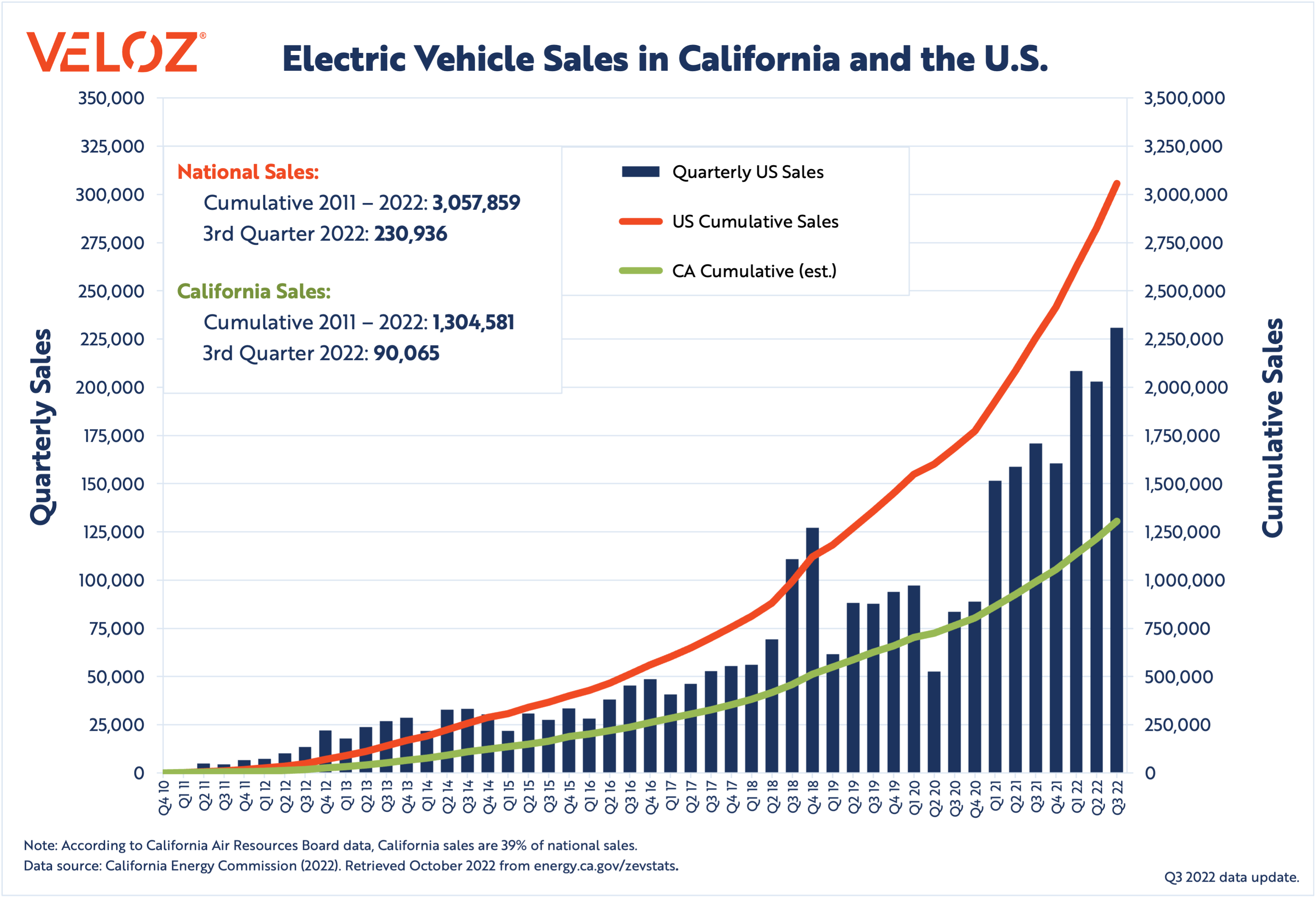
EVs aren’t selling in the US. No one wants them. They are prohibitively expensive for most and have terrible resell value because once the batteries die the car itself is essentially junk.
1/5 cars sold in California last year were EVs, 6% of all vehicle sales in the US were EVs. They'll easily sell over 1 million EVs next year and every major brand has a half dozen new models coming down the line.
There's an exponential growth curve in EV sales that is going to continue as the cars become cheaper / longer range / better made.
I live in small-town Midwest, I don't know a single person who's shopping for a new car that is shopping for an ICE vehicle. Even my friends who do a lot of towing are buying EVs because the stupid FB memes about lack of towing distance don't reflect the actual usage of pulling a boat 20 miles to the ramp and they're all tired of paying $4/gallon for a daily driver that gets 15mpg.
"Auto makers sold 807,180 fully electric vehicles in the U.S. last year, or 5.8% of all vehicles sold, up from 3.2% a year earlier, according to year-end figures released this week by market-research firm Motor Intelligence. In comparison, total U.S. auto sales fell 8% in 2022 from a year earlier."
Can't speak for the US but next door in Canada there are waiting lists for EVs. Second-hand EVs sell very well, too. We feel lucky we bought a second-hand, short range EV several years ago and it does almost all of our driving tasks. Haven't visited a gas station in a long time.
Do you think you just step into your EV one morning and the drive train battery is just "dead"? Are you sure you're not conflating a high tech 500kg piece of technology to the crappy bargain bin 12V battery you have in your ICE car?
The battery will degrade, that's how the laws of physics and chemistry work. But the degradation is perfectly predictable and actually (according to historical data) slower than expected. You can buy 10 year old Teslas with 80-85% battery capacity left.
So instead of 450km you can only go for 360km before needing to charge. If you're a hardcore roadtripper who does 1000km+ every weekend just for fun, you can sell it and get a new one. But the average driver doesn't do even 100km per day, they won't care.
Yup, just happened with our (ICE) 2016 Kia Sedona Minivan. The head gasket blew, had quotes from 6-10K to fix it. We sold it to an auto auction for 2K. It only had 150K miles on it and we had just paid it off.
We couldn't just swap a new engine into it, too complex, too much to fix.
This is exactly right. Also, gasoline cars aren't selling in the US either. No one wants them any more, because they're all buying uranium-powered cars.
When the battery dies, why is it essentially junk? Can't one just swap a new battery into it? Or are you saying that because it would cost 10K+ to do that?
Replacement batteries aren't exactly like engines either. Can you replace an old big block V8 with a rotary compact engine? Not typically.
A battery just has to deliver electric current. If your electric car you bought in 1998 is NMC chemistry, and you replace that pack in 2025 with a 200 wh/kg (that is, about the same density) sodium ion chemistry battery that costs half of what the NMC would, is there some massive overhaul to the system? Maybe the battery management software needs a different set of parameters, but that's about it. Now, the cell-to-frame... well, that's a different issue.
Point is, ICE engines cost what they cost. There's no magic technology coming (not compression-combusted gasoline like Mazda has, or even the inside-out rotary will save ICE).
People don't appreciate what the forthcoming 150 wh/kg sodium ion batteries and 200-230 wh/kg LFP batteries mean for almost all urban and suburban vehicles. These batteries also don't have runaway fires, so they don't lose functional density at the pack level like NMC chemistries.
So if you had some Tesla going 400 miles with 260 wh/kg NMC, that was ACTUALLY about 180 wh/kg at pack level with cooling and safety, the 200 wh/kg LFP using modern Cell-to-Pack techniques, is that same battery. No Nickel. No Cobalt. Lithium is the limiter (and lithium supplies are largely constrained by lack of development, not scarcity like Nickel and especially Cobalt).
So if 200 wh/kg LFP can do 400+ mile cars, the math should be pretty simple on 150 wh/kg sodium ion. That's a 300+ mile car. No lithium needed even.
The roadmap for LFP is 230 wh/kg in mass production later this year. 200 wh/kg is already scaling up.
The roadmap for Sodium Ion is 200 wh/kg in a year or two, we'll see on that.
And once sulfur-based chemistries come online, which are allegedly 2-3x as dense as NMC, look out. That means battery packs that are 45% to 30% of the size of previous ones.
Also, yes batteries aren't junk when they need to be replaced. There will be a couple options:
1) the pack is likely 60-70% capacity of the original. It can be used for home powerwalls, grid storage, etc.
2) the pack can be torn apart and individual cells tested/harvested that still function, and those are reintegrated in other uses (lawnmowers? Power tools? powerwalls? Batteries are useful EVERYWHERE).
3) Recycle the whole pack to get the materials / metals back.
That's what is interesting about battery packs. They don't catastrophically die typically. Their EoL is a gradual failure, but they are still useful. Can an ICE engine near its end of life be torn up into hundreds of little engines and repackaged into toys, tools, security cameras, leaf blowers? No? An EV battery can.
So the battery being a major component cost isn't a total loss, more like a depreciating asset component. It will still have inherent value in many ways, far better than the scrap metal value of an engine from an ICE drivetrain.