> Their populations will shrink with mathematical certainty.
Yeah you know why? Because both parents sitting in offices 8 hours a day have no means of looking after their kids. And a mother giving birth needs to return to work in a few months time, else she there's no pay. Oh and neither parent can give up work to raise these future adults because living expenses are too high. I don't know why everyone is so surprised by the raging population decline. Most of the western world is not child friendly, simple as that.
This is a popular theory on reddit, but it's not true. Birth rates are extremely low even in countries that paid parents to stay at home with kids and generally have good work culture.
You would also expect birth rates to be lowest among people working 2-3 low-wage jobs, which is also not true.
As financial stability and safety increase, birth rates go down. That's the only common driver of it.
Historically, children were sources of unpaid labor. They worked (either at the family business or outside the job), raised younger siblings, and took care of elderly parents.
In short, children were (and sometimes are) a social safety net. What happens in societies that try to eliminate poverty, take care of the elderly, and ban child labor? A lower birth rate.
Low birth rates are not a problem (and reflect enormous amounts of social progress). We just need to solve the Ponzi scheme of retirement and elder care, which I think is doable with automation.
> Birth rates are extremely low even in countries that paid parents to stay at home with kids and generally have good work culture.
I'll still bet that there's a significant career opportunity cost to leaving the workforce for a while like that.
> You would also expect birth rates to be lowest among people working 2-3 low-wage jobs, which is also not true.
If anything, aren't these the people for whom the opportunity cost is lowest? A gap on your "resume" after "McDonald's fry cook" to care for your kids doesn't require much explanation when you later apply for "Starbucks barista". If on the other hand you're a lawyer, maybe you didn't make Partner.
> In short, children were (and sometimes are) a social safety net.
I agree with this, and think it applies not just to children, but also to many adults, who can be helpful to their families but who might be unemployable in the larger market. The destruction of family businesses and informal employment is a problem, because society turns into, "get a job with formal compensation from one of these ten monopolies, or else you are worthless". And there are a lot of people who can't meet that standard.
For example, say your family member has mental illness that makes it hard for him to keep a job. If you owned a farm, you could still find something useful for him to do, and put up with him, and he'd be able to earn his keep, more or less.
Or say you meet a woman who, though creative and intelligent in many ways, also has unrealistic ideas about her "career", and who has never really had a proper job. So she's never going to make money, but she naturally tends to the house and does some cooking and contributes to the social life of the people around her. And say she wants to marry you. Do you do it? In a world of small family businesses, surely she'd help out somehow. In a world of FAANG-employed DINKs, she's worthless. And if she insists on living in California? "Sorry, I can't do this single-handed."
What this whole structure of society forces on people is cruelty. "Can you make money or can you not?" becomes the only important question to ask about another human being. It's horrible. At some level, Jeff Bezos' calculations of human worth enter our own calculations.
I'm not at all sure that the subjection of all things to the market has been progress. A world in which more "wealth" was in social/family networks, and where not all labor were so formal, might be a better one.
I'm dating right now, and it's almost always one of the first things asked. Tinder let's you stick that info up front so people can filter appropriately.
Edit: Just double checked, occupation data is right below your name and age.
Although people use much more flowery language then what you use.
"What do you do for a living?" And so on.
Wish me luck finding someone to split rent with. Peace y'all.
Endless (population) growth might not be sustainable, but
> Low birth rates are not a problem (and reflect enormous amounts of social progress). We just need to solve the Ponzi scheme of retirement and elder care, which I think is doable with automation.
… neither is endless shrinkage, automation or not.
Resulting from otherwise positive changes doesn't mean low birth rates aren't a problem. It's a long term one, of course, but they have to be fixed at some point. If the entire world gets to the development level of South Korea with birth rates below 1, civilization will collapse until it regresses to a point that people start having >2 children again.
Social security (in the US) is explicitly designed such that each generation is paying for the one that came before it and generally needs to be larger.
Pensions could and should work just as long as the funds grow faster than inflation, although in practice they can also indirectly rely on younger people paying for older people.
Birth rates are collapsing in rural India as well. Even where women have an extremely low participation rate in the labor force.
I don’t think the issue is simply “cities have less space, working couples have less money”. Its likely more complicated than that, because nothing really explains why people in India’s vast rural areas would have so few kids.
India has issues with traditional farming being uncompetitive, highlighted by infamous farmer suicides. Pesticides were commonly fingerpointed in the past with simplistic "Monsanto responsible for all bad" narratives, but they didn't stop to think. Not using their products would leave the farmers even worse off economically. Better yield is why they pay.
Kids aren't valued anymore economically. Parents will spend a lot but kids aren't seen as a literal asset but as a sacrifice. Altogether it suggests that at some point if governments want more reproduction they will have to subsidize it more strange as it sounds. It hasn't been a problem in the past from growing poorer undeveloped regions but eventually we could run out of people to uplift economically, leaving even the most xenophilic to have to breed more as immigration numbers wind up low. That scenario probably won't come to pass this century, but potentially the next or later.
Nah. EU is "the west" too, and it's more people than US. And maternity leaves here are around 6-12 months. Population still decreases. Significant part of EU was under communism and had baby booms then despite abysmal pay and much WORSE standards of living then than now. Now their populations go down despite the face they are much wealthier and well off. I live in Poland. There's no comparison, when I look at photos and videos made in 80s in my country it looks like 3rd world. I haven't realized then but now when I look back it's crazy how much changed. But people had kids then and don't have kids now.
What changed is perspectives. In communism you'd earn almost the same no matter where, how much, and how well you worked. And money mattered little anyway, you couldn't buy anything with them, you had to have connections to "arrange" anything (even basic building materials were "arranged" through social networks not bought from a shop). So people invested in families and big social networks to survive. And had lots of kids cause there wasn't much else to do. No career to sacrifice, no recreation other than drinking and partying. No internet. TV had 2 channels and most people had only black-and-white receivers. Culture was only accessible in big cities. Half the families had no car. You couldn't travel abroad easily. There was censorship. There were blackouts at the night.
Why not have kids in these circumstances? What are you losing?
Now your standard of living depends mostly on your education and working ethic. And it can vary greatly. Sky is the limit. You can have a yacht. You can travel all over the world. You can be unemployed and live under the bridge. And anything in between.
You don't need other people to survive. Money are very important. Career is an option. There's LOTS of ways to spend time and money. Having a kid is a big sacrifice in this world. So people work more and have smaller families.
The parts of each country that are less wealthy are usually also the parts with highest natural growth.
Basically - economic growth and development reduces natural growth. Pro-family laws are nice, but they don't change the basic calculation of pros vs cons as much as the changes in societies did.
Go back and read Adam Smith. The thing we don't appreciate today is that having more children used to be an investment -- not just in the idea of family, but literally an investment, as kids would grow up enough to start producing more resources than they cost pretty quickly, and were a net contributor to the family.
Nowadays, having kids is wonderful and great and fulfilling and life-changing and all those things -- but economically a disaster.
It is therefore unsurprising that there are so many fewer children. You have to really want them.
Oh, for sure, having children stopped being net-economically-positive long ago -- though the degree to which it is net-economically-negative seems like it has kept increasing, as our expectations of an acceptable childhood keep growing.
I don't think going from 2.x kids per family to 1.x or even lower was mostly about money. It's about opportunity costs (and the resource that you must allocate between the alternatives is mostly time).
To put it differently: in 80s your standard of living was X no matter if you had kids.
Now if you have kids it's 2X and if you don't it's 5X (assuming the same effort).
That's why giving people with kids enough money to survive don't help much. It changes it from 2X vs 5X to 2.1X vs 5X. Maybe 3X vs 5X if you're very generous.
This is really about economics. 100 years ago, having a kid produced more resources. 40 years ago, it was relatively close to neutral ("X no matter if you had kids"). Now, it's super strongly negative.
If that was the case - big social spending would increase natural growth significantly. But it doesn't.
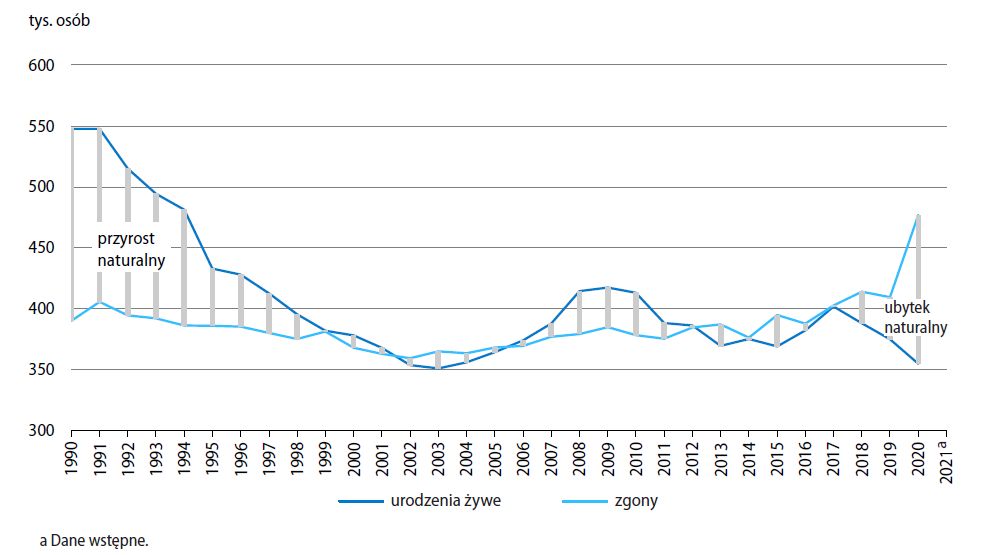
For example in Poland in 2015 a new social program was introduced. Parents get paid 500 PLN for each kid each month till it's 18 years old. At the time the median wage was under 2500 PLN for comparison. So 2 kids increased your earnings by 20%-40% (depending if both parents work).
Natural growth increased by 3.5% for 1 year and quickly returned to the trend. You can't even guess on the graph when it was introduced [1]
Our paper economies are not in tune with reality. They were made to serve people. If there are fewer people with fewer relationships and our economies value numbers over creating happy families, our metrics and economies are broken.
It did not take material wealth or years of checkbox regulated planning to raise a happy family in the past and it does not take it now.
The decline in birthrates is a world wide values and time allocation problem. We do not prioritize relationships and community building, we prioritize immediate gratification and status seeking.
All that an economy should do is manage the logistics of a higher purpose.
But working in the fields doing manual labor is what makes population explosions. It is crassly more a matter of economics. Kids are liabilities in urban and highly educated sections and an asset in rural manual labor situations. Urban vs rural has basically always seen that through different means.
Even if we fixed those problems, birth rates would still be falling. Why? Even accounting for social changes like the sexual revolution, researchers have found that birth rates would still fall due to decreasing male fertility which is common in any industrialized country even for developing ones now, which is alarming. (Everyone has good theories, but no one knows definitively why it is happening.) The only continent that still has healthy fertility is Africa, and that’s only for central Africa. Even coastal Africa is starting to be affected by this Children of Men phenomena.
Need I remind you women are creatures with their own volition and needs, who may decide for or against going to work -- and derive satisfaction or frustration from it -- just like men?
You could make the more reasonable argument that it's increasingly unreasonable to expect any person of any sex to sit in an office for 8 hours a day. And that's not even to mention people doing real, physically extenuating work for really long hours (which those of us on HN tend to forget about, comfy in our white collar bubbles).


Yeah you know why? Because both parents sitting in offices 8 hours a day have no means of looking after their kids. And a mother giving birth needs to return to work in a few months time, else she there's no pay. Oh and neither parent can give up work to raise these future adults because living expenses are too high. I don't know why everyone is so surprised by the raging population decline. Most of the western world is not child friendly, simple as that.