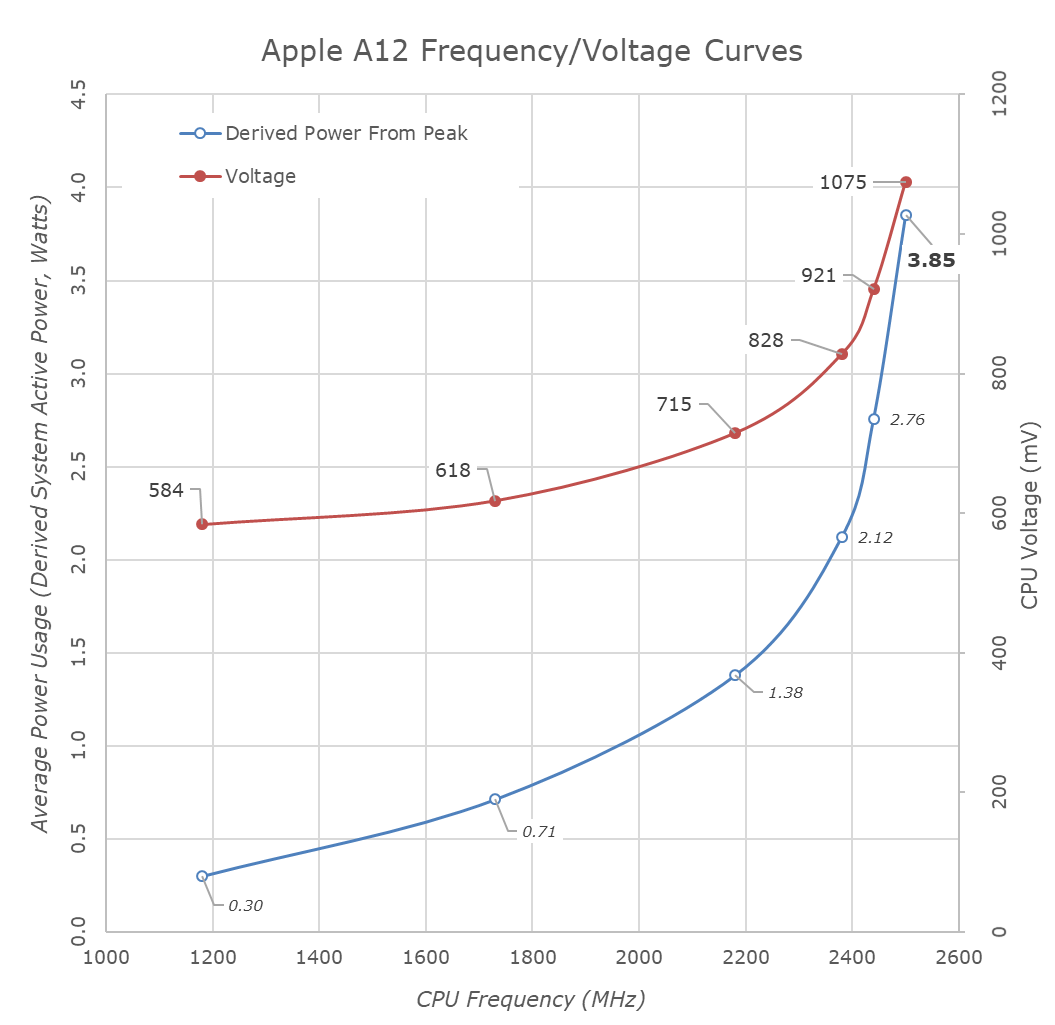
That's fair. However, according to the same chart, it draws 1W at 2000 MHz, which should give 80% the single core performance. This is how Apple is getting 4x the perf/watt of Intel and AMD competitors in Geekbench and similar workloads. Apple is able to acheive very high multithreaded performance within a 5-6W TDP by running all the cores around 80% of peak performance.
> Those curves also apply to Intel & AMD. As in, you can drop frequency on AMD to also achieve significant improves in perf/watt. That's not a unique aspect of the A12. That curve is more "this is how TSMC's 7nm transistors behave" type of thing. Geekbench only measures perf, not perf/watt. It does not try to achieve maximum perf/watt, nor has Apple tuned to the A12/A13 to achieve maximum perf/watt in Geekbench either. Geekbench's single thread numbers where it "competes with Intel & AMD" are also these ~5W per core power figures.
While similar curves also apply to Intel and AMD, their mobile parts are drawing 10-20 watts per core to acheive the very top results. When you're using all the cores together under a 6W TDP (as apple is doing), Apple is able to achieve a much higher Geekbench result than Intel or AMD parts set to a comparable TDP, or even 3x the TDP. Compare multi-core Geekbench scores of Apple's parts running at a 6W TDP to Intel or AMD's most efficient parts running at a 15W TDP, and you'll see that Apple outperforms them while drawing 1/3 the power. Similar curves apply, but Apple can achieve far morea at 1W per core than any x86 competitors.
Those curves also apply to Intel & AMD. As in, you can drop frequency on AMD to also achieve significant improves in perf/watt. That's not a unique aspect of the A12. That curve is more "this is how TSMC's 7nm transistors behave" type of thing.
> 4x the perf/watt of Intel and AMD competitors in Geekbench
Geekbench only measures perf, not perf/watt. It does not try to achieve maximum perf/watt, nor has Apple tuned to the A12/A13 to achieve maximum perf/watt in Geekbench either. Geekbench's single thread numbers where it "competes with Intel & AMD" are also these ~5W per core power figures.
I'm not sure where you're getting this random 4x better number from anyway?
Researching the very most efficient parts from Intel and AMD today, 3x the perf/watt would be more accurate. Operating at a 5-6W TDP, the 2018 Apple A12X gets a multicore Geekbench score of 4730. Operating at a TDP of 15W, the i7-1065G7 (Ice Lake) gets multi-core Geekbench score of 4865. This is on Intel's 10 nm process that's comparable to TSMC 7 nm. Near equal performance for 3x the power.
I'd expect a 2020 A14X or whatever it's called to comfortably beat what they could achieve in 2018, so getting 4-5x the perf/watt of Intel and AMD's best is what I'd expect when operating at similar points in the frequency/power curve. The A12X was around 4-5x the perf/watt of what Intel and AMD had out in late 2018.
Unfortunately I could only find this old chart [0] showing how power draw scales with frequency on Intel. However for the sake of demonstration it should be more than enough.
The chip needs around 25W at 2.5GHz and 200W at 4.7GHz. 8x more power for
1.88 times the performance. In other words Intel chips running at 2.5GHz are 4.25 times more efficient than Intel chips running at 4.7Ghz. No magic. Once Apple has chips that go this far they will suffer from the same problems.
Here is a slightly newer chart [1] that demonstrates a 57% increase in power consumption for a 500Mhz frequency gain (12% performance gain).
If it was that easy then everyone would do it. I call this the curse of the single number. There is this complicated machinery with lots of parts with different shapes, some are bigger some are smaller. However, the customer is not aware of the complexity and only sees a single number like 5W and maybe another number that showcases the performance score of the chip. Surely, since that is the only information we have about power consumption and performance it must be true in all situations. The reality is that those two numbers were measured during different situations and combining them into a meaningful calculation might actually not be possible.
For example. Geekbench measures peak performance of all cores at the same time and the power draw may go above 5W.
The 5W TDP may refer to normal day to day use where one or two cores are active at the same time for the duration of the user interaction (play a game for 5 min or something) and once the user stops using the phone it will quickly go back to a lower TDP.