I recently made a 1600 mile trip by car. In all of the places we stopped, I saw exactly one place that had EV charging set up.
Tesla, and non-hybrid EV in general, have a co-dependent relationship with charging stations to overcome "range anxiety". This is especially true for those od us who live in cold climates and must drive in conditions unfavorable to operating batteries, such as -20 to -40 degree weather.
I'm also very curious to see what the electric pickup trucks that all the manufacturers are not-so-secretly working on end up being capable of. A frequent consequence of rural life is needing to haul heavy things, such as wood for repairing out buildings or outdoor furnaces, or towing boats to go fishing.
>I recently made a 1600 mile trip by car. In all of the places we stopped, I saw exactly one place that had EV charging set up.
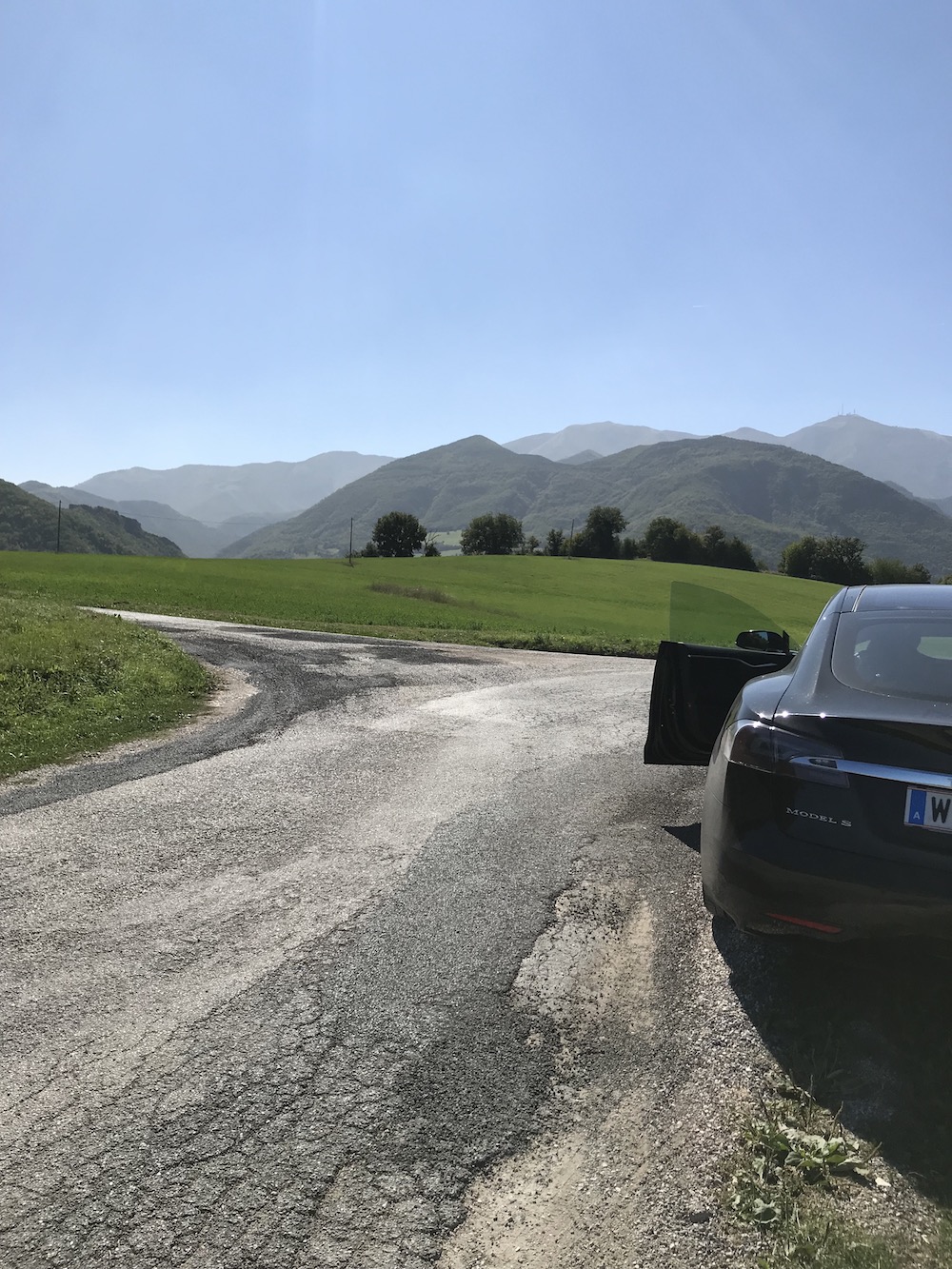
I made a 2800 Km (5 days) trip through Italy a few months ago, it was a breeze with SC and abetterrouteplanner.com, never had to wait at chargers. To give you an idea what kind of roads we travelled: http://666kb.com/i/dxjj2jkx7h0uvhmmg.jpg
Range anxiety: 0. Cost: only road tolls. I can imagine range anxiety and charging costs being an issue with other brands of EV (non-Tesla chargers in Italy are often horrendously expensive) and of course there's more planning involved than with an ICE, but for Tesla owners, this has been a non-issue for quite a while (at least in western/central/northern Europe and most likely the USA).
The USA is huge. Imagine an EU with 50 represented countries, and a common-ish heritage, spread them out across twice the land mass, and you have the USA- lots of cities, lots of land. Just like the EU, different countries (states) have different adoption rates. In short, parts of the USA have much better support and adoption of EV's, and the adoption will likely radiate out from there.
Only limited areas of the USA, as evidenced by my recent trip. That'll change over time, but as you also pointed out with the case of non-tesla chargers, one limitation of EV in general is the co-dependency on new infrastructure.
You can get from virtually anywhere in the USA to anywhere else in the USA using the supercharger network. The problem is you're expecting to see them on every corner like gas stations, but most people with electric vehicles charge every night. They wake up with a full tank. So they don't need charging stations for day to day use. Just longer road trips. So not as many are needed. They're also often tucked away in a hotel parking lot somewhere that you don't notice unless you're actively trying to find it.
> Only limited areas of the USA, as evidenced by my recent trip.
For Tesla chargers, that might be the case, but there are a lot more multi-standard chargers supporting CHAdeMO, CCS1 & 2, etc., than Tesla chargers in the USA. Tesla has the biggest single-owner network, but that doesn't actually put them ahead in infrastructure supporting their cars, because they are the only ones relying on single-owner infrastructure.
I did a bit of research along the route I followed, and the worst stretch seemed to be around 120 miles of no charging stations. The rest of the trip typically had them between 15 and 20 minutes away from the freeway.
If I needed to spend an hour (driving off freeway + charging) for every 200 or 250 or even 300 miles, that would have made the drive far less pleasant.
As someone who also travels by ICE vehicle I don't look for EV chargers and they're not on my mind so I don't see them. That's probably not at all the case for someone with an EV especially a Tesla owner who has that information at their fingertips in the vehicle. I know around here they're at malls, movie theaters and a little more off the highway than gas stations. That said I don't know where you were driving so it's entirely possible there weren't many charging stations around.
Very significant portions of the trip were between large cities. If we had had to zig-zag back and forth between cities with movie theaters or shopping malls that had charges, it would have added a significant number of hours to the trip.
Even with an ICE, there was a (small) amount of range anxiety, in that some areas had 30-45 miles between exits with gas stations near by. Get caught up in a podcast or some good music, and if you're not paying attention, it's not impossible to run out of gas out there.
Better build quality for one. The experience of actually driving a Tesla is undeniably sweet, but the panel gaps, the feeling of cheap half-assedness about details is not (especially at the Tesla price). More broadly price and range need to improve for those of us not willing to spend a premium just because it’s Tesla, and who don’t make only small commutes in a place full of superchargers. For me as well, OTA updates and the willingness of the CEO to go public blaming the driver for an accident is a no-go as well as all-touchscreen controls.
cost (max 15000€/$ for a low end EV)
range (400-500km minimum)
charging infrastructure (at home and on the highway)
charging speed (not longer than 20min)
I agree with this as a dream list (at which point electric cars are better than ICE cars in every way), but we don't need all of them for batteries "to not be deemed crappy anymore"
For me personally, if I can get the first two, then I'll gladly give a bit on the third (even though I regularly do a one-day, 1400km drive and 1-hr charging times would slow me down dramatically).
Tesla right now has the range pretty alright, and the charging speed not bad (but not close to your 20 min full charge), but the cost is just too high. I'll keep driving my 7 year old Yaris.
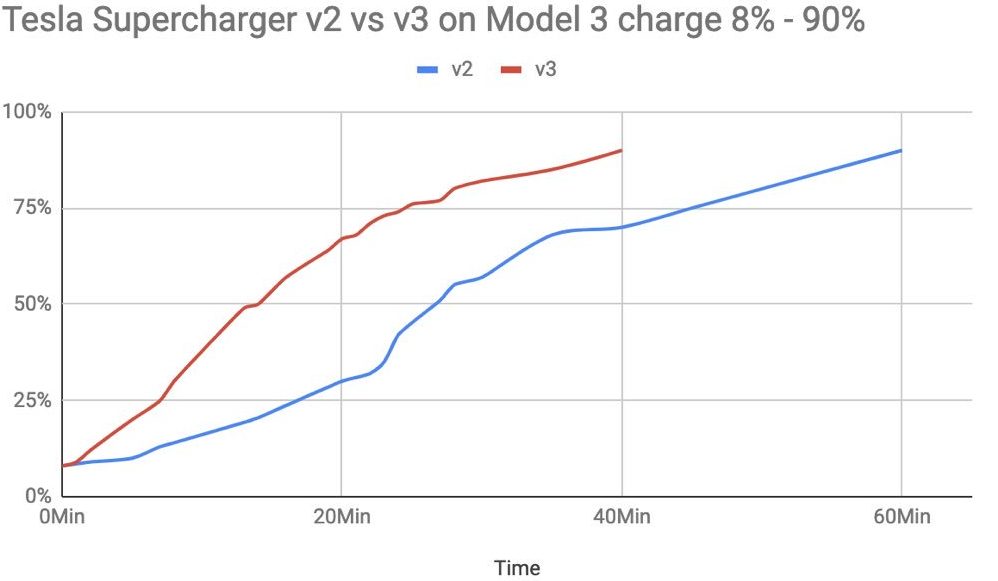
The Tesla Supercharger v3 DOES achieve this. Can do >210 miles of charging in 20 minutes. 67% state of charge on a Model 3 LR in just 20 minutes, which works out to 210 miles of range on the EPA standard, and about 400km of range on the European standard. The Tesla Supercharger v3 DOES achieve this. Can do >210 miles of charging in 20 minutes. 67% state of charge on a Model 3 LR in just 20 minutes, which works out to 210 miles of range on the EPA standard, and about 400km of range on the European standard. https://electrek.co/2019/03/07/tesla-v3-supercharger-action-...
I think you've got a formatting issue doubling up your comment.
That graph shows it charging from ~10% to ~65% in 20 minutes - assuming that is a long range model, that works out to (523km*0.55=) 290km range in 20 minutes.
I know Supercharger v3 is great, and i'd be satisfied with that speed (as I stated). I was replying to someone who wants sub 20 minutes for (what I assume to be) a full charge.
Other than the cost one, Tesla has achieved this, as I pointed out below.
Reproduced here: The Tesla Supercharger v3 DOES achieve this. Can do >210 miles of charging in 20 minutes. 67% state of charge on a Model 3 LR in just 20 minutes, which works out to 210 miles of range on the EPA standard, and over 430km of range on the European standard. The Tesla Supercharger v3 DOES achieve this. Can do >210 miles of charging in 20 minutes. 67% state of charge on a Model 3 LR in just 20 minutes, which works out to 210 miles of range on the EPA standard, which works out to about 400km of range in 20 minutes charging on the European standard. https://electrek.co/2019/03/07/tesla-v3-supercharger-action-...