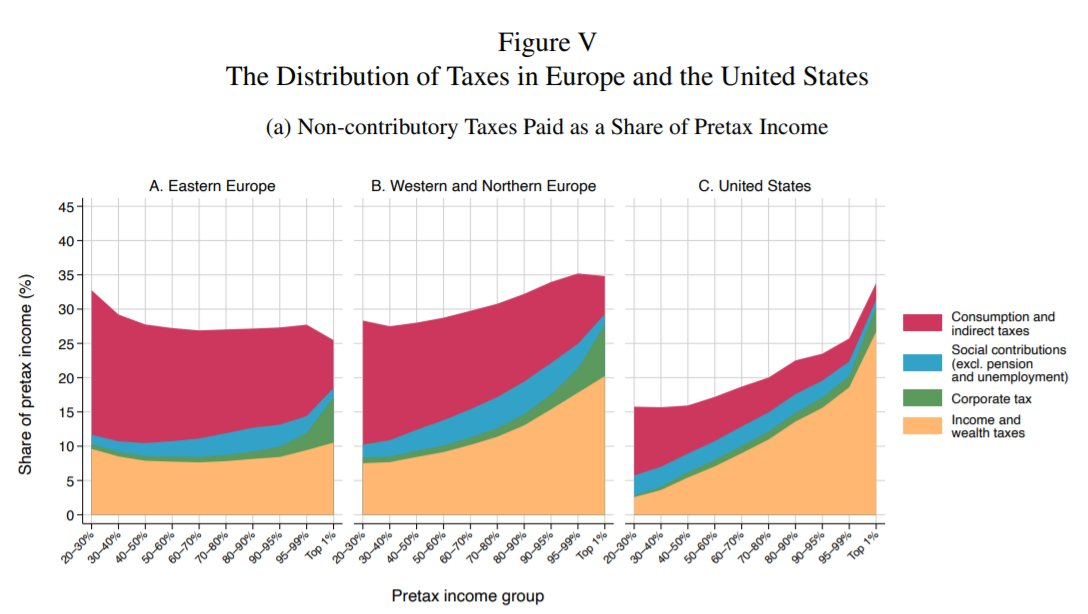
When you look at Europe, they raise most of their taxes from the lower to middle classes, i.e. people like me. Through both higher income taxes and then a 20% VAT on most purchases you make with your post-tax earnings.
Here is an interesting paper (pdf warning) which on page 49 shows a very good visual of just how progressive the US tax system is compared to both Eastern and Western Europe. In Europe, the tax burden is much more evenly distributed across incomes.
After spending a number of months on Lemmy as my primary social media, I actually think the fediverse makes one of the biggest issues of social media much worse.
There's a very real and dangerous trend towards extremist positions as a result of social media bubbles. I'm sure most people have noticed how large family gatherings have shifted over the last 15 years, and how some family may no longer even be invited as a result of social media driven shifts.
The fediverse makes these bubbles so much worse, with servers of like minded moderation creating a trend towards groupthink as opposed to representing a variety of opinions.
So while it's promising from a standpoint of shrugging off corporate driven issues in managing social media, the fragmentary nature is perhaps the opposite of what social media actually needs, which is less bubble driven optimization with regression towards extremist means and more broad exposure and interaction with regression towards the normal mean.
https://nakashimawoodworkers.com (new commissions around $7K-$15K for a coffee table, $20K-40K for dining table, plus shipping; older Nakashima pieces are highly valued in the art world and sell anywhere between $15K-$300K)
Edit: Also, to echo what someone mentioned below, if you're interested in solid wood furniture you should find a local woodworker.
Another edit and thought: I used to own a lot of IKEA furniture and as I've gotten older, have slowly replaced those pieces with items from Knoll, with custom pieces from local woodworkers, with a few pieces from the studios listed above. A lot of people are commenting on the cost, and yes they're expensive and could be considered luxury goods.
But if you like art and design and you care about quality, you save for what you want to buy. I wanted to be surrounded by great craftsmanship, so instead of buying "stuff" and instead of spending money on lots of subscriptions and services, or constantly upgrading phones and computers, I buy one piece of nice furniture every year. I believe the more you appreciate the things around you, the more they begin to influence your own work, and your sense of place.
I regularly see a lot of IKEA furniture on the side of the road and in dumpsters. I think this is the difference between buying "things" and having "possessions" but that's a discussion for another day.
2008 was a huge outlier though. This was the start of the hugely lucrative cloud, app-payment, SAS, smartphone, 4g, app-store, social networking, mobile confluence. Also, low interest rates forever. A typical bad economy is not like 2008. But sound advice
Are there any examples of really a great PWA on mobile? I always find the experience of company's mobile site far worse than its app (such as YouTube or Spotify), and I'm never sure if it's just lack of effort and attention, intentional to push users to the app, or just the ever so slight annoyances like slight tap delay on Safari iOS.
> Private companies should not be the de facto moderators of free speech in our society. They are forced into that position by woefully inadequate governance by legal authorities operating multiple decades behind the current landscape.
That's not what happened here. They made an appropriate decision.
It's not a difficult to say, "while we have no policies that restrict lawful content, we reserve the right to not service those who host and promulgate content that explicitly creates emergency threats to human life."
People and their companies aren't computers who have to allow everything to meet some absurd MVP product definition of false fairness.
  - Stripe-like header.
  - 3 key benefits side by side.
  - Unsubstantiated sponsors and awards list.
  - Information density: 20 words per viewport height.
  - Weirdly shaped human pudding figures.
  - Wavy curve backgrounds because we can.
  - Card-based design philosophy, formerly known as "boxes".
Argh! The linked NPR article on that tweet had me yelling at my phone:
> It is unusual for tech executives to face criminal changes when their startups collapse under the weight of unrealized promises.
That's because it's not illegal to over promise about your future results. It is illegal to lie about simple facts regarding the present state of your business to attract funding.
I'm so sick of so many press outlets framing this as just "fake it til you make it" gone wrong, "a page from the Silicon Valley playbook", or that it's just an over hyped company take to extremes.
No, Theranos was outright, egregious fraud, and most startups that "collapse under the weight of unrealized promises" are not committing fraud.
Art imitates life. Squid Game is very deep. The reason is that it doesn't allow for the initial knee-jerk reaction that the poor are virtious and are simply crushed beneath the wheel of the powerful and the rich.
The main character is a gambler that lives off of the back of his mother. This can be blamed both of his own shortcomings and that of society. At the end of the show it is proven yet again that he is a gambler in heart when he chooses to play the last game with the mastermind of the game instead of going out and helping the freezing homeless person. On top of that, he hoards the money and sits on it for a year instead of helping the victims' families. This can hardly be blamed on society or on the rich.
Dog eat dog world assumption really doesn't work in Squid Game. Here's why. Being a woman and old is disadvantegous. Yet the team chooses two women and old man for the tug of war competition. If this is not downright irrationality I don't know what is. Yet the little compassion that they muster during life and death situation ends up being their ticket towards survival. This imitates real life where even the morally worst will do something to save someone just to prove to themselves that they are not that far gone.
In the following game the main character again chooses the old man who most likely would've been left off to die. Yet again this small compassion brings him a victory as the old man simply gives him the marbles because they are friends and friends share everything.
So yeah squid game imitates life but that's not really pessimistic because it contains both the beautiful and horrible aspects of human nature.
The research I've seen (e.g. [0] [1]) consistently shows a modest decrease in rent prices for existing renters when new housing is built. Are there studies showing the opposite that I'm not aware of? I understand that there are two competing effects at play (which [0] calls an amenity effect vs. a supply effect) but my impression is that empirically the latter seems to reliably outweigh the former.
> "I think climate change is no more than 20 to 25% responsible for our current fire problems in the state, and most of it is due to the way our forests are,”
It's refreshing to hear that. Human driven climate change is real and I'm not denying it, but we have to understand CA's climate for what it is.
CA plants are uniquely adapted to fire and they serve as a testament to the history of fires in CA. Las Pilitas Nursery, which specializes in CA natives, has a nice writeup here: https://www.laspilitas.com/advanced/advecology.htm
I find it especially interesting how the droughts typically preceding a fire suppress herbivore levels so that post-fire seedlings are protected from predators. It's really amazing how our ecosystem has adapted to the challenges of our historical climate.
When my first daughter was born in 2018, I had a respiratory infection. It lasted three months before I went in to the doctor. I hesitated to seek medical advice because it was clearly viral. But the cough was so bad it was causing the newborn to wake up.
The doctor (at a walk-in clinic) told me viral respiratory infections can last months and there's nothing you can do. Just wait. HE gave me some pills to stop the cough since it was interfering with my life.
That was it. It was about one year later that the cough finally dissipated. It got better after about 5 months, but it took many more months for all symptoms to go away.
I guess my question is... why did my doctor tell me that viral respiratory diseases can last for many months in early 2019, when according to what I gather here, doctors are surprised that COVID may do the same?
Along with this, vertical scaling is severely underrated. You can do a lot and possibly everything ever for your company with vertical scaling. It would apply to 99% of the companies or even more.
Edit:
Since people are confused, here is how StackOverflow handles of all of its web operations. If SO can run with this, so can your 0.33 req/minute app which is mostly doomed for failure. I am only half joking.
Everytime you go to SO, it hits one of these 9 web servers and all data on SO sits on those 2 massive SQL servers. That's pretty amazing.
I want to be clear though, Horizontal scaling has a place in companies that has a team of corporate lawyers. Big. And in many many other scenarios for ETL and backend microservices.
USA per capita CO2 emissions are large, but at least they have been coming down moderately fast. From 2007 to 2017, USA reduced emissions by 20%, whereas if we take Germany as an example of a country with strong "green" element in politics, Germany reduced by 8%.
Apply linear extrapolation, and USA would go below Germany in 20 years. Extrapolating with exponential decay, in 40 years.
>4 more years of inaction from the government of one of the biggest polluters in the world will really bite us in the ass.
But that's not the case. America is reducing its emissions greatly by shifting from coal to natural gas (which mirrors what Germany is doing, for example). Coal is ostensibly dead in US. If you look at the charts from Wikipedia [1][2], you'll see the US has cut emissions at about the same rate (or faster) than Europe. That trend will continue. So what will Paris actually do in practical terms?
The problem is that after transitioning away from coal, there isn't a clear answer about the next step. Renewables are not a panacea and may never be able to power a modern economy as they will probably always require fossil fuel baseload ... not to mention that because renewables are a diffuse energy source, they require HUGE land areas which makes no different for CO2 emissions, but makes a huge difference for environmental collapse.
This might work for outliers/higher IQ/elite people in the HN community, but consider this:
1. School is probably the best public invention to systematically distribute knowledge to the masses. Some like to point out "dropouts", "self-taught" geniuses or the "lucky few" as models instead of exceptions to the rule.
2. Not everyone is self-motivated to learn. Children, at critical developmental ages, are more prone to be led astray than "follow their passions" (at this age, really?). They will more likely be manipulated by vices if not constantly monitored. Note: Even adults struggle to find their "passion", good for the lucky few.
3. Not all parents are good teachers. Usually, responsible families understand the value proposition- they wish their children have a better future- and education is the most assured/common ticket that provides these opportunities.
4. School's purpose is not to teach obedience or even getting a job. It is there to teach us critical thinking, and consequently, how to be a good citizen. An educated population is also less prone to fall into totalitarianism. Ex: Nazi Germany and Mao's China burned books and persecuted the educated (1984 style).
Public schools, with all its flaws, are the best instruments to free the masses.
Knowledge is democratized power to avoid the corruption that absolute power entails.
I think that free world should ban every company that comply with china censorship, here we are not talking about something like explicit content, or violence censorship which belong to cultural differences, here we are talking about not being put in jail because you say publicly that tibet should be free. or because you try to report abuse and suppression of the ruling class
this type of free speech should be guaranteed to anyone and reinforced with the non-violent marginalization of those who struggle to take away fundamental human rights, the ban of a society under the control of this regime is the least I expect from a state that wants to enact these rights.
talk about what you want (here you can do it) talk about rights in the west etc ... (here you can do it) there (in china) you are just on another level, compare them if you want .. here you can do it .. but try to go there ..
In 2015 their columnists were arguing for arming ISIS as a ‘homegrown Sunni resistance’ and the “last Sunni bulwark” against Iran[0]. That’s in the print edition too.
It’s not like their ethos were suddenly made worse in 2018 with Sulzberger.
As a bonus, that same columnist argued for arming a Kurdish-Shiite anti-Sunni militia in 2005 and fawning over a civil war.
Evidence? CDC has more funding than ever. And it's a myth trump got rid of the pandemic team at NSC. They just renamed it the bioterrorism team after people left.
Gun violence research is a good example of how science can be skewed to make different political points. For example, one of the new tactics gun control advocates have adopted is lumping homicides and suicides together into “gun deaths” even though the policy implications of the two things are quite different. (Suicides accounting for the large majority of “gun deaths,” but bans on semi-automatic rifles and high capacity magazines will have little effect on suicides. Likely red flag laws as well. Those are the three most viable gun control laws on the table right now.)
Measuring homicides versus “gun deaths” also changes whether there is an observed correlation between gun ownership rates and “gun death”/homicide rates: https://medium.com/handwaving-freakoutery/everybodys-lying-a... (there is no correlation for homicides; there is a moderate correlation for suicides). So, for example, whether you research homicides or “gun deaths”/“gun violence” is already a politically significant choice that will alter the results.
So yes, more research and more data is always good. But this data will get twisted and abused for political grandstanding. People need to be prepared to cut through that.
I’d also point out that, at the end of the day, gun rights derive from the Constitution. Gun control is therefore not merely a policy choice to be made based on facts and data. In fact, there are lots of areas where we are quite reasonably sensitive to research efforts being misused for political ends.
The problem with US health care is that it costs too much.
The elephant in the room in US health care costs is inefficiency on the provider side. Payer-side reforms have limited impact, because contrary to rhetoric from both sides of the debate, we could probably zero out administrative costs entirely and still deliver little more than a grocery store discount to American consumers.
However we structure payment, we're still going to have overprescription of outpatient procedures, a shortage of doctors who as a result make drastically more than their counterparts in Europe, bed vacancies in inefficiently provisioned hospitals, diagnostic procedures that vary wildly between providers just a few miles from each other, and a total lack of price transparency to enable consumers (and their doctors) to collaborate and make decisions about care.
There's not much evidence that our government-run health programs (Medicare in particular) is up to the task of solving these problems; Medicare has a central role in how the current health care system is organized, and some of these problems stem directly from decisions made by Medicare.
Ruminant grass-fed meat is the best thing for the environment. It requires no pesticides, no herbicides, and the manure their bodies produce act as fertilizer and cause grasslands to expand and sequester carbon. Meanwhile, wildlife can actually live on a pasture. Rabbits, squirrels, birds, tons of insects, snakes, even coyotes. Wheat, corn and soy fields by contrast require artificial fertilization, insecticide application, rodent poison to protect crops, and harvesters also kill small mammals.
I’m a supporter of universal healthcare. But the fact that Germany or Denmark can do it doesn’t mean we can. Copenhagen is building a fully automated circle line subway beneath downtown for the same money it’s costing us to build a shorter light rail line through the DC suburbs. Moving a bit further afield, our schools are terrible despite our per-student spending being near the top of the OECD. We already spend as much public money on healthcare as most Western European countries do, without achieving universal coverage. Our non-military government spending per capita is slightly higher than Canada’s, and we get fewer services for it. Americans are uniquely bad at government compared to western countries.
Look at it from the other side. If European governments were as inefficient at providing public services as Americans are, would Europeans support mass transit and universal healthcare? If it was going to cost $6 billion to build a light rail line through the suburbs, mightn’t the Danes say: “fuck it we’ll build a freeway?”
Concrete example on the healthcare front. In Europe, universal healthcare is typically paid for with social insurance taxes primarily imposed on people making under $70,000. If you look at the proposals for Medicare for All that have been proposed by Democrats, you see two remarkable things:
1) Nobody proposes taxes to actually fund the expected cost;
2) Nobody proposed the level of middle class taxes (VAT and social insurance) typically imposed in European countries to find universal healthcare. Sanders’ proposal comes the closest, but is half the level of say France’s.
There is an important political observation here: there is little support for European-style healthcare in the US. What would happen if we had a straight up/down vote on Germany’s healthcare system? Or France’s? Or the UK’s? The support that exists in the US is for universal healthcare that is paid for by billionaires and corporations rather than the middle class. That’s a system that exists nowhere in Western Europe. It’s completely unprecedented.




Here's how to use the skill on the latest version:
/code-review # do a balanced code review. checks for bugs and inconsistencies, poor code quality, duplication, band aids, etc.
/code-review --fix # same as above, but also fix the issues
# choose an explicit effort level (defaults to your current effort level). all of these also accept --fix:
/code-review low
/code-review medium
/code-review high
/code-review xhigh
/code-review max
# do an expensive and extremely thorough review (reliably catches >99% of bugs, costs $3-20 per review depending on complexity):
/code-review ultra
Open to feedback if anyone has feedback or ideas for how to make these even nicer to use.