For anything outside your LAN, 2 nodes must need a negotiator(over internet) to know each other unless the nodes already have public dedicated IPs in which case they can talk to each other securely without the need of a negotiator.
The number of residency slots (a legal requirement to be a doctor) is limited because it's funded by Medicare and only Congress can increase it. AMA (American Medical Association) has lobbied to keep it that way.
not really, but private funding is generally pretty controversial with weird incentives (e.g. a company may only fund for positions that will create demand for their products--like a skincare company only funding dermatologists) [1]
don't think many other entities besides the federal government have a ton of incentive to fund residency. and the federal government does have caps on residency slots
they contribute already, but it's more challenging than federal. many residents do not stick around in the state they train in, so states have less incentive to fund this
Staffing companies are extremely profitable and mostly operate on the edge of the law, exploiting visa workers for maximum profit. Any attempt by USCIS to regulate staffing agencies use of H1B has been fought tooth and nail by armies of lawyers.
With the fall of Chevron, I don't think there is a way out of this without legislative changes.
The other side of the coin is the extremely arbitrary and capricious nature of the US employment based visa and immigration system. This naturally leads to middlemen who can navigate the system exploit it.
> Staffing companies are extremely profitable and mostly operate on the edge of the law, exploiting visa workers for maximum profit. Any attempt by USCIS to regulate staffing agencies use of H1B has been fought tooth and nail by armies of lawyers.
That seems weird. Why would they be extremely profitable? Are there big barriers to entry?
Without barriers to entry, you would expect the profits of staffing companies to be competed away. (Just to be clear: you wouldn't expect workers to be less exploited. That's a feature of the visa system and their relative lack of other opportunities, not a function of the staffing companies.)
If there are so profitable, why isn't everyone and their mom starting staffing companies?
We would still have to explain, why all those greedy private equity companies and billionaires and VCs etc aren't starting staffing companies left and right, if they are so profitable?
Physics can tell you how frictionless, spherical cows behave in a vacuum. When you see real cows behave differently, you can investigate which of your violations are violated (and by how much, and which assumptions are still ok to make; eg air resistance is seldom a factor in the movement of real cows). The spherical cows are still a good starting point.
Economics can be similar. First, I doubt that staffing companies are actually all that profitable across the board. Yes, the difference between what they charge and what they pay out might be big, but they have plenty of overheads. Do we have any sources for their supposed extreme profitability?
Second, I suspect that any remaining excess profitability can probably be explained by barriers to entry.
Though some quick googling really makes me lean very much towards the first: staffing companies are by and large not more profitable than companies in other sectors.
The simplest solution is to automatically give an H1-B a green card in 12 months--24 at the longest. Force the sponsoring company to pay for and complete all of the required background and security checks. Make failure to complete or shitty completion of those checks criminal liability directly on the CEO.
This would immediately deprive these kinds of staffing companies of the economic incentive as they would have to pay for the legal costs of an H1-B every 12 months. This would remove the depressive impact that H1-Bs have on salaries as they would be free to compete in the market at large after 12 months.
And the H1-B pipeline would be free to bring in people that we actually want.
This requires Congress to pass legislation, so cannot be done tomorrow. Legal immigration isn't a high priority in general and Congress hasn't moved on immigration in decades.
However, I was under the impression that almost all of this is directly under the purview of the Executive Branch (with the possible exception of the criminality).
Apparently one of the bottlenecks is the total number of visas per country. Demonstrating that you're unblocking the H1-B to Green Card pipeline by fast-tracking those from countries that don't have a big backlog should send the body shops running for the hills and unblock the ones with a big backlog as well. Or shutting down any new H1-Bs from countries until their backlog is gone would also accomplish the same thing.
The problem is that US companies like the multi-year indentured servitude of the H1-B program as it depresses salaries.
The executive branch cannot make laws. The H1B program and green card numerical limits came to be from Congress passing laws and can only be changed by them passing new laws.
And go with the naked truth of what it is, patronage. Let each Senator/Representative be responsible for giving out a certain number of visas each year and let them auction it off to the highest bidder.
The auction is an excellent idea, but you don't need to tie it to representatives. Just make the proceeds go to general revenue, and tout it as making those pesky foreigners pay and how much it benefits the tax payer.
Huh? How could passing multiple new laws (anti-business laws at that), including fundamental changes to legal residency (especially in the current political environment) be done quickly (tomorrow according to you)?
What he meant is that it could be done quickly if there were political will for it. Obviously, there's no political will for this, so it won't be done.
But this is an example of the most ridiculous ideas floated on HN. Even if every politician agreed there was a problem with the H1-B system, the proposed solution is far from agreeable to everyone. Adding criminal liability? Increasing labor costs ("remove the depressive impacts on salaries")? Making it easier to obtain permanent residency?
One of the reasons HN gets mocked is how dismissive many commenters are about the real-world complexities of various domains. Someone thinking that some wacky proposal he just made up 5 minutes ago is the ultimate solution to longstanding labor constraints and that everyone would automatically agree to it within 24 hours, makes it a joke rather than a basic idea that might have some merit if explored further.
I think the parent's point is to move to a free market/merits based system rather than whatever insane lottery system they have. Almost every other country has some type of points/skill/wages type system.
And my point is, whatever he was trying to say doesn't matter. When you assume the problem is so simple that it could all be fixed tomorrow, you expose yourself as someone who actually doesn't understand the problem.
>Even if every politician agreed there was a problem with the H1-B system, the proposed solution is far from agreeable to everyone. Adding criminal liability? Increasing labor costs ("remove the depressive impacts on salaries")? Making it easier to obtain permanent residency?
What's wrong with these ideas?
1. Criminal liability - this sounds a bit harsh, but some people are concerned about making sure "bad people" don't get in, so making the completion of proper background checks a hard requirement seems reasonable to allay their concerns. But then they might be concerned the background checks are bogus, so adding criminal liability helps with these concerns too. But granted, this is probably the most extreme part of that post.
2. Increasing labor costs - why is this bad for anyone except employers trying to use H1B as a way of keeping costs down? It's claimed to be a system for letting employers get skilled help where there's a labor shortage, so it's supposed to cost them more.
3. Easier to obtain PR: what the heck is wrong with this? If these immigrants are highly skilled, aren't causing any problems, and want to stay, why would you want to make it difficult for them to stay in your country and help your economy?
I'm not here arguing for or against any proposal, or claiming any moral approval or disapproval. I'm just stating that they would face serious resistance and therefore would be extremely difficult to pass, directly contradicting the OP's implication that they are simple and easy.
1. and 2. are anti-business. Just like raising the minimum wage, passing anti-business legislation is very, very difficult. 3. well, if there aren't any negatives, why is there currently a limit on the number of visas?
>1. and 2. are anti-business. Just like raising the minimum wage, passing anti-business legislation is very, very difficult.
Sure, I'll agree to that.
>3. well, if there aren't any negatives, why is there currently a limit on the number of visas?
That's a good question, and I have no idea what the answer is. If anti-business legislation (like #1 and #2 here) is so hard to pass, then it seemingly shouldn't be that hard to pass pro-business legislation. Increasing the number of visas (or eliminating the limit) should, logically, be a pro-business position (lots more workers), while also being of interest to the left-leaning people who generally claim to be pro-immigration. So WTF is the problem? I don't know. The only people who should be opposed to such a move are 1) the outright anti-any-kind-of-immigration racists on the right (who aren't even a sizeable number, a large portion (most?) of the anti-immigration people are usually against illegal and/or low-skilled immigration), and 2) any firms that are profiting off the shortage of visas.
>directly contradicting the OP's implication that they are simple and easy.
I don't think the OP was under any illusion that passing such legislation would be simple and easy, due to the hyper-partisan nature of the current government. If the government weren't this way, passing reforms would be easy.
In Go it’s not uncommon to use code generation to recreate boilerplate code, especially before the introduction of generics. No human looks at this usually. And if they do, they find the code they’re looking for contained in a few files. I personally found this pattern pretty good and easy to reason about.
Well, someone (a human being) still maintains it, and ultimately someone likely will find the code unmaintainable even if LLMs help. If you use ChatGPT enough you would know it has its standards as well, actually pretty high. At one point the code likely still needs to be refactored, by human or not.
It’s really not a problem at a certain point. Also, we’ll probably have “remove and replace” but for software in the next couple years with this stuff.
I see lots of progress and resources put towards monitor refresh rates but very little progress on making 5K displays cheaper. Any reason why ? Is this due to gaming ?
Mostly because 4K is the standard for video content and game consoles, and on desktops it is fine for Windows users, who make up the majority of the market. The only people really clamoring for >4K monitors are Mac users due to Apples decision to standardize on 220dpi in macOS. That is a potential market, but it's a price-insensitive one, so the current gouging for monitors in that category probably isn't going to stop any time soon.
I don't think so. I'd love to have 8k or more panel at 27-32 inch. The reason is that I can easily see pixels from a metre away and it is annoying. I'd love to have more detail etc. for instance being able to display nice texture underneath my text editor so it is more pleasing and easier to read.
The cables and ports for 5k120hz barely exist at this point (it needs displayport 2.1 uhbr13.5 or better, which only exist AMD's 7000 series GPUs at this point). Dual cable solutions always suck so everyone tends to avoid them.
32" is large enough that you can get away with 100% scaling and have much more actual workspace instead of increased clarity. It's not really until you get to the 15" or 17" laptops 4k starts being about high DPI and in that space the MacBook Pro screens actually overshoot the target a bit.
Because most people pick monitors by size, not resolution and PPI.
4K is also popular because it fit within the capabilities of common HDMI and DisplayPort ports on people’s computers and cables.
If you try to sell a monitor that doesn’t work well out of the box with the average laptop, it’s going to have an extremely high return rate. That’s why display resolution will always lag behind the common capabilities of your average HDMI port on a cheap laptop.
I had one, Dell's UP2414Q. It was a piece of shit, mostly due to requiring multi-stream transport to run in 60 hz mode. So you'd get a GPU driver or OS update and the screen would stop working. Sometimes the panel would split in half and one of them would black out or shift its content sideways so there was a seam in the middle and a piece of the edge wrapped around to the center. Would not recommend.
The ones afterward that got rid of the MST requirement might've been better. Pixel density was great.
The gaming market is huge. And gamers are typically willing to spend top money on hardware (thanks to nVidia raising the bar every time). That's why the market is flooded with expensive 1440p models featuring ridiculous refresh rates and RGB lightning.
This is the same reason why you can get a 65" 8K OLED TV from Samsung for "just" €2500, but you still pay €4000 for a Dell 32" 8k monitor. The market for 8k TVs is just so much bigger than 8k computer monitors.
> This is the same reason why you can get a 65" 8K OLED TV from Samsung for "just" €2500, but you still pay €4000 for a Dell 32" 8k monitor. The market for 8k TVs is just so much bigger than 8k computer monitors.
I was with you until this point. I’m fairly certain that this is due to shrinking pixels to cram 8K in 32” is much harder than doing it at 65”. That’s why it’s cheaper. Recently, many super high resolution TVs debuted at CES (or whatever has replaced CES) start at larger sizes and it’s an accomplishment when they start to come /down/ in size.
> This is the same reason why you can get a 65" 8K OLED TV from Samsung for "just" €2500, but you still pay €4000 for a Dell 32" 8k monitor. The market for 8k TVs is just so much bigger than 8k computer monitors.
Speaking of which... the market has this really obnoxious hole in it.
There are 32" 8k monitors and 65" 8k TVs (I think there are a few older 55" models), but there's nothing really in between.
I really hope someone either makes smaller 8k TVs or larger 8k monitors, because the situation is a little absurd. From what I can tell, 8k monitors are one of the few areas where people could be expected to notice the difference in resolution from 4k at normal viewing distances.
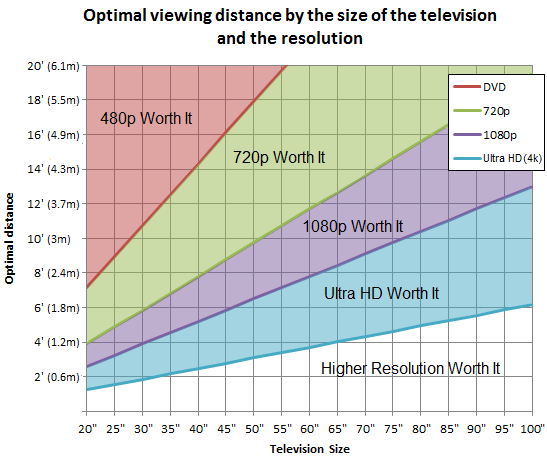
I was going off of this chart[1]. It's true that some people sit relatively close to their TV, but in most of the living rooms that I've been in, the TV has been more than 6 feet away.
This is purely subjective. I could definitely tell the difference from more than 6ft. The picture looks just more life like.
There are people for whom it makes no difference or they don't pay attention to details. Like I have a friend who wouldn't tell 720p from 4k, unless you tell them what to look for and still they wouldn't understand what's the fuss about.
I've also heard some handwavey explanation about how certain parts of the panel manufacturing process is essentially separated by DPI. That you can reuse certain aspects of a ≈ 100 DPI manufacturing line across varying refresh rates (and physical sizes).
Then those line can probably serve a large part of the gaming / normie market, while the ≈ 220 DPI (e.g 5K @ 27") have a very small market.
Yes. The two mass markets for good screens are business and gaming. Business pushes for color accuracy and good stands at reasonable prices, gaming for high refresh rates.
Of course gamers also like 4k, but given a limited budget for monitor and GPU a high refresh rate has the better payoff
> inadvertent misconfiguration during provisioning of UniSuper’s Private Cloud services ultimately resulted in the deletion of UniSuper’s Private Cloud subscription
The real question here is who pushed the misconfiguration that led to account deletion ? If was Google, it looks really, really bad on them especially considering they also seemed to have deleted their backups.