If you are in a role where you could be involved in the decision making of the product(s) you work on, getting involved in that [initially informally] is definitely the best way.
Be knowledgeable about metrics/kpis (and help create them if they don't exist), help your teammates grow through coaching, and work your way to be involved in those product discussions.
If you're not in such a position, try looking for a new job. So many companies need product managers and if you come clear on your ambitions, it seems to be easy to get past that initial wall.
The only reason busses are the size they are is the labor cost of the driver only makes sense with many, many passengers. When that is eliminated, the equation changes.
Even if these weren't point-to-point, smaller vehicles can a) serve more routes that would otherwise be below breakeven for minimum passengers served by a bus, b) be more comfortable for passengers to enter/exit, and c) take up less room on streets. Buses barely fit on streets, they only make sense on very dense thoroughfares as an alternative to rail.
I appreciate that argument and in some/many situations it is likely true, but in others it is not.
What matters isn't people per square foot, it's throughput. And the larger the vehicle, the more likely:
a) people are to want to stop at each stop,
b) multiple people are to get on and off at each stop,
c) the less likely it is to be full, and
d) the more awkward and slow it is in maneuvering on streets.
A/B/D all delay every other passenger, and make 3 mile trips take half an hour through a city.
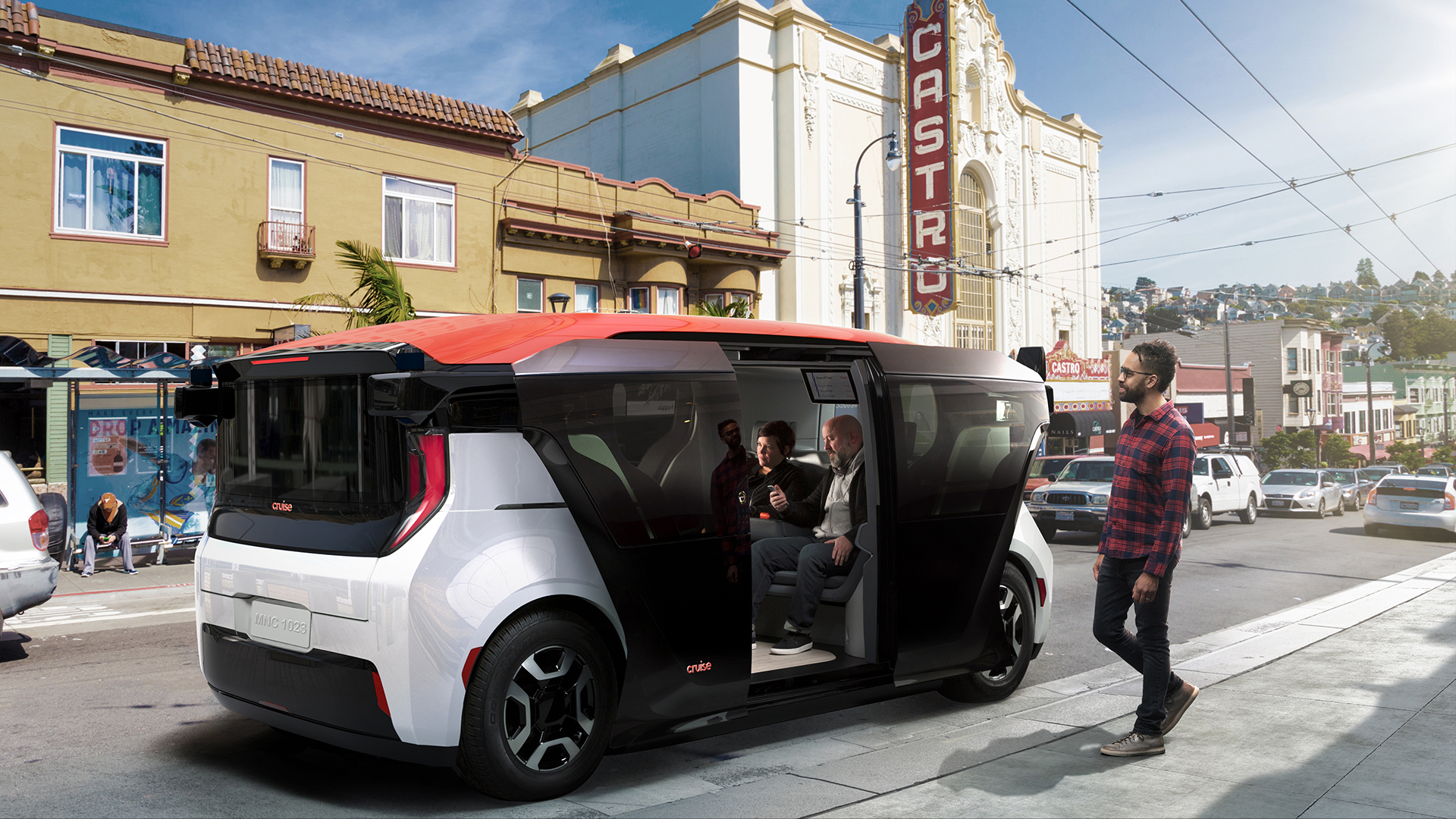
Cruise Origin isn't the only autonomous bus. The great thing about autonomy is that it allows us more degrees of freedom to optimize transportation needs including offering a variety of shapes and sizes and densities, while removing the labor cost and the physical space cost of a driver.
You can just as easily design an autonomous bus to have density to match a larger bus while retaining the footprint of smaller vehicles, which improves all of the above issues with larger busses.
Bus dwell time plays a nonzero role in bus performance, but many multilane urban streets are choked with cars during rush hour. It’s often the case that congestion accounts for the lions share of bus transit time, yet there are typically more people on the bus than in all the cars on a given block. Creating a dedicated bus lane can dramatically improve bus performance, and has a follow-on effect that since congestion has been mitigated, the same set of buses (a fixed capital cost) can, in the same timeframe (fixed operating cost), make more circuit trips. So not only does a single trip get much faster, a bus lane magically produces more capacity.
The Origin looks van sized, which is perfect. It doesn't take up significantly more space than a car while moving or stationary but can carry more people (and more importantly for congestion, likely will much of the time). Averaging three people per car/van sized vehicle would likely solve the vast majority of current congestion needs, as it would likely halve the vehicles on the road.
Remember Supershuttle? They had vans. "Never more than 3 stops". Remember the long, long indirect routes of Supershuttle? Remember what happened to Supershuttle?
Lack of network effect, perhaps compounded by inadequate routing (I have no idea if they were as good as possible or much worse than necessary).
Network effect must be huge for a system like that. Imagine a large fraction of the cars on the road was shared in the way of supershuttle, you'd already have in that pool a near-perfect itinerary to tie into for almost any trip. And the remainder could easily be fulfilled by assigning a new trip. If you just have a few cars and price for shared occupancy tours will inevitably be much worse. But once you have a critical mass network, route inefficiency will be just a load factor price/performance tradeoff like in a hash-map.
On the other hand, Lyft Line and Uber Pool seem quite efficient.
Supershuttle was concentrated pickup but distributed dropoff, whereas with network effects leading to more vehicles & considerably more efficient routing, you can even that equation out a bit more.
I was thinking along the lines of alternating between a distributed pickup and concentrated drop off and concentrated pickup and distributed drop off. That is, you use these for last mile travel at either end of a commute artery.
Given there are many different bus/rail stops along a route (and many routes for buses), there's a relatively small geographic area to pick up in and drop of to when the other side of the trip is bus/rail. So you might have an automated van drive through an area and make a quick 4-6 pickups in a few block area, drive to a bus stop or rail station, drop those people off, and pick up 4-8 people for drop-off in close geographic proximity. Rinse and repeat.
The point doesn't have to be that they solve the last mile by replacing current mass transit, but by supplementing it in a way that allows for people that were far enough away that it was hard to use previously now have an easy and cheap way to do so, because you've expanded the coverage area of mass transit stations.
You are right, a bus trip I used to take regularly in London would take 15mins if you got the first bus at 5am, which was quite busy with shift workers. At 9am it would take 45mins with a similar level of crowding. A good portion of the journey was on bus lanes, but there were certain pinch points that killed the journey time in rush hour.
Throughput is an incredibly important one, but something that seems to get little attention from the tech world at least as far as I can tell. Is there work being done to improve throughput of normal cars at intersections, or at least semi autonomous ones. I am talking about the accordion effect that happens at each intersection/red light that there is. If a whole column of cars could start moving at the same moment, and then spread out with increase in speed it would result in an improved throughput at critical points in the cities.
Is there work in that area? I feel it shouldn't be a massive technical challenge, cars are stationary, lights are visible and in the future could even "talk" to each other to pass along critical information (if the car infront needs to brake for example).
Agree, those are the longer term efficiencies when we have primarily / only autonomous vehicles on the road. At that point we can optimize from the system POV not just from the vehicle POV. But that's a ways off.
But there is no reason why it couldn't be done today, even with non-autonomous vehicles. There are cars on the road that can automatically brake if they discover that you are incapacitated, or that something jumped out infront of you. Having some kind of "assisted red light start" which reduces accordion effect could be an easy way of improving throughput. At first only some cars would have it, and effect would be smaller from a system POV, but with time it would propagate.
The metrics that matters most are throughput and travel time.
Theoretically buses are best for throughput, but there's very few routes out there that can fill up a street with full buses. In most cases to totally alleviate traffic we need to take something like 4 people in 4 cars and put them in 1 van. Taking 100 cars and putting them in 1 bus is overkill.
Travel time is where big buses are going to lose. You have to balance density, transfers, and stops. There's no way to get them all. If you want density your buses have to go on the main thoroughfares. Which means you need to transfer to get to the secondary streets. Often trips will look like secondary route -> primary route -> secondary route which vastly increases travel time. Anywhere I want to go by bus in my city takes 3-4 times longer than driving because of this.
The sweet spot is Uber Pool/Lyft Line. You get there much faster and when you account for all subsidies it's price competitive with the bus.
If transportation departments prioritized buses (ie bandwidth) over cars, buses would make a lot more sense on smaller nonresidential collectors and minor arterials. It takes a lot of cars to make up for one bus.
Labor costs are the only thing? Fuel efficiency and traffic (how many double parked Ubers jamming a single lane road will I see tomorrow? Will it be more or less than half a dozen?) would like a word.
> Labor costs are the only thing? Fuel efficiency and traffic
Is that the case? A quick Googling indicates that buses get 4–6 mpg; let’s go with the pessimistic end of that and assume 4 mpg. Diesel currently costs $3/gal and the average bus travels at 12.7 mph, which means that a bus is spending $9.53/hour on fuel. That’s a lot more than I expected, but how does it compare to bus driver wages?
Another quick Googling indicates that a bus driver makes a little over $15/hour. Double that for fully-loaded costs, and that comes out to $30/hr. That’s treble the cost of the gas, but still in the same ballpark. I’m genuinely surprised that the cost of fuel is so close to the cost of the driver. It may indeed be that fuel efficiency is a factor in bus size.
Yup. Also take into account that many municipalities have buses that run off natural gas, which is both cheaper and not (currently or generally) practical to run in a smaller vehicle.
You're right, not the only thing, but I do think it is by far the primary.
Efficiency-wise a large diesel vis-a-vis traditional car yes the bus wins by a lot, but with smaller multi-person autonomous electric busses I'm not sure if there are any meaningful efficiency gains.
Traffic-wise it may actually be better to have smaller autonomous busses than hulking road giants, because they're not stopping as frequently and they're more nimble. I swear every fifth time I'm around a bus it's stuck idling waiting for a bicyclist or someone to get out of the way, because it's too big to maneuver. Separated bus lanes help, but that isn't a property of the bus as much as urban planning.
I guess it depends on where when and where you ride the bus, but every time I get on a bus in San Francisco its overflowing with people to the point that they have difficulty closing the doors.
That's because you want to ride on the popular bus routes, which isn't a coincidence. If lots of people wanted to ride on the empty bus routes, they wouldn't be empty—they'd be the overflowing ones!
That depends on the municipality- I’ve definitely lived places where a goal of the transit system was “access” even if the buses were nearly empty on some routes. I’m not sure it’s an invalid goal eithier.
Additionally, buses are certain sizes for political reasons. Constituents want a full sized bus driving through their neighborhood as a sign of respect given, passenger occupancy is not a concern in these situations.
I don't quite understand your argument. Should I enjoy sitting near people having violent mental health crises because I might one day have a mental health crisis? It seems to me that the compassionate approach would be to support the availability of mental health care. Being content with sharing public space with people suffering from mental health problems does not seem like a compassionate or helpful approach.
Maybe. But the more well-off people crawl into cocooned experiences, the less they care about public infrastructure. Look, for example, at how suburbs not only often lack public transit themselves, but work to fight regional transit.
They are funding it less and less. And things like the wave of white flight and suburbanization in the 1960s and 1970s make it clear how comfortable well-off white people are doing that.
In any case, I'm not arguing for guilt trips as a means of solving the problem. Instead, I think the right solution is the bedrock of any community: shared experience.
Are you implying this replaces mass transit? I don't understand how that makes any sense. Why didn't cars replace mass transit? Why hasn't Uber killed mass transit?
Cars did replace mass transit in many cities. Many cities had better mass transit decades ago than they do now. And ridesharing companies have had deleterious effects on mass transit. They haven’t killed it, but studies are starting to show there’s been some harm and, at the same time, that ridesharing contributes to worsening congestion.
Because buses are in many ways a worse experience than taking a cab or driving yourself.
Bus downsides:
1. Does not go from where you are to where you need to go. Having to go from and to bus stops increases travel time and reduces convenience. Even worse if you have transfers.
2. Scheduling issues. The bus may not go when you need it to. Late evenings, maybe not at all.
3. Stops lots of places where you don’t need to get off, making travel speed much slower.
4. Personal space problems. Having to sit thighs-touchingly close to strangers is unpleasant, and unless the bus is pretty empty, unavoidable. Even worse if it’s so full you have to stand.
5. Privacy problems. You can’t use the ride time to make a phone call, scratch your balls or do something else without having to share it with everyone around you.
6. Reliability problems. Depending on where you live, busses are often delayed or cancelled.
7. Noise problems. The bus is loud, the other passengers often noisy.
8. Comfort problems. Bus seats are usually a lot less comfy than a car seat, with less leg room, etc.
Busses are cheaper than taxis, and in some ways more convenient than driving, but those advantages do not outweigh the downsides for most people.
A bus doesn't pick you up from where you are and drive the shortest route possible to drop you to exactly where you want to go. I'm really surprised people don't understand this. Every time this topic is discussed on HN the same question gets asked.
And bus routes always somehow manage to offer two simultaneous problems: the bus stops are too far from your location and destination, and the bus stops so frequently that it takes forever to get anywhere.
This is analogous to micro transit - on demand, smaller buses or vans. One crucial difference, the most expensive cost is eliminated - the driver. Larger buses still have a significant place and will become much cheaper when the driver is gone.
Because unlike the private sector, the public transit officials don’t listen to the public. For example, everyone from across the SF Bay Area have been clamoring for BART to get stainless steel seating like what NYC and HK have for years. Why? Because it’s more hygienic and it’s less smelly over time. However BART just keeps using either some fabric or plastic based seating.
There are also only so many bus stops and it’s not on demand.
True fact: Not everyone who needs a bus is able to get to a bus stop, which is why cities have door-to-door paratransit services. Does it make you feel better if this replaces that instead of replacing buses?
Because buses are miserable and waste time. In my city I stopped using the bus after it took 50 minutes to get home from somewhere 15 to 20 minutes away.
The experience is bad because we don’t invest in them. Most cities have heavily prioritized single-rude vehicles and act like the resulting congestion is a natural part of life. If instead we had priority signals, lanes, etc. the experience would be far more pleasant. Unfortunately in most cities, however, that’s deemed a lower priority than more subsidized street parking.
If you want better public transit, advocate for transit agencies to buy these. I agree that the problem with busses is that they're slow and unpleasant to ride. Your solution is to speed them up by avoiding congestion. That would certainly help.
Even if we eliminated congestion though, with 30 people on a bus, average riders wait for 30 people to get on and 30 people to get off on their ride. The average person also has 30 people walk past them and possibly bump into them. Also, any time you get 30 random people together, probably one of them will be doing something unpleasant.
The alternative smaller busses. More, smaller busses make you wait less for others getting on and off, and there are less people to disrupt the ride. It means that the bus system can serve more routes, moving people more directly. ince you're not making 30 people make a detour, you can make bus routes dynamic and get closer to a perfect route for every passenger. With more busses, you can run more frequently, so there's less waiting for your bus to arrive. Smaller busses are also more maneuverable, so it's easy to get in and out of traffic. Smaller busses can also serve areas where the ridership doesn't support a big bus driving past every half hour.
The only thing stopping this from happening before was the cost of all of those drivers. If we solve that, public transit has the potential to get way better.
> Even if we eliminated congestion though, with 30 people on a bus, average riders wait for 30 people to get on and 30 people to get off on their ride. The average person also has 30 people walk past them and possibly bump into them
This is too simple a model: not all stops are equally popular and especially it’s leaving out the time needed to stop and start again relative to the time it takes people to board, not to mention the limiting factor in many areas being traffic and signals.
Like I said, reducing the traffic congestion that busses deal with will speed them up.
However, it is completely unavoidable that if there are 30 people on the bus at all times, the average person will have to wait for 30 people to board and 30 people to get off. That could mean 60 stops, or it could mean one stop where everyone gets off and everyone gets on. Obviously the second one is faster, but reducing stops also means people have to walk further, which increases travel time.
Except in extraordinarily dense cities, the iron math of transit is that if you want to have 30 people on a bus, you're going to have to make people do some walking, they're going to have to wait a little while for a bus, and even without any congestion, they're not going to go very fast because of all of the stopping. That makes the door to door time very unfavorable relative to driving, and so except in those extraordinarily dense cities, very few people that can afford a car use transit.
Because there are a bunch of people on the bus, getting on and off has to be hurried and stressful, because you're making 30 people wait. This is particularly annoying if you're traveling with luggage or kids.
The environmental benefits of transit are potentially big, but let's do the math. A city bus gets about 3.3 MPG (https://afdc.energy.gov/data/10310) It's low mostly because the bus is so heavy and has to stop so frequently. If you have 30 people on the bus, it's about 100 passenger miles/gallon. The average car is about 24 MPG. If you have 4 people in it, it's 96 MPG. If you have 1 person in it, it's 24 MPG, so we can see that the big efficiency benefit of putting people together happens with just a few people. Smaller vehicles are also more flexible. The city bus that is running full at rush hour is also running with 2-3 people on it at 10 at night. It might be getting 6 MPG with less stopping, but it's very wasteful to run such a large vehicle almost empty. Smaller pooled vehicles can still run relatively full in off hours, and the extra capacity sits parked not using any energy.
My point overall is that transit just gets much better in basically every dimension if you reduce the number of passengers per vehicle.
The only reason transit agencies aren't doing this now is the cost of the drivers. Even with the cost of the drivers, UberPool is a similar product with non purpose built vehicles that has been fairly successful. If you took out the cost of the driver and reduced the ride price accordingly, it would dominate passenger transportation.
Widening a street to put extra lines isn't a small undertaking. I like taking the bus and chose where I lived based on transit availability but I would much prefer small buses that run more frequently. Bigger buses are only full a small amount of time each day, but then run slower because they have to make more stops, and when they're not full they still take up a lot of room and require a lot of energy to run.
At the risk of stating the obvious, you don't have to add extra lanes to make dedicated bus lanes, you just have to take lanes away from cars. Would not be popular, but if you could guarantee that these things didn't get stuck in traffic, and they ran frequently, I think they'd steal a huge amount of share from cars, and it would lessen the sting for many people.
Walk around a real neighborhood, most of the roads have only two lanes. There are no lanes to take away unless you want to convert every second street into a one-way, and that (by definition) is going to double the distance people have to walk to take a bus because they won't be able to run buses in both directions on the same street. You don't have to sell me on the virtues of public transit, but it's just a fact that large buses are not efficient in many respects because they are carrying only a fraction of their capacity most of the time.
Small buses that run more frequently address this problem.
> that (by definition) is going to double the distance people have to walk to take a bus because they won't be able to run buses in both directions on the same street
No it won't. At most it adds about a block. At best the new route is closer.
In most cities you don’t even need to take a traffic lane: just the subsidized parking. Let people use garages or, better, take the bus and the entire area works better for everyone.
You haven't actually proposed a solution though, because I have very little control over how much is invested in public transit, but I do have near total control over whether I take public transit.
Completely agreed that buses need lots of love, especially in SF.
However, Uber/Lyft exist, and this divide exists as we stand today. I really hope these are cheaper, and help us drive down the cost of transportation.
Secondly, I'm very excited about areas that are subruban-ish where we could get rid of many many cars and use something like this instead.
I expect that you'd be able to pay a premium to get a vehicle to yourself (or use a different service that offers that). Otherwise you're at the mercy of their algorithms. Based on pickup and dropoff locations/times, each vehicle would pick 4-6 people from disparate locations and then work out the optimal route and drop schedule. You'd get a cheaper fare (or monthly subscription) in exchange for tolerating the extra pickups and dropoffs.
Fewer stops than a typical bus, more nimble, and more flexibility with locations/routes. I imagine we'll see apps that offer a further discounted fare if you move closer to a thoroughfare for pickup or accept a dropoff short of your house (e.g., end of the street).
That doesn't seem too unreasonable. The car-summoning services like Uber and Lyft already offer discounts for opting into shared rides where other riders may join you.
This is a completely valid concern, too. I would hope that these fleets would be operated in conjunction with the city – or even be municipally owned – and integrated with the public transit system. I feel that these would be great for last-mile transit, however, or serve areas that don't have the population density for high frequency transit; in my mind, these complement busses, not replace them.
Why should public transit have to pay for itself? The downstream economic benefits of mass transit are enormous. Expecting transit to break even is a recipe for poor service
America is not built for public transit and without huge federal investment in rebuilding communities, that will not change. Simply getting more buses on the road when you're dealing with pretty huge suburbs is going to get very costly -- and remember, public transit fares can't be expensive to pay the costs, they have to remain low. So you're talking about a huge uphill battle with suburb communities who a) don't want "shit" in their backyards and b) don't want to pay for it.
So, this method is easier to roll-out, easier to bring profits from (especially with an ageing population who don't want to live in city centers), and can easily fit into nearly any community in America with ease.
Ideally, you would be right, we would instead be investing in a massive public transit overhaul from trains to buses but as the saying goes, we do not live in a perfect world.
"Simply getting more buses on the road when you're dealing with pretty huge suburbs is going to get very costly..."
The service we're talking about with the Cruise vehicles (and "easier to bring profits from") is getting more buses on the road in huge suburbs, right?
Why couldn't a service like this be purchased/leased by a community/city/state to become part of its public transport mix?
It's not like this will be the only self-driving minivan in the future.
Learning what's new and shiny is great, but try to spend time this year building something, seeing it live in the wild, fixing and debugging it, nurturing it. Build on your critical thinking.
I would suggest the same, building something and let it pass out to the public or contributing to the existing projects that might be using the stack that you want to work with.
You learn a lot when you share your own work to others. Good life lessons or maybe career lessons are often learned when sharing something.
The lack of edibles for the initial launch is a big blocker for casual adoption IMO.
As per the visuals, cannabis use has not grown dramatically since legalization. Oils and raw bud are simply not as accessible as a bar of chocolate.
I imagine that won't cause a significant bump either, but at the least, it opens up the market to the casual user -- which simply has not happened yet in Canada.
Continue reducing my anxiety to improve physical and mental health.
In 2019, I peaked. I did an international move with my family (wife, 3yr old) while working on a major project which was ultimately setting us all up to fail
Since that move, I've begun running 5km 2-3 times a week, and improving how I focus my time. I am a workaholic, but now redirecting that time to work on (or for) myself, rather than for the company I work for (I love my job, but I was spending an inordinate amount of time for it)
Next steps are to continue reducing my caffeine intake. I don't know if it'll help but caffeine can increase anxiety. I'm working on going down from two double-shot espressos and a tea in the evening to one cup a day. I'm much better off here than others but again -- it's about reducing that anxiety!


I guess that's already been done anyways. Anyone care to help me understand why this lives here?