No, you’d remark that your house has appreciated in value over the past 20 years. But you wouldn’t have realized any of that gain until you sold the house - the point being that the realization is the actual taxable event, which is why it matters from the pedantic technical accounting POV. The fact that you turned around and bought another house just means you’re doing something new with your realized gains. Now you have a new cost basis. Maybe that’s what you’re saying with “unrealized gain” though.
It’s funny, I hear the exact same phrasing used when justifying Tesla’s valuation. “It only makes sense if…” … if you ignore what the actual, physical business does today, and picture it doing something entirely different, beyond its current capabilities (robotaxis, androids, etc)
The difference with this pie-in-the-sky ambition (Mars Colony) is that I don’t even understand how it would be profitable if achieved. What do you get from a Mars colony? What on earth (no pun intended) could you extract from it that would command that amount of value? This isn’t like colonization of the americas, where there was a trove of readily available natural resources to extract and sell back to the mainland markets - nothing is going to get shipped back from Mars any time soon. A Mars colony could only be supported through significant public investment - so is the valuation justified via the expectation that SpaceX will be the primary vehicle for public investment in Mars exploration, or through the centuries-long payback period of founding a self-sustaining civilization? Or both?
My belief is that Mars will be colonized for ideological reasons, not for profit. A Mars colony won't be profitable. But it will be colonized, mostly for prestige, and also because of overcrowding & pollution, which will become bigger issues in the coming decades.
But why? We’ve not colonised either of the poles of our own planet in any real way out of a sense of prestige. Heck there’s huge areas in Canada and Russia uninhabited and these are all a dream to live in compared to Mars.
Turns out the real overpopulation is in places people want to live.
Because I don't believe our species should be trapped this planet forever. If we don't become multiplanetary now, then when? And there is an incredibly short window for us to become multiplanetary. We currently live in a golden era of abundance that will not last, and we must make the most of this time period.
I think most people don't realize how inherently unstable our society is, and how quickly civilization can devolve.
Nuclear war is a huge issue. We've had three conflicts this decade that could have led to a nuclear war. All of which are still unresolved.
> Nuclear war is a huge issue. We've had three conflicts this decade that could have led to a nuclear war. All of which are still unresolved.
I'm kicking myself for engaging with this at all, but that's poor reasoning if you're worried about nuclear war. The risk of MAD forces a detente, if there were a (perceived) hedge against it, that increases the likelihood of MAD happening.
If nuclear war happens, Mars colonies depend on expensive, technical supply chains on Earth that will be destroyed.
We take for granted a whole damn planet where water falls from the sky, food and fuel come out of the ground and there's abundant amount of replenishing atmospheric O2 available for ubiquitous reaction and combustion.
Without resupply from a nuked Earth, you're left with the fact that food, manufacturing, construction, etc all depend on, at the very least, atmospheric oxygen, and Mars will never hold a meaningful atmosphere. Without atmospheric oxygen, and thus combustion, when it comes to supply chains required for existing anywhere, you aren't building infrastructure, you aren't growing food without nutrient supplies, and you aren't manufacturing sustainably, efficiently, or at all.
And that ignores that Martian dust and soil is toxic[1] to life, which requires even more resources to mitigate, remove, keep out/off of people and living things, and even more resources to treat and maintain the soil if you ever want to use it to grow food.
Earth is the one shot people have, and a nuked Earth is infinitely more habitable than Mars. Even the bottom of the ocean is more habitable than Mars. It just does not make sense as a backup option to Earth. And if Mars is a pipe dream, life isn't leaving this solar system and surviving independently as anything resembling humans.
I think the prestige, overpopulation, and pollution arguments all suck. The important differences are that the poles are not political free-for-alls that people can just colonize, and everything is still 1g vs. Mars' 0.38g.
The ecological cost of moving the amount of people to even put a tiny dent in the earth's population would kill more and adjust the number that way than the actual moving would.
I did not invest on those grounds. I was looking at the stock a few years back and realized SpaceX was underpriced.
My rationale is, when SpaceX actually launches the first Mars mission, the price will go hyperbolic. It will be the stock pump of the century. I estimated what valuation it would hit (~$5 trillion at the time), then looked at the current valuation, realized this will 50x in the next two decades, and concluded it would make a great investment.
Came here to quote the same sentence, but say the exact opposite - it seems to me that today’s LLMs are progressing far faster on the “thinking” front than the “doing”.
I suppose it depends on your definition of “doing” - if it’s “writing code”, then sure. But there’s a whole world of actual, physical “doing” that AI is nowhere close to matching humans at, and it’s much easier for me to envision a world where AI replaces the management / “thinking” layer of society than the physical labor. Which is scary, because it’s the opposite of his (and I would assume most people’s) ideal.
China is the world’s largest fossil fuel importer, so this is a case where their economic incentives align with global environmental trends. I suspect they would be trying to do this regardless of whether global warming were a problem. And now that they’re heavily invested in green tech manufacturing, it’s kind of a self-fulfilling feedback loop - they have an interest in promoting electrification worldwide.
of course, we shouldn't forget that they manifacture the entire world's shit, and have a larger population than US and EU combined. And despite manufacturing all shit, they still emit less per Capita than US and EU.
If this turns out to be true, which seems increasingly likely day by day, this will be the humanitarian price against which the rest of the campaign will be measured. The US will have ceded much of the moral high ground they claimed in avenging the slaughter of innocent protesters.
I hope you're right, and one day we don't read 20 or 30 years from now the biography of a terrorist, and it starts out with their experience being the sibling of a child injured at one of these schools.
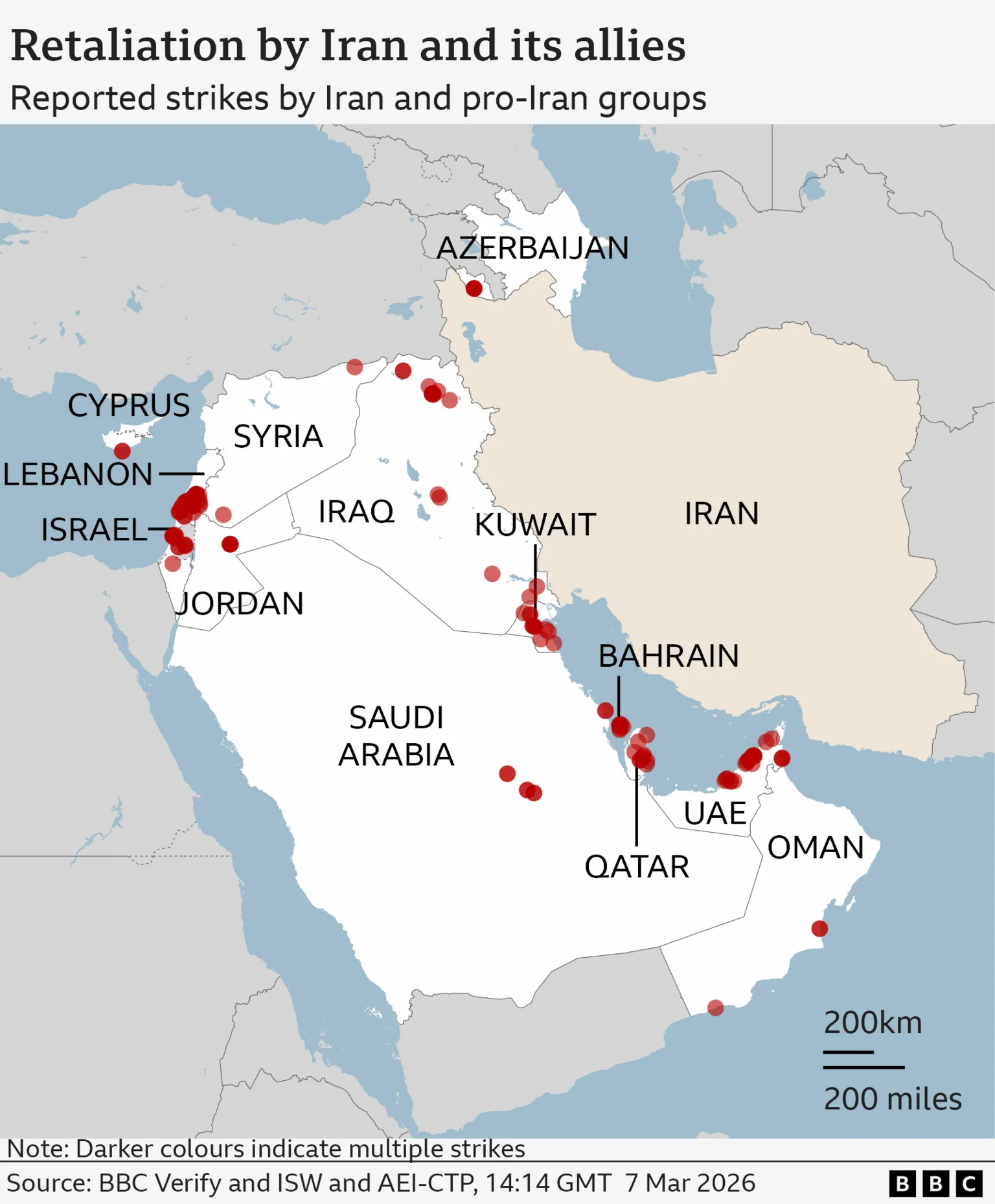
The IRGC's strategy in this conflict has been to blow up civilian targets in nearly all nations surrounding it.
It appears the IRGC has chosen civilian targets (eg: high rise apartments, airports, oil fields) on purpose, but if not, then they have such poor technology that their strikes are random.
Killing people in 11 nations to put pressure on the two nations that actually attacked you is a good demonstration of the Iranian regime's morals.
If the USA or Israel bombed this school, it clearly was an accident, since the only party it benefits is the Iranian regime.
Although the UAE and everyone else Iran has attacked may not have directly attacked Iran, they are hosting the American infrastructure making the attacks possible.
I can understand why Iran considers most gulf states complicit.
This story is now being carried by WSJ.. the likelihood that it’s real only seems to grow each day. If true, this will be the humanitarian price the war is measured against, assuming the casualties don’t grow further.
I can’t argue with you there. The Pentagon’s silence is deafening; I only want to caution myself as much as anyone against jumping to conclusions. It may be AI, it may be bad intelligence, it may be Russian counterintelligence, it may be an IRGC false flag, it may be a little bit of all of the above.
The key difference is that Anthropic aired their disagreement with the DoD publicly, and the DoD is not going to work with a company that tries to exert any amount of control over their relationship via the public sphere. Same goes for Trump.
I think Anthropic knew full well that by publishing their disagreement, it would sink the deal and relationship, and I think they also calculated (correctly) that that act of defiance would get them good publicity and potentially peel away some of OpenAIs user base. I think this profit incentive happened to align with their morals, and now here we are.
This reminds me of the Al-Ahli hospital incident in Gaza, when a mysterious explosion at a hospital was immediately blamed on an Iraeli strike - first by Hamas, then by the international press. A precise death toll was immediately available: 500 killed. Israel urged caution as they investigated, but were ignored.
Eventually, it was established that 1) the casualty number had been a fabrication, 2) the explosion was in the parking lot, 3) it was NOT caused by an Israeli strike, but by a Palestinian Islamic Jihad rocket that had fell short.
Soon the press was forced to issue corrections - New York Times [1] , Le Monde [2], BBC [3]...
This incident looks VERY similar. Which is not surprising, since Hamas was trained in information warfare by the IRGC. Note that Al Jazeera (the media arm of Qatar, who funds Hamas and hosts their leaders in Doha) is enthusiastically amplifying this story with no apparent effort to cross-examine Iran's official source.
I predict that this story will turn out to be fabricated as well.
What the comment fails to mention is that Al-Shifa hospital was ultimately destroyed by Israeli forces, with grave civilian casualties, and no Hamas tunnels ever found: https://en.wikipedia.org/wiki/Al-Shifa_Hospital
The Wikipedia article you link says that Hamas tunnels were found under the hospital, and did have entrances near the hospital, but that no proof was provided that they were using the hospital and nearby tunnels as a 'command and control' centre.
My comment is about Al-Ahli, not Al-Shifa. Those are two different hospitals.
> Al-Shifa hospital was ultimately destroyed by Israeli forces
It was damaged by a series of battles between Hamas and IDF, because Hamas militants embedded themselves within it - like they embedded themselves within all civilian infrastructure. That is the reality of urban war against a terrorist group.
> with grave civilian casualties
Hamas alleged grave civilian casualties. Israel contests it. Again, just like the Al-Ahli incident, Hamas rushes to publish suspiciously precise casualties and reframes an urban battle as a genocidal massacre; naive newsrooms uncritically publish it; wikipedia editors quotes it; then people with an axe to grind endlessly reference it in online arguments like this one.
With Al-Ahli, we got lucky. Independent evidence made it impossible to ignore that Hamas was lying. In many other cases, it is impossible to independently verify how many civilians were truly killed in this or that battle. You have to either believe the IDF, or Hamas.
> and no Hamas tunnels ever found
Al-Shifa was controlled by Hamas and used as a military facility. Hostages were held there. After the ceasefire, Hamas used it as a jail and torture center for Palestinian dissidents.
Or do you believe Israel sent troops inside a hospital in a warzone, at great risk to their safety, to destroy a random hospital with no military value?
The Palestinian rocket story was never confirmed, and it seems unlikely that the rockets from PIJ were the cause. Their ballistic trajectory did not match with the hospital, and most or all their fuel had burned [1].
I recommend you read the whole text, it's quite short.
In other words, the new "established facts" about Al-Ahli are also questionable, and part of Israeli propaganda. It remains to be seen what the truth is in either case.
The fact of the matter is. Eventually Israel destroyed a fuckton of hospitals and schools in Palestine, on purpose. So this particular story in itself does not really matter.
If this spreads into a broader conflict, it remains to be seen whether Europe sticks tightly with that block. They certainly won’t align with Russia, but they may be tied so closely to China economically that they can’t afford to be dragged into a direct conflict with them. I could see a situation where they try to remain non—aligned.
Given that we now that to deploy troops to prevent the US from invading Greenland.
I'd agree, it's not a given that the US can count on Europe in a conflict with China.
But probably Europe wouldn't be trading with China or anything.
It's just given the treatment of the US administration, the US probably can't build a volunteer coalition like I Iraq - unless there is an attack on US mainland.


reply