‘“The people who designed it understood that in a 7-million-person city like Bogotá, a very small percentage would actually see the mime artists,” says Felipe Cala Buendía, the author of Cultural Producers and Social Change in Latin America. However, Mockus believed in the power of word of mouth.’
I used them at the (US) Naval Research Laboratory, programming in a dialect of C called C*. This automatically distributed arrays among the many processors, similar to how modern Fortran can work with coarrays.
If the problem was very data-parallel, one could get nearly perfect linear speedups.
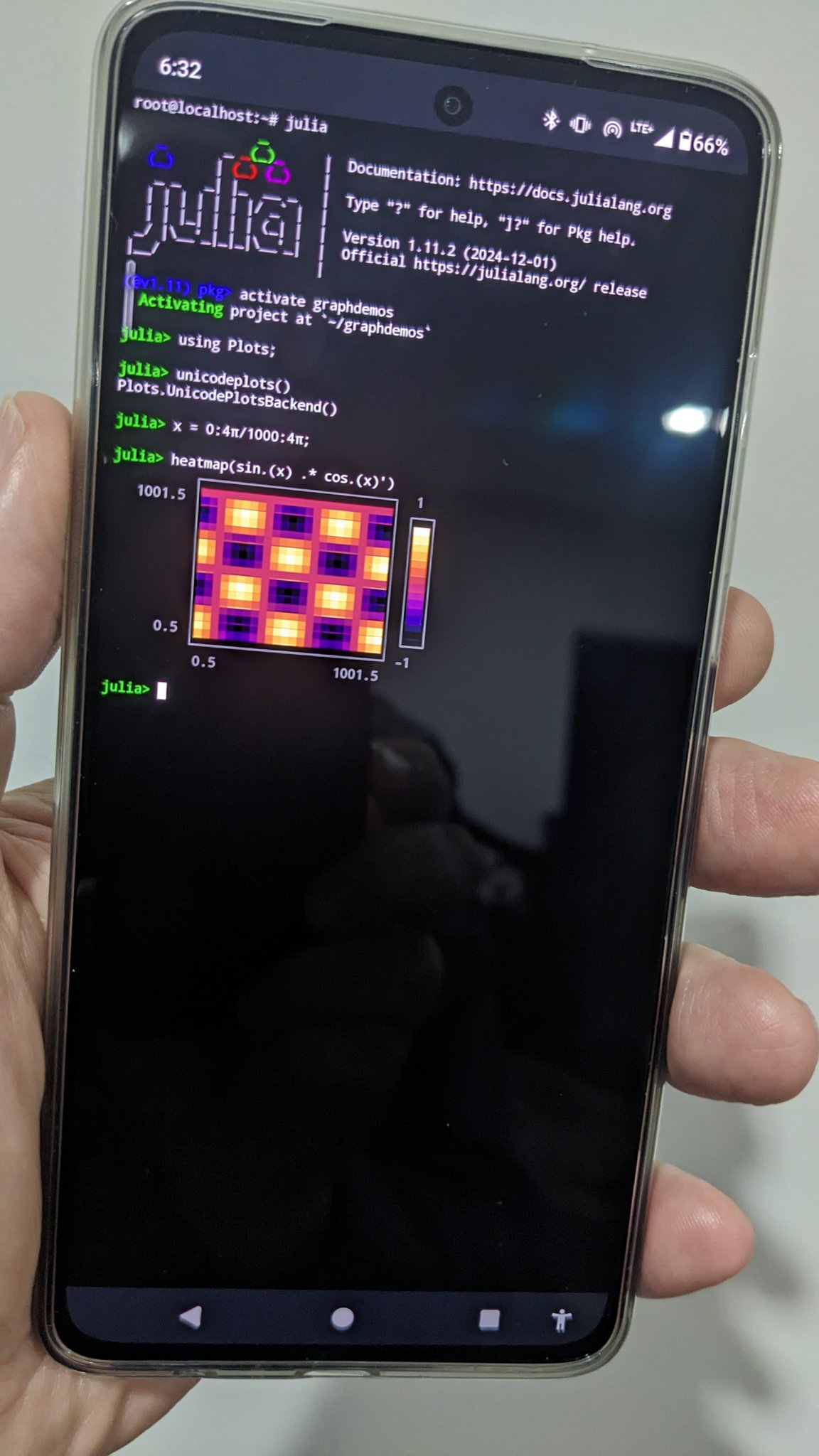
I just downloaded the archive (from the usual Julia downloads page) for ARM on the phone and put a link to the binary in /usr/local/bin — same as on Linux desktop. But I did this in the proot Debian environment.
Ah I see. Even after installing proot Debian I couldn't get juliaup to work, but I'll have to give it a shot manually installing the binary and linking to /usr/local/bin
Google started as a company that seemed worthy of trust. The founders had ideals and followed them. Look what happened. Companies can turn evil surprisingly quickly. I'm also a Kagi customer, but I wouldn’t use a closed-source browser either.
It’s just transient fashion, driven by people who don’t read books. In another few years the same type of people might be using “employ” or something instead of “utilize”, or returning to “use”.
If you want your English to be good, try to spend more time with books, and less time with anything written after about 1960. This (excellent, and free) advice applies to native speakers as well as those enjoying English as a second (or third, etc.) language.
“That's why having goofy names for them matters so much, because it reminds me not to believe the biggest bog lie of all: that I'm stuck in a situation unlike any I, or anyone else, has ever seen before.”
Great question! I love Pandoc and use it often, but as a "universal" converter, it sometimes misses the nuances of specific pairs.
Tylax is designed specifically for the LaTeX $\leftrightarrow$ Typst workflow. By focusing on just this 1-on-1 pair, we can offer:
Better Math & Macros: A built-in macro expander handles custom commands (\newcommand) and complex nested math that general parsers often struggle with.
Cleaner Code: The output is designed to be idiomatic and human-readable (e.g., using native Typst functions), not just "compilable."
WASM Support: Being written in Rust means it runs instantly in the browser, making it easy to embed in web apps without a backend.
Pandoc is the Swiss Army knife; we're trying to be a specialized tool just for this specific transition.
You are absolutely right. Thank you for pointing this out! Regarding your questions:
1. The `\pair` issue: This is definitely a bug. My macro expander is based on text replacement and obviously cannot handle nested parameters. I will fix the recursive logic.
2. The `fib` loop: Pandoc seems to use `typst-hs`, which contains a complete Typst evaluator. Tylax is strictly designed as a static AST transformer. We haven't implemented the Typst virtual machine, so loops or recursive functions cannot be executed. This will be gradually improved later to make it more usable; my claim of "better macro support" was clearly premature. This was a big mistake on my part, and we will strive to achieve this goal in future updates! Thank you very much for your feedback and for pointing out the bug!
That makes sense, especially the issue with macros. As many people have pointed out, since TeX is not just markup but an actual programming language, its output can not be determined, in the general case, without running the source through the TeX interpreter. Of course, the same is true of Typst.
You are absolutely spot on. Both systems are Turing-complete, so a perfect conversion without a full runtime execution is theoretically impossible for the general case.
That's exactly the trade-off Tylax makes: we aren't trying to be a full TeX engine (which would be overkill and slow). Instead, we aim to cover the "99% use case" of academic and technical writing—where macros are mostly used for shorthand, notation aliases, or simple formatting, rather than complex computation.
Our "limited macro expander" is the middle ground: it's dumb enough to be fast and safe (no infinite loops), but smart enough to handle the \newcommand shortcuts that riddle almost every paper. It's about being pragmatically useful rather than theoretically perfect
I haven’t tried this out yet but my gripe with pandoc is that it produces latex (and typst) that no human would ever write. It looks messy and is annoying to share with coauthors.
This is not to say that pandoc isn’t a fantastic tool.


‘“The people who designed it understood that in a 7-million-person city like Bogotá, a very small percentage would actually see the mime artists,” says Felipe Cala Buendía, the author of Cultural Producers and Social Change in Latin America. However, Mockus believed in the power of word of mouth.’
reply