I like that everyone is trying to make something like SQL that reads more naturally to them. More alternatives is good! SQL is a widely accepted standard, and has strictly defined and super broadly accepted semantics.
As someone who has written quite a few half-baked-for-general-use but fit-for-purpose SQL generator utilities over the years, I'll suggest that if you intend for a novel syntax to be a general SQL replacement then being isomorphic to SQL would massively increase usefulness and uptake:
1. novel syntax to SQL; check! Now novel syntax works with all the databases!
2. any valid SQL to novel syntax; a bit harder, but I'd start by using a SQL parser like https://github.com/pganalyze/libpg_query and translating the resulting AST into the novel syntax.
3. novel syntax to SQL back to novel syntax is idempotent; a nice side effect is a validator/formatter for "novel syntax"
4. SQL to novel syntax back to SQL is idempotent; a nice side effect is a validator/formatter for SQL, which would be awesome. (See also https://go.dev/blog/gofmt, which is where I learned this "round trip as formatter" trick.)
I don't mean for this to sound negative, and I know that 2, 3, and 4 are kind of hard. Thank you for building prql!
I once made a real meals-and-visits schedule signup sheet app for a sick relative (dozens of folks signing up for slots over days, etc.) in about 20 minutes, including learning a bunch about the tool.
Ultimately it "just" made CRUD apps, but it made the process amazingly fast. The equivalent of updating a Django model and view was usually a click or two with no waiting, and the only typing was to name things.
This was a cool illustration of the Smalltalk programming language. I never found a use for Dabble (well, until recently when I went looking for it), but the demos were magical.
Fitbits don't do smart alarms, which is what he's asking for. He wants an alarm to wake up him roughly around the end of a sleep cycle. No fitbit currently has this feature at all.
I was confused since I was sure it didn't have this feature. Had to look it up to make sure.
I have rolled an extensive (purpose-built) general data quality system at work, and would love for there to be a general purpose tool that does the same sort of thing. I would love to use, contribute to, or otherwise make real an open source version of such a tool.
There is an enormous need in several industries for this sort of thing; but most people don't really know they need it yet.
Fanta is one kind of coke that I didn't see much growing up.
My brother and I used to argue about whether Orange Fanta counted as a coke. He thought it wasn't, because it was orange soda and not cola. I thought it was, because it was sugary carbonated soda.
My wife refers to them all as soda or pop. The industrial name for them all is "soft drink", which I think means they don't have alcohol in them.
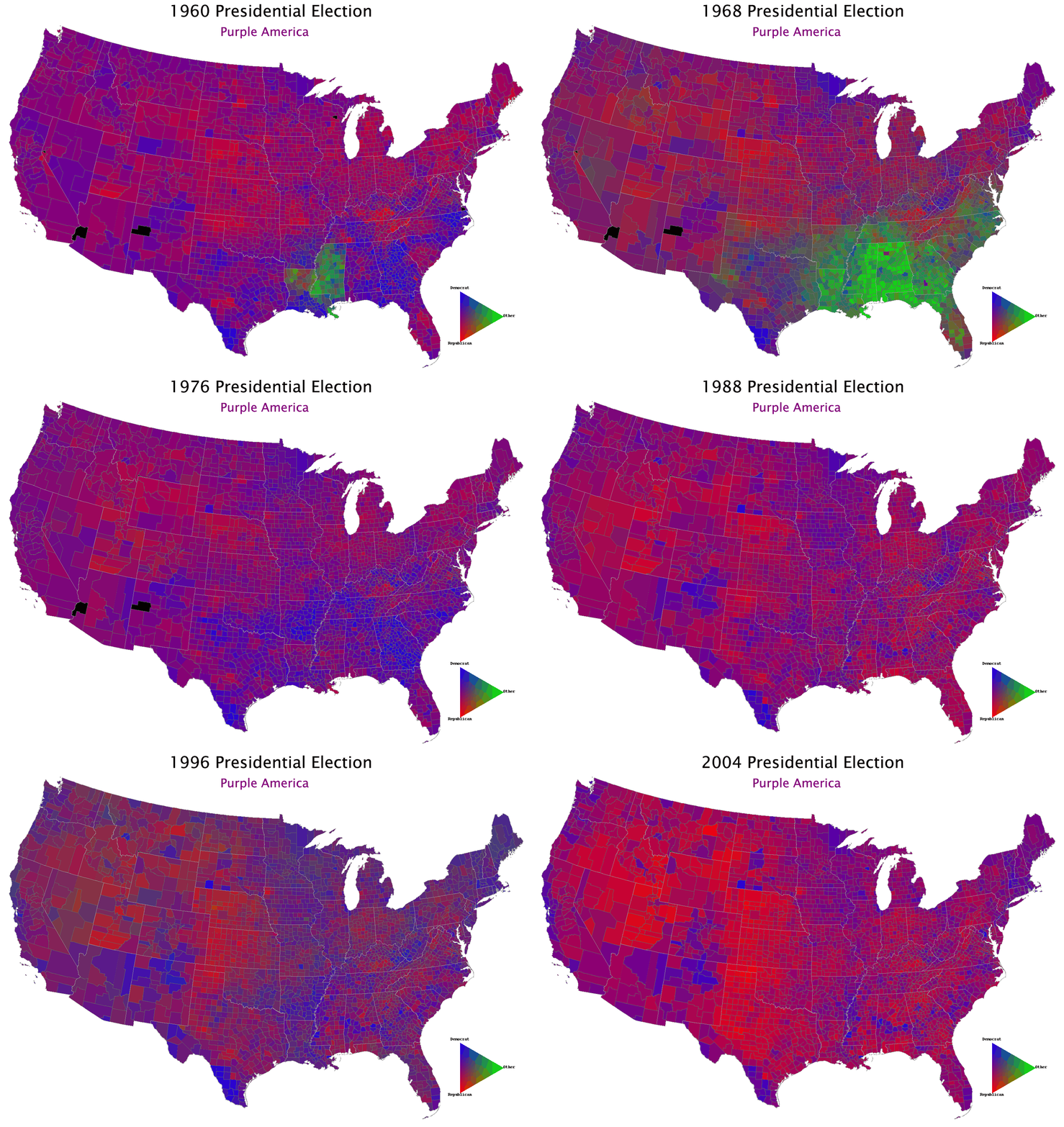
Yeah, I know cities tend to vote liberal, but DC has always seemed extreme to me, even accounting for that. I mean, I don't have data for how big cities vote in general, but I thought it was something like 70% liberal. A solid majority and dissenters.
But DC voted 93% Democrat in 2008. 93! That's not a majority. That's a consensus.
It's on the high end, but I think around 80-90% Democratic for an urban core is fairly common. It's hard to get exact numbers because it depends on where lines are drawn. For example, Cook County (where Chicago is located) "only" voted 76% Obama, but it includes a number of suburban areas, and would be >80% if you pruned them.
Here are the next-most-Democratic cities I came across in some spot-checking, with NYC boroughs broken out b/c they're separate counties: 89% Bronx (NYC), 86% Manhattan (NYC), 84% San Francisco, 80% Brooklyn (NYC), 79% Boston, 79% Alameda County (East Bay), 77% Portland.
Silicon Valley is closer to the 70-ish you're thinking of, but it includes a number of quite suburban areas. Obama won 74% in San Mateo County, and 70% in San Jose County. LA County is about the same (70%), as is Fulton County (Atlanta).
Sorry, I guess we're a bit overly fussy out here. That one would be Los Angeles County. (Not that you couldn't call it LA County, just doesn't sound quite right. It's not uncommon to abbreviate the city to LA, but not so much the county.)
I don't think that's true of the past decade or so. While DC's outlying suburbs in Virginia and Maryland are more Republican than the urban core, they most certainly vote more Democratic than the average suburban county elsewhere in the U.S.
It's been as high as 71.1% Black (in 1970). The percentage has been decreasing as Blacks have moved to the suburbs and Hispanics have moved into the city.
The Project Euler problems might be right up your alley. They are little programming exercises that start easy and rapidly become harder. Along the way you figure out enough math to make the programming easier, or at least enough to make better algorithms. The forums are enormously helpful. http://projecteuler.net/
I'm a big fan of George Carlin, but that point was still irrelevant and largely self-defeating when he first popularized it.
For such an astute student of language, with an eye toward practicality over formality, I don't know how he could see a difference between his complaint that the colloquial 'save the planet' implied rather than explicitly expressed a human point of reference and his many rants against unnecessarily precise techno-jargon. (see: PTSD, pre-boarding, etc)
The only useful value in highlighting that 'save the planet' implies 'so we can still live here', is to draw attention to how the knee-jerk response to such slogans and policy suggestions [1] is the height of arrogance/ignorance.
But rather than exposing the absurdity of that knee-jerk response, his little rant has served as ammunition for that response, shifting the expectation of evidence of lasting harm to an intellectual game of pointless abstraction. [2]
As such it started, and continues, to bother me.
So, again, if you find any legitimate comfort in the idea of the planet continuing on without us (As Carlin may well have) there's no good reason to stop at that level of abstraction.
And if you just want to complain about colloquial language, generally speaking, that pursuit winds up on the receiving end of the bulk of Carlin's analysis of language.
[1] In short: dismissing any potential for a legitimate concern about defending life as we know it by casting conservationist policies as the work of extremists or dismissing any potential for damage by humans by suggesting that we're powerless to truly harm nature.
[2] E.g. "We may turn America's breadbasket into a dust bowl - but after we all starve to death, things will grow again!" As if that matters to the conservationist or their opponent, being as they would both have starved to death.


As someone who has written quite a few half-baked-for-general-use but fit-for-purpose SQL generator utilities over the years, I'll suggest that if you intend for a novel syntax to be a general SQL replacement then being isomorphic to SQL would massively increase usefulness and uptake:
1. novel syntax to SQL; check! Now novel syntax works with all the databases!
2. any valid SQL to novel syntax; a bit harder, but I'd start by using a SQL parser like https://github.com/pganalyze/libpg_query and translating the resulting AST into the novel syntax.
3. novel syntax to SQL back to novel syntax is idempotent; a nice side effect is a validator/formatter for "novel syntax"
4. SQL to novel syntax back to SQL is idempotent; a nice side effect is a validator/formatter for SQL, which would be awesome. (See also https://go.dev/blog/gofmt, which is where I learned this "round trip as formatter" trick.)
I don't mean for this to sound negative, and I know that 2, 3, and 4 are kind of hard. Thank you for building prql!