it has become unfortunately common in marriott hotels in the (western) US, specifically the current generation of residence inn; and i think i've seen it in new towneplace suites as well. it's entirely a form over function decision: you end up with cool air wafting in while you shower, and you end up with a wet bathroom floor (including a soaked floormat).
the same hotels have a kitchen sink tap which has hot/cold selected on the vertical axis, with no indication of which direction is hot/cold.
if you're up for a road trip, then cedar city utah is an option from southern california. the mountains on the east side of town have plenty of fall colors (lots of hiking options, national forests/parks).
the article claims the playlist is "scientifically verified" ... but doesn't seem to cover the science behind the list construction or verification. is there a background article somewhere else?
I was wondering that myself, as reading the list I suspect it's got something to do with people reporting they experienced the feeling from that song. Too many bands had their most popular song featured, and while it could be that songs that cause frisson are more popular it seems more likely that more people listening to the song makes it more likely to be reported.
If they had some program check some huge library of songs for ones that have some sequence likely to cause frisson I'd expect the playlist to be far different.
I wish there was. There's so much subjectivity and context that feeds into whether you experience "frisson" when hearing a song.
I was very surprised to see Infected Mushroom in the playlist. Psytrance is the last thing that will give me goosebumps. Though I'm sure there are people out there who have imbibed, who have a connection to music like this.
Psytrance gives extra frisson, but most people have to be high on something to appreciate it. I know that the nootropics I've taken are working when psytrance goes from being slightly annoying to listen to to being awesome.
FWIW the peakbagger app (android, ios) includes excellent fire and smoke layers. andrew has added these features over the past few years as fires have complicated the quest for peaks.
caltopo.com is another great tool with fire layers, useful for planning hikes in affected areas.
But how would you synchronize the poor weather days of Seattle with the nice days the Bay Area?
Then again, it’s definitely something I miss from doing research at school. Nice day, go for a hike. Bad day, time to finally rerun those experiments. Sadly, I have way more meetings than those days...
yeah i dunno how people live in the PNW, i was totally depressed the 8 months i spent in vancouver BC!
it would be kind of cool to have calendar software which has a "bad weather" feature: correlate the 10-day forecasts of the required attendees, and pick the least sunny timeslot. mind you i'd also want the software to keep track of how frequently i've hiked, because even a sunny day of meetings is OK after a couple days of hiking. gotta mix it up. i'm sure this bin-packing problem has a reasonable enough solution :)
It could be exaggeration, or “potential” in this case could include data from people and companies who expressed interest in the product captured during lead generation.
$100 of gas gets you about 24 gallons at california average prices, even at 20mpg that's 2x what you need to get to reno (218mi), on the way to reno you travel through sacramento. there are alternately many other central valley options at less distance from SF (from which many uber/lyft drivers commute to SF for their day -- for example stockton, modesto). redding is also 217mi from SF if you want to go north instead. eureka is only 271mi. grants pass OR, and los angeles are both in the 380mi ballpark, still within the $100 budget.
i'm not sure why you think vegas has a wider diversity of options -- it could be i don't understand your criteria for options. vegas is central in a vast amount of desert. it's 271mi to LA, 286mi to bakersfield, 302mi to phoenix and 421mi to salt lake city. a massive amount of NV north/northwest of vegas is off-limits military test range -- population density is extremely thin in most directions from vegas.
sources: gmaps for distances, and AAA for gas price (https://gasprices.aaa.com/?state=CA) i rounded up to $4.20/gal. 20mpg i picked semi-arbitrarily because i didn't find a good hit in the first search i did.
I agree that all those places are options. I need some convincing that they are better options than San Francisco. Your gas cost and mileage are about what I used
I used $4 for California. But nobody in Orlando is saying "3.89 what a deal".[1] California's high gas prices exacerbate the problem of distance. In the east $100 provides more range in addition to go along with more options. Even $2.00/gallon wouldn't get you across the all deserts and mountains between SF and Denver. It wouldn't even get you to El Paso where there's nearly 1000 miles of Texas still left.
The "whys" of this are interesting, though I suspect much of this revolves around water and transport. How much it affects homeless populations is an interesting question as well.
The climactic factors Doreen mentions are undoubtedly a factor, though I suspect the ease/difficulty in finding nontraditional means of support (odd jobs, busking, panhandling, gig work) likely matter. The options for other than traditional single-family and long-term apartment dwelling, and the relative costs of mortgages and rent also undoubtedly matter, as does the ability to get too and from residence, work, and/or services.
My experiences travelling through the US are:
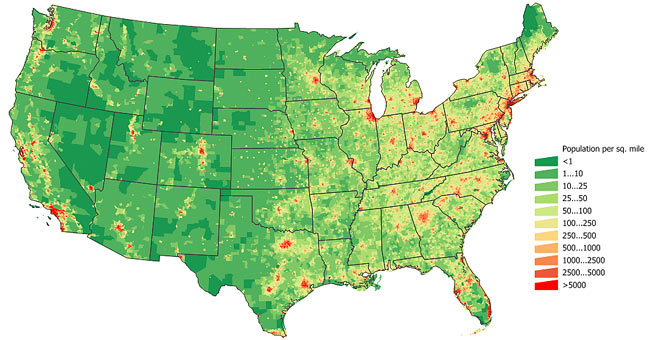
1. The changes in density are hugely apparent, with the almost wholly unpopulated region between California's central valley and the eastern front of the Rockies being most pronounced. There are marked transitions at, say, SF, the 9 bay counties region, Sacramento, Reno, excepting Salt Lake / Wasastch next Denver / Front Range, Omaha, Chicago, and then points east. The density of development along the East Coast, from Boston well into Virginia is hard to appreciate for those who are only familiar with California. And even more rural regions east of the Mississippi and well through the South are far more developed than most of California is. The stretch of CA-99 from Roseville to Bakersfield being only slighly comparable -- it's a linear belt whereas through the Eastern US you'll find comparable or higher densities in all directions.
From San Francisco, for two hours' travel, you have ... more or less two destinations: Sacramento or Stockton. Going north or south, there's nothing until Portland, OR, or Los Angeles. And once you pass Sacramento, there's very slim pickings until you cross the Rockies, or better, the Missouri or Mississippi rivers, which is at best days travel by car or bus. And once you arrive, options may be few and attitudes not particularly welcoming.
2. Density alone isn't vitality. There are relatively habited regions which offer little economic opportunity. That's pointedly obvious as you travel through the Mississippi Delta region, much of Arkansas, and old rust-belt regions of Indiana, Ohio, and Pennsylvania. Even with density and clement weather, and despite low costs, support is scarce.
The feel of regions that do have some level of wealth or at least money flows is palpable. Aspen, CO, Seattle, WA, and Menlo Park, CA have tremendously different feels than Clinton, IA, St. Louis, MO, or Gallup, NM. Even attractive tourist-based regions often seem to have an edge of concern based on a mix of past indigenous sources of wealth (often mining and timber) now gone and a fear for what happens when the travel fad fades. What passes for generally vibrant in most of the US would be considered strongly depressed in much of California, where the distinctions between even thriving core and outlying regions of the SF Bay Area are severe.
3. Local attitudes matter. Homeless, housing-challenged, car- or van-dwellers, and the like, are more evident where support and services exist, all else being equal. Over the past few decades, I'd say they're more evident generally, and aren't strictly limited to the west or even coastal regions generally.
4. Much of coastal California, as well as the central valley, has and has long had its homeless or transient populations. I strongly recommend Steinbeck's Grapes of Wrath as a backgrounder.
The question of why homelessness suddenly emerged in the late 1970s / early 1980s is one that's interested me. I've had an occasional correspondence with Doreen since replying to a comment of hers on HN about a year ago based on some research I'd done on the question at the time. How much of the phenomenon is simply nomenclature and semantics, and how much is an increase in the number / visibility of the unhoused, is something I still don't have a good handle on myself, though I do strongly suspect the problem is getting worse. Failing to offer options other than detached single-family dwellings or rabbit-hutch apartments or housing tower blocks seems another. There really ought be a sensible middle range. There isn't.
Doreen has been advocating for SROs as at least a partial solution. She may be right on this, though I see it as at best only a partial element. Co-housing, intentional communities, boarding, and other options may also be useful. As well as a widely implemented land value tax.
Treating housing and real estate as financial assets rather than essential societal services seems to me a very strong component.
That last element turns up in another item I've found fascinating, a 1937 analysis of resistances to technological innovations which includes among other sectors housing, by Berhnard J. Stern:
My attention had been first brought to that by Stern's research assistant for the project, a young Columbia University graduate student named Isaac Asimov.
There are a whole slew of valuable lessons from that piece. I've submitted it a few times to HN though discussion's been light to date.
All told, though, this is a problem that's proved stubbornly resistant to technological (or any other) solutions attempted to date, and for which awareness and understanding are at best limited. Doreen has direct experience (I really don't), and her criticism of what I'd seen as a generally sensible and surprisingly sympathetic White House white paper is cogent.
> The question of why homelessness suddenly emerged in the late 1970s / early 1980s is one that's interested me.
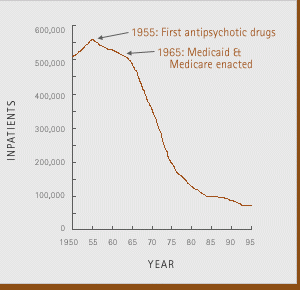
My understanding is that deinstitutionalization plays a large role here. The US institutionalized about 500k people nationwide until 1965, when that number cratered to about 100k by 1980 [1]. Not everyone who is released this way ends up homeless, but a recent study in Massachusetts in Ohio found that about a third of people released from mental institutions have no known address within six months [2].
You seem to have thought a lot about this topic, what is your take on the role of deinstitutionalization? Institutionalization seems cruel, but our current system pushes many people with severe mental illnesses onto the streets or into prisons, which seems worse.
Denstitutionalization had a significant impact on the demographic composition of the homeless population. But urban renewal in the years following the Second World War reduced the stock of cheap housing. Single room occupancy and boarding houses became rare. In many places they became extinct.
The quality of housing at the left of a price histogram became higher. But so did its minimum cost. There's less transient and temporary housing. The overall population is larger. Hope VI continued the removal of the least expensive housing under the rubric of urban renewal policy right up to the twenty-first century.
This is a huge part of the problem. I've been researching the history of US housing for at least two decades at this point and I feel clear that this is a consequence of WW2, post-war prosperity and the existence of the Baby Boom generation that mostly grew up with unprecedented wealth, didn't need cheap housing and essentially imposed it's ideas of "minimal, acceptable housing" on the nation as a whole.
Then demographic and economic reality changed, but we've been both reluctant to rebuild the cheaper accommodations that got demolished and we face serious logistical barriers to recreating such. Cheap housing tends to be older housing. New construction is generally built for the middle class or the wealthy. Poor people don't finance new construction.
So we currently have a huge shortage of housing that works for lower income people. It's not just a factor of rent price per se. We also have created a situation where most Americans cannot live without a car, which is de facto another substantial financial burden and logistical barrier for anyone with physical barriers to being able to drive. On top of that, we just straight up do not have a lot of decent housing options for anyone who prefers a smaller home for some reason.
I'm still trying to figure out out how to document and communicate the shape and extent of the housing problem. Using the term "affordable housing" fails to be helpful in talking about the issue. In fact, it's counterproductive.
But the huge loss of entry-level housing is a large part of this problem space and the period of its active destruction coincides with the findings by dredmorbius that at some point our terminology changed in a way that suggests the issue of homelessness fundamentally changed such that it is inherently more serious, problematic, chronic and long term.
The stigmatization of poverty is an Anglo-American tradition going back at least as far as the 1536 English Poor Laws.[1] Among it's intellectual benefits is a convenient absence of necessary inconvenience upon the wealthy.
Stigmatization of poverty is not the only tradition at play in America. San Francisco's namesake advocated poverty and homelessness. The city was literally established by homeless men who lived in poverty.
The "affordable housing" problem limits solutions to those meeting some criterion for "economically deserving." It precludes pursuit of universal shelter security free of relative political disability. Affordable housing allows eviction from public housing when a family member is criminally charged. Affordable housing allows assistance disqualification for past drug offenses fully paid. Affordable housing is premised on scarcity not abundance.
At the macro-economic scale affordable housing has the delusional premise that there's a housing market that exists in an independent way. The delusion that there's a housing market that can reach equilibrium. Housing is not just one among many alternatives for achieving returns on real-estate investment.
It's one of the worst because conversion of real-estate to housing is sticky. Conversion of housing to more productive commercial, industrial, and agricultural uses ranges from hard (rental trailer parks) to near impossible (multiple single family fee simple lots). Politically, housing houses voters. Economically, homeowners have an incentive to hold out during aggregation.
Real-estate investment is primarily a vehicle for preserving wealth. It's long term. Cashing out is only rational when the returns are high. Cashing out into housing only makes sense when the cash value of the housing at time of delivery exceeds the potential long term value of other uses minus the increased risk from liquidating a perpetual real property title into goods, chattels, and/or financial instruments.
Your use of the term "affordable housing" suggests you are talking about government run poverty relief programs, aka The Projects. I am not. This is one of the reasons it isn't useful terminology for my purposes.
I see our current homeless crisis as a crisis that emerged out of the success of past generations, much like London burned to the ground because as big cities finally emerged from a growing population, it wasn't obvious beforehand that thatched roofs and the like would be a disastrous detail when building a lot of housing under conditions of population density that had not been previously seen.
I am aware that classism and other evils exist. I experienced classism first-hand while homeless.
But I don't find it constructive to focus overly much on that and I don't feel that framing is particularly accurate. I think the majority of the problem is due to factors like blind spots on the part of the privileged.
In a case where you have a mix of root causes, it's generally better to focus your effort on the more readily resolved pieces of the problem. When one of those pieces is prejudice, addressing other pieces of the problem is an effective means to combat prejudice.
Condemning people for their prejudice tends to entrench the problem, not remedy it. Casting light on the fact that their assumptions are incorrect is far more productive.
I believe that this problem exists not because most people in power actively desire to be abusive assholes punishing the lower classes for existing but because they don't have good answers. I think the best thing I can do is do the research, figure out how to effectively communicate it and make it freely available on the internet for anyone interested in the topic.
That still leaves me with an unresolved question of how to pay my own bills. I'm off the street, but I still struggle to make ends meet. I'm currently nearly broke and facing a week where I am likely to go hungry for a few days.
This is an all too common occurrence in my life. Ads are "dead" so to speak and I don't know how to get enough tips and/or Patreon supporters to turn my writing into a middle class income for me.
But other than the detail that it isn't paying enough, I feel pretty confident that this model of 1. Do the research and 2. Put out good info for free is our best hope for finding a viable path forward on some of our current hard problems.
Thank you for your participation in this discussion. Your comments have been enormously helpful for me.
Sorry for not being clear. I agree that "affordable housing" is not a particularly useful starting point for addressing housing insecurity in a meaningful way. I agree that it is a way of maintaining wealth and power.
I think in the context of homelessness, "affordable housing" is used to muddy the waters. "Affordable housing" gets people off on the tangent of home ownership and the American Dream expectations of FAANG engineers. And when that connotation starts to gain traction, "affordable housing" can be used to derail that conversation by bringing homelessness into the mix. No matter what I mean, "affordable housing" has another meaning that can be used to derail my point.
I am really glad you are writing what you are writing and sharing it on HN. It makes Hacker News a better place.
My perspective on housing has developed over the thirty years since I studied architectural drafting at vo-tech and later an MArch. I worked nearly exclusively in housing from 2001 until just a few years ago. With and for developers and homebuilders plus some time in government as a planner and building plans examiner. I watched Hope VI go down in grad school. I worked on some Tax Credit housing projects when I had an independent practice.
Anyway, if I can help, my email is in my profile. Thanks for making HN better.
I've seriously suggested that the oil crisis may well play a factor.
The connection is complicated, but plausible.
As the US increased its share of oil imports, starting in 1950, its balance of trade shifted from net exporter to importer (debtor). Before the OPEC crisis of 1973-4, Nixon took the US dollar off the gold standard. I see this not so much as a problem as a response to one: it's not possible to maintain a stable currency against a consistent spending outflow.
The '73 crisis itself not only cut off oil supplies but created a huge spike in cost, again exacerbating the BoT problem. One of the critical events in resolving the crisis appears to have been a meeting in December 1973 between Henry Kissenger and the Saudi finance minister, on which I've as yet found little as to substance. A consequence of this was the "dollarisation" of the US-Saudi oil trade, later extended to the entire international oil market.
From a currency perspective, this solved two problems. The US saw a huge new demand for dollars (absorbing much of the inflationary consequence of increasing the money supply, and both government and private spending), and the Saudis weren't saddled with an ever-appreciating (deflating) riyal.
But the US and the Federal Reserve still had the problem of how to manage the money supply, and fixed on fractional reserve banking and open market operations to do so. This meant that banks and bank assets played a huge role in managing the money supply, where bank assets are loans, largely business and real estate. (Stocks and other equities play a relatively minor role.)
Appreciating real estate valuations, already attractive to banks, became even more so.
A second whammy came with the Iran embargo in 1979, by some measures more severe than the 1973-74 crisis. Meantime, increased energy costs and political shifts were undermining both manufacturing and union jobs, with them, pensions. Appreciating housing also became the household asset and retirement plan for homeowners. Toss in environmental regulations (not a bad thing of themselves) and tax revolts such as California's Proposition 13 in 1978 (a bad thing of itself), and you'd pretty much put all the ingredients together for a fatal brew.
Stew over a sputtering GDP for 50 years, and voila!
The first major reporting on homelessness came in 1980, during the US presidential election campaign, from CBS. The Doonesbury comic strip began an item at about that time, and many homeless organisations date from 1980 or shortly afterward.
There's the question of why this hadn't happened earlier. I'd largely chalk this up to the post-WWII urban exodus and suburban housing boom, throughout the US, but in particular in California, which until 1970 had never seen a subdivision or freeway it didn't love at first glance. OK, slight exaggeration -- the San Francisco freeway revolts began in about 1956, and numerous planned routes in SF were cancelled in 1959, but the movement continued to pick up steam statewide through the 1960s:
By the mid-1970s, the idea of simply rolling out massive new tract home and automobile-centred transport projects within California had largely ended. Projects could move, but took far longer and cost much more. Urban centres were already unpopular (the reverse migration into SF began in the 1980s), and there were considerable resistances to densification. What effect events such as the Loma Prieta Earthquake (1989) and Oakland Hills Fire (1991) I'm not sure.
By the mid 1990s, housing prices were taking off again, new dense construction was at best difficult, and at the same time, employment was fairly ill-defined -- California was in the process of shrugging off much defence-related activity (base closings, shifts from defence-related industry), but hadn't yet discovered high-tech. "Multimedia Gulch" (South Park, SF) was A Thing briefly in the mid-1990s, biotech was generating far more hype. There were military base closings across the state (San Diego, Los Angeles, Santa Barbara/San Luis Obispo, Sacramento, Stockton, Vallejo, Alameda, Mountain View, Concord, Fairfield/Vacaville, and more).
Then Netscape appeared and Dot Com 1.0 took off, August, 1995.
I think you are on the right track here.
Energy, energy efficiency, Distribution in a system.
The more centralised, the more uneven the distribution. Decentralised localism might be solution.
as a former public radio listener, who grew increasingly tired of finding something else to listen to during the all-too-regular fund drives, i very much appreciate the ability to skip forward on podcasts.
i'm also happier paying for good audio content than i am willing to pay for a dozen different news site subscriptions. my regular day is full of visual-attention-required tasks, and having an audio-only source of information and entertainment is worth paying for.
it's nice to know that it appears to be a successful business model for NPR.
They've experimented with "silent" fund drives lately in Iowa, where if they raise a target amount then the full fund drive is skipped. I like that a lot, as well as the fact that their programs are all podcasted.
I find the silent drive to be soooo painful. It's the most passive aggressive form of fundraising. I think they've gotten better at it the last couple times around, but the first one was rough.
"We're just going to keep this silent drive going until we get the money!" ... A month later "Come on people, going to have to do a real pledge drive since no one is paying up..."
for a long time i used a variation of this as an interview question for performance analysis positions at google. instead of focusing on I/O costs i was focusing on cache miss costs, but it's pretty much the same observation at a different scale. it's always seemed like an excellent educational example of the difference between theoretical and practical concepts in computer engineering, such as big-O and turing machine vs. practical problem sizes and hierarchical storage/cache capacities/costs.



the same hotels have a kitchen sink tap which has hot/cold selected on the vertical axis, with no indication of which direction is hot/cold.
form over function. so annoying.