This really hinges on whether you let state accumulate, and where you let it do so. NixOS generally creates a dedicated user and data directory for its services, for example. I make some of my XDG config directories symlinks to the nix store because I want those configurations to be read-only. home-manager should ask before making modifications outside of the nix store (or make a backup).
This is not only a Nix problem, fwiw. I first encountered this with, say, running ZNC in Docker. It will happily write logs and configs to a temporary directory in the container and get blown away on restart unless you mount persistent volumes in just the right spots. Syncthing can be configured to manage its own config or it can be configured fully by Nix, etc.
He turned 95 years old on August 30. He was 75 when he began giving away his fortune, announcing plans in June 2006 to give away the bulk of his wealth to five foundations, primarily the Bill and Melinda Gates Foundation. He changed his will in 2024, designating 99.5% of his remaining fortune after his death to a charitable trust overseen by his three children and also announcing in June 2024 that donations to the Gates Foundation would cease upon his death.
Just think, if that charitable trust is structured correctly, it could be used to pay a modest believable "administration" salary to many many generations of offspring all while paying out some token pittances to make the whole thing seem genuine.
That article seems to accurately describe the charitable activities of Peter Buffett and his NoVo Foundation, but it's worth pointing out that Howard G. and Susan Buffett have charitable foundations of their own that seem to have a more conventional philanthropic approach, one that may perhaps be more amenable to a clearer focus on getting the right outcomes. It seems unwarranted to assume that the description in the article applies to the Buffett children's activities as a whole.
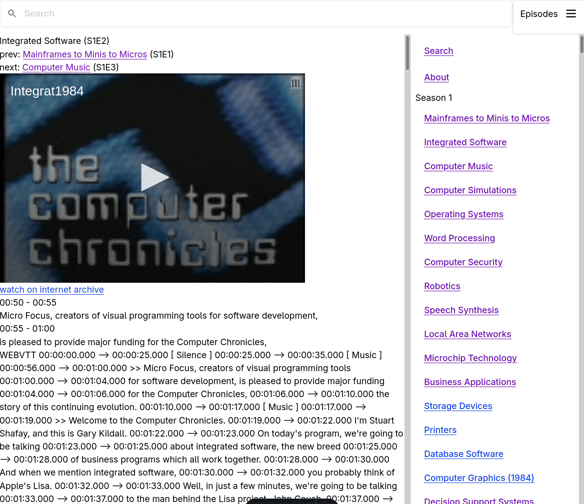
I've had this on my back burner! Glad to see someone else wants this as well. The Internet Archive already has transcripts generated by whisper.cpp, so it's (just) a matter of gathering them into one place and making a good search feature.
The issue with Whisper is that it messes up both names of both products and guests. What we aim to do is make new subs, but including all the product names and guest names as hints, so Whisper will get them right.
After leaving television production, he worked as a consultant for the Internet Archive, helping to preserve and provide public access to cultural and technological media, including Computer Chronicles and other technology programs.
The full archive of Computer Chronicles is online because Stewart put in the work to make that happen. He talks a bit about it (and Computer Chronicles in general!) in a 2013 interview with Leo Laporte on TWiT: https://youtu.be/WdtHS_X1ibg
Some of the better quality video archives, too. Most of them have interlaced MPEG-2 versions available, although a handful of the older ones do unfortunately have incorrect field order set in the MPEG headers
There's been several people in the archive community identifying and pointing them out, digging through large tape collections as well of syndications of it. David however got to go through the original masters recently
The thing AI miss about the internet from the late 2000s and early 2010s was having so much useful data available, searchable, and scrappable. Even things like "which of my friends are currently living in New York?" are impossible to find now.
I always assumed this was a once-in-history event. Did this cycle of data openness and closure happen before?