I think it's highly circumstantial. For example, my personal servers run a lot of FreeBSD and even though I could stay on major releases for a rather long time, I usually upgrade almost as soon as new releases are available.
For servers at work, I tried running Fedora. The idea was that it would be easier to have small, frequent updates rather than large, infrequent updates.
Didn't work. App developers never had enough time to port their stuff to new releases of underpinning software, so we frequently had servers with unsupported OS version.
Gave up and switched to RockyLinux. We're in the process of upgrading the Rocky8-based stuff to Rocky9. Rocky9 was released 2022.
When an agent just plows ahead with a wrong interpretation or understanding of something, I like to ask them why they didn't stop to ask for clarification.
Just a few days ago, while refactoring minor stuff, I had an agent replace all sqlite-related code in that codebase with MariaDB-based code.
Asked why that happened, the answer was that there was a confusion about MariaDB vs. sqlite because the code in question is dealing with, among other things, MariaDB Docker containers. So the word MariaDB pops up a few times in code and comments.
I then asked if there is anything I could do to prevent misinterpretations from producing wild results like this.
So I got the advice to put an instruction in AGENTS.md that would urge agents to ask for clarification before proceeding.
But I didn't add it. Out of the 25 lines of my AGENTS.md, many are already variations of that.
The first three:
- Do not try to fill gaps in your knowledge with overzealous assumptions.
- When in doubt: Slow down, double-check context, and only touch what was explicitly asked for.
- If a task seems to require extra changes, pause and ask before proceeding.
If these are not enough to prevent stuff like that, I don't know what could.
Are agents actually capable of answering why they did things? An LLM can review the previous context, add your question about why it did something, and then use next token prediction to generate an answer. But is that answer actually why the agent did what it did?
It depends. If you have an LLM that uses reasoning the explanation for why decisions are made can often be found in the reasoning token output. So if the agent later has access to that context it could see why a decision was made.
LLMs often already "know" the answer starting from the first output token and then emulate "reasoning" so that it appeared as if it came to the conclusion through logic. There's a bunch of papers on this topic. At least it used to be the case a few months ago, not sure about the current SOTA models.
The cursor-mirror skill and cursor_mirror.py script lets you search through and inschpekt all of your chat histories, all of the thinking bubbles and prompts, all of the context assembly, all of the tool and mcp calls and parameters, and analyze what it did, even after cursor has summarized and pruned and "forgotten" it -- it's all still there in the chat log and sqlite databases.
cursor-mirror skill and reverse engineered cursor schemas:
  The German Toilet of AI

  "The structure of the toilet reflects how a culture examines itself." — Slavoj Zizek

  German toilets have a shelf. You can inspect what you've produced before flushing. French toilets rush everything away immediately. American toilets sit ambivalently between.

  cursor-mirror is the German toilet of AI.

  Most AI systems are French toilets — thoughts disappear instantly, no inspection possible. cursor-mirror provides hermeneutic self-examination: the ability to interpret and understand your own outputs.

  What context was assembled?
  What reasoning happened in thinking blocks?
  What tools were called and why?
  What files were read, written, modified?

  This matters for:

  Debugging — Why did it do that?
  Learning — What patterns work?
  Trust — Is this skill behaving as declared?
  Optimization — What's eating my tokens?

  See: Skill Ecosystem for how cursor-mirror enables skill curation.
>Žižek on toilets. Slavoj Žižek during an architecture congress in Pamplona, Spain.
>The German toilets, the old kind -- now they are disappearing, but you still find them. It's the opposite. The hole is in front, so that when you produce excrement, they are displayed in the back, they don't disappear in water. This is the German ritual, you know? Use it every morning. Sniff, inspect your shits for traces of illness. It's high Hermeneutic. I think the original meaning of Hermeneutic may be this.
>Hermeneutics (/ˌhɜːrməˈnjuːtɪks/)[1] is the theory and methodology of interpretation, especially the interpretation of biblical texts, wisdom literature, and philosophical texts. Hermeneutics is more than interpretive principles or methods we resort to when immediate comprehension fails. Rather, hermeneutics is the art of understanding and of making oneself understood.
----
Here's an example cursor-mirror analysis of an experiment with 23 runs with four agents playing several turns of Fluxx per run (1 run = 1 completion call), 1045+ events, 731 tool calls, 24 files created, 32 images generated, 24 custom Fluxx cards created:
Cursor Mirror Analysis: Amsterdam Fluxx Championship -- Deep comprehensive scan of the entire FAFO tournament development:
Just an update re German toilets: No toilet set up in the last 30 years (I know of) uses a shelf anymore. This reduces water usage by about 50% per flush.
of course not, but it can often give a plausible answer, and it's possible that answer will actually happen to be correct - not because it did any - or is capable of any - introspection, but because it's token outputs in response to the question might semi-coincidentally be a token input that changes the future outputs in the same way.
Isn't that question a category error? The "why" the agent did that is that it was the token that best matched the probability distribution of the context and the most recent output (modulo a bit of randomness). The response to that question will, again, be the tokens that best match the probability distribution of the context (now including the "why?" question and the previous failed attempt).
if the agent can review its reasoning traces, which i think is often true in this era of 1M token context, then it may be able to provide a meaningful answer to the question.
Wait, no, that's the category error I'm talking about. Any answer other than "that was the most likely next token given the context" is untrue. It is not describing what actually happened.
I think this statement is on the same level as "a human cannot explain why they gave the answer they gave because they cannot actually introspect the chemical reactions in their brain." That is true, but a human often has an internal train of thought that preceded their ultimate answer, and it is interesting to know what that train of thought was.
In the same way, it is often quite instructive to know what the reasoning trace was that preceded an LLM's answer, without having to worry about what, mechanically, the LLM "understood" about the tokens, if this is even a meaningful question.
But it's not a reasoning trace. Models could produce one if they were designed to (an actual stack of the calls and the states of the tensors with each call, probably with a helpful lookup table for the tokens) but they specifically haven't been made to do that.
Unless things have changed drastically in the last 4 months (the last time I looked at it) those traces are not stored but reconstructed when asked. Which is still the same problem.
They aren't necessarily "stored" but they are part of the response content. They are referred to as reasoning or thinking blocks. The big 3 model makers all have this in their APIs, typically in an encrypted form.
Reconstruction of reasoning from scratch can happen in some legacy APIs like the OpenAI chat completions API, which doesn't support passing reasoning blocks around. They specifically recommend folks to use their newer esponses API to improve both accuracy and latency (reusing existing reasoning).
For a typical coding agent, there are intermediate tool call outputs and LLM commentary produced while it works on a task and passed to the LLM as context for follow up requests. (Hence the term agent: it is an LLM call in a loop.) You can easily see this with e.g. Claude Code, as it keeps track of how much space is left in the context and requires "context compaction" after the context gradually fills up over the course of a session.
In this regard, the reasoning trace of an agent is trivially accessible to clients, unlike the reasoning trace of an individual LLM API call; it's a higher level of abstraction. Indeed, I implemented an agent just the other day which took advantage of this. The OP that you originally replied to was discussing an agentic coding process, not an individual LLM API call.
Well, right, I see those reasoning stages in reasoning models with Ollama and if you ask it what its reasoning was after the fact what it says is different than what it said at the time.
I can't speak to your specific set up, but it sounds like you're halfway there if you can access the previous traces? All anyone can ask for is "show me the traces that led up to this point"; the "why did you do this" is a notational convenience for querying that data. If your set up isn't summarizing those traces correctly, then that sounds like a specific bug in the context or model quality, but the point is that the traces exist and are queryable in the first place, however you choose to do that.
(I am still primarily talking about agent traces, like the original OP, not internal reasoning blocks for a particular LLM call, though - which may or may not be available in context afterwards.)
In particular, asking "why" isn't a category error here, although there's only a meaningful answer if the model has access to the previous traces in its context, which is sometimes true and sometimes not.
There can be higher- and lower-level descriptions of the same phenomenon. when the kettle boils, it’s because the water molecules were heated by the electric element, but it’s also because I wanted a cup of tea.
If the reason the LLM retroactively invents for it's previous mistakes is still useful for getting the LLM to not make that kind of mistake again, then the distinction you're driving at doesn't matter.
> Any answer other than "that was the most likely next token given the context" is untrue.
"Because the matrix math resulted in the set of tokens that produced the output". "Because the machine code driving the hosting devices produced the output you saw". "Because the combination of silicon traces and charges on the chips at that exact moment resulted in the output". "Because my neurons fired in a particular order/combination".
I don't see how your statement is any more useful. If an LLM has access to reasoning traces it can realistically waddle down the CoT and figure out where it took a wrong turn.
Just like a human does with memories in context - does't mean that's the full story - your decision making is very subconscious and nonverbal - you might not be aware of it, but any reasoning you give to explain why you did something is bound to be an incomplete story, created by your brain to explain what happened based on what it knows - but there's hidden state it doesn't have access to. And yet we ask that question constantly.
If you want to be pedantic about it you could phrase it as follows.
When the LLM was in reasoning mode, in the reasoning context it often expressed statement X. Given that, and the relevance of statement X to the taken action. It seems likely that the presence of statement X in the context contributed to this action. Besides, the presence of statement X in the reasoning likely means that given the previous context embeddings of X are close to the context.
Hence we think that the action was taken due to statement X.
And that output could have come from an LLM introspecting it's own reasoning.
I don't think that phrasing things so pedanticaly is worth the extra precision though. Especially not for the statement that inspecting the reasoning logs of sn LLM can help give insight on why an LLM acted a certain way.
Just this morning I have run across an even narrower case of how AGENTS.md (in this case with GPT-5.3 Codex) can be completely ignored even if filled with explicit instructions.
I have a line there that says Codex should never use Node APIs where Bun APIs exist for the same thing. Routinely, Claude Code and now Codex would ignore this.
I just replaced that rule with a TypeScript-compiler-powered AST based deterministic rule. Now the agent can attempt to commit code with banned Node API usage and the pre-commit script will fail, so it is forced to get it right.
I've found myself migrating more and more of my AGENTS.md instructions to compiler-based checks like these - where possible. I feel as though this shouldn't be needed if the models were good, but it seems to be and I guess the deterministic nature of these checks is better than relying on the LLM's questionable respect of the rules.
We have pre-commit hooks to prevent people doing the wrong thing. We have all sorts of guardrails to help people.
And the “modern” approach when someone does something wrong is not to blame the person, but to ask “how did the system allow this mistake? What guardrails are missing?”
It seems like LLMs in general still have a very hard time with the concepts of "doubt" and "uncertainty". In the early days this was very visible in the form of hallucinations, but it feels like they fixed that mostly by having better internal fact-checking. The underlying problem of treating assumptions as truth is still there, just hidden better.
LLMs are basically improv theater. If the agent starts out with a wildly wrong assumption it will try to stick to it and adapt it rather than starting over. It can only do "yes and", never "actually nevermind, let me try something else".
I once had an agent come up with what seemed like a pointlessly convoluted solution as it tried to fit its initial approach (likely sourced from framework documentation overemphasizing the importance of doing it "the <framework> way" when possible) to a problem for which it to me didn't really seem like a good fit. It kept reassuring me that this was the way to go and my concerns were invalid.
When I described the solution and the original problem to another agent running the same model, it would instantly dismiss it and point out the same concerns I had raised - and it would insist on those being deal breakers the same way the other agent had dimissed them as invalid.
In the past I've often found LLMs to be extremely opinionated while also flipping their positions on a dime once met with any doubt or resistance. It feels like I'm now seeing the opposite: the LLM just running with whatever it picked up first from the initial prompt and then being extremely stubborn and insisting on rationalizing its choice no matter how much time it wastes trying to make it work. It's sometimes better to start a conversation over than to try and steer it in the right direction at that point.
I really hate that the anthropomorphizing of these systems has successfully taken hold in people's brains. Asking it why it did something is completely useless because you aren't interrogating a person with a memory or a rationale, you’re querying a statistical model that is spitting out a justification for a past state it no longer occupies.
Even the "thinking" blocks in newer models are an illusion. There is no functional difference between the text in a thought block and the final answer. To the model, they are just more tokens in a linear sequence. It isn't "thinking" before it speaks, the "thought" is the speech.
Treating those thoughts as internal reflection of some kind is a category error. There is no "privileged" layer of reasoning happening in the silicon that then gets translated into the thought block. It’s a specialized output where the model is forced to show its work because that process of feeding its own generated strings back into its context window statistically increases the probability of a correct result. The chatbot providers just package this in a neat little window to make the model's "thinking" part of the gimmick.
I also wouldn't be surprised if asking it stuff like this was actually counter productive, but for this I'm going off vibes. The logic being that by asking that, you're poisoning the context, similar to how if you try generate an image by saying "It should not have a crocodile in the image", it will put a crocodile into the image. By asking it why it did something wrong, it'll treat that as the ground truth and all future generation will have that snippet in it, nudging the output in such a way that the wrong thing itself will influence it to keep doing the wrong thing more and more.
You're entirely correct in that it's a different model with every message, every token. There's no past memory for it to reference.
That said it can still be useful because you have a some weird behavior and 199k tokens of context, with no idea where the info is that's nudging it to do the weird thing.
In this case you can think of it less as "why did you do this?" And more "what references to doing this exist in this pile of files and instructions?"
Agreed. I wish more people understood the difference between tokens, embeddings, and latent space encodings. The actual "thinking" if you can call it that, happens in latent space. But many (even here on HN) believe the thinking tokens are the thoughts themselves. Silly meatbags!
Thinking happens in latent space, but the thinking trace is then the projection of that thinking onto tokens. Since autoregressive generation involves sampling a specific token and continuing the process, that sampling step is lossy.
However, it is a genuine question whether the literal meanings of thinking blocks are important over their less-observable latent meanings. The ultimate latent state attributable to the last-generated thinking token is some combination of the actual token (literal meaning) and recurrent thinking thus far. The latter does have some value; a 2024 paper (https://arxiv.org/abs/2404.15758) noted that simply adding dots to the output allowed some models to perform more latent computation resulting in higher-skill answers. However, since this is not a routine practice today I suspect that genuine "thinking" steps have higher value.
Ultimately, your thesis can be tested. Take the output of a reasoning model inclusive of thinking tokens, then re-generate answers with:
1. Different but semantically similar thinking steps (i.e. synonyms, summarization). That will test whether the model is encoding detailed information inside token latent space.
2. Meaningless thinking steps (dots or word salad), testing whether the model is performing detailed but latent computation, effectively ignoring the semantic context of
3. A semantically meaningful distraction (e.g. a thinking trace from a different question)
Look for where performance drops off the most. If between 0 (control) and 1, then the thinking step is really just a trace of some latent magic spell, so it's not meaningful. If between 1 and 2, then thinking traces serve a role approximately like a human's verbalized train of thought. If between 2 and 3 then the role is mixed, leading back to the 'magic spell' theory but without the 'verbal' component being important.
> I really hate that the anthropomorphizing of these systems has successfully taken hold in people's brains. Asking it why it did something is completely useless because you aren't interrogating a person with a memory or a rationale, you’re querying a statistical model that is spitting out a justification for a past state it no longer occupies.
"Thinking meat! You're asking me to believe in thinking meat!"
While next-token prediction based on matrix math is certainly a literal, mechanistic truth, it is not a useful framing in the same sense that "synapses fire causing people to do things" is not a useful framing for human behaviour.
The "theory of mind" for LLMs sounds a bit silly, but taken in moderation it's also a genuine scientific framework in the sense of the scientific method. It allows one to form hypothesis, run experiments that can potentially disprove the hypothesis, and ultimately make skillful counterfactual predictions.
> By asking it why it did something wrong, it'll treat that as the ground truth and all future generation will have that snippet in it, nudging the output in such a way that the wrong thing itself will influence it to keep doing the wrong thing more and more.
In my limited experience, this is not the right use of introspection. Instead, the idea is to interrogate the model's chain of reasoning to understand the origins of a mistake (the 'theory of mind'), then adjust agents.md / documentation so that the mistake is avoided for future sessions, which start from an otherwise blank slate.
I do agree, however, that the 'theory of mind' is very close to the more blatantly incorrect kind of misapprehension about LLMs, that since they sound humanlike they have long-term memory like humans. This is why LLM apologies are a useless sycophancy trap.
> Asking it why it did something is completely useless because you aren't interrogating a person with a memory or a rationale, you’re querying a statistical model that is spitting out a justification for a past state it no longer occupies.
Asking it why it did something isn’t useless, it just isn’t fullproof. If you really think it’s useless, you are way too heavily into binary thinking to be using AI.
I genuinely fail to see the usefulness, though, it seems counterproductive to me to do this kinda stuff. In my experience I just throw out the whole chat/session as soon as I notice it's starting to repeat mistakes/start doing stupid shit consistently, the few times I've tried interrogating it I could immediately tell all it was doing is, for lack of a better word, being a sycophant and aping my words back at me.
It hasn’t failed to be useful to me yet, even if it isn’t complete info about what went wrong. Better if you can ask it a specific question about what it did (why do you do X?). Sometimes it made a mistake and you can ask it how you can word instructions better to not make the mistake (useful in prompt engineering), sometimes I made an actual mistake and gave it conflicting instructions, sometimes it’s still something that can be fixed. Eventually it stops making mistakes because you’ve tested it enough and made your prompts robust. I guess your mileage will vary, but my experience is that it’s a conversation to get a good prompt, not a single one shot ask (which is why I save my prompts and reuse them).
Gentoo is what really made Linux click for me, too. I'm still very, very glad for that and remain a loyal user to this day!
Although I've had to restrict it to the 2 desktop machines. Maybe I should give it a shot again on the laptops, now that binary packages are universally available...
It won't matter because they don't care. The masses don't concern themselves with theoretical threats even when they understand them on an intellectual level, they buy the emotional argument no matter how weak it is on technical merit.
To convince them otherwise, you need to offer a more compelling emotional argument, but politicians and lobbyist already tell them that they're going to get raped and killed in the street unless they support their agenda.
So what do you do? How do you come up with an emotional argument that's more compelling than that?
Germany squandered so much money on nonsense, when they could have simply driven the few kilometers over to Eindhoven and bought an ASML machine for "Silicon Saxony".
Sure, it would have taken years and years and serious commitment by the government and private sector to make that a successful move. But instead of putting in the hard work with a clear vision for the future, we mostly spend our time whining and wailing. It's a shame.
High-end chips should be more of a EU concerted effort rather than every country for itself.
The problem is that unlike Airbus, which (highly inefficiently) can be made in multiple countries, you can't really spread out parts of a fab that way. The most you can do is fab machines + chips + chip packaging. Netherlands already has fab machines and in packaging there isn't a high margin.
That leaves chips, and you can be sure that whoever gets the fabs, the other EU countries will throw a shit fit and demand counter investments to compensate. And on top of that there is also regional animosity. So even if it makes logical sense to pop the fab down in the middle of the blue banana, it won't make political sense because France and all of South and East EU will be angry about "the rich getting richer".
>High-end chips should be more of a EU concerted effort rather than every country for itself.
And how are we gonna do that exactly? EU runs on national interests of those footing the bill, mainly France and Germany as the largest net contributors.
When you're relying on national subsidies to build and run a factory and adjacent infrastructure in a country, you're tied to national interests and demands of those countries footing the bill for all that infrastructure.
So the likes of France and Germany aren't gonna give billions in subsidies from their taxpayers' money to semiconductor companies so that they can incorporate in Netherlands to dodge taxes and then create jobs in low-cost Poland and Romania instead of at home, even though that's already been happening to an extent in other industries over the last 20+ years.
It's the same with arms purchases now. France blocked Ukraine from using its money to buy British made weapons that are already available, since it expects that money to go back into the French economy, not to the economy of a competitor, even if the much needed weapons will arrive much later.
Yeah I know, UK isn't EU anymore, but the point still stands, as EU nations are still economically competitors to each other and they're not gonna spend their tax money to fund competing economies even in the EU block.
> And how are we gonna do that exactly? EU runs on national interests of those footing the bill, mainly France and Germany as the largest net contributors.
The top net contributors are countries like Denmark, Sweden, The Netherlands, etc., I'm not sure where you get the idea that France and Germany are.
I will say you point out another big problem with the EU: its budget is tiny compared to the member states themselves. I do think as time goes on and millenials get in real positions of power, the idea of a more unified EU will get much broader support. So more of an EU army, much more of a single market, etc., but this will be a 25-50y timescale. I would have said it might have taken much longer, but the US and China bullying single EU countries has really displayed how exposed the current situation is.
> It's the same with arms purchases now. France blocked Ukraine from using its money to buy British made weapons that are already available, since it expects that money to go back into the French economy, not to the economy of a competitor, even if the much needed weapons will arrive much later.
> Yeah I know, UK isn't EU anymore, but the point still stands, as EU nations are still economically competitors to each other and they're not gonna spend their tax money to fund competing economies even in the EU block.
No, that is just reasonable. Theoretically I am all for open trade in the name of efficiency, but in the coming multi-polar world, there is real advantage to having more onshored production. This also really makes me want to integrate Ukraine into the EU. Their troops are very battle-hardened at this point, and would bring ample experience to EU armies. Especially in the field of drone warfare.
> and millenials get in real positions of power, the idea of a more unified EU will get much broader support. So more of an EU army
Wow, how convenient that millenials who age out of military conscription , become more pro-military conscription.
Also, check the stats, majority of EU youth don't want to fight to even protect their own country, let alone other EU countries. For example Only 16% of Germans would "definitely" take up arms to defend Germany if attacked. Let that sink in.
Because why would they? What's to fight for when you can't afford to own a house and people aren't starting families anymore? Go fight and die to protect your landlord's, Blackrock's and Vanguard's wealth? N'ah bro, I'm packing my bags and fleeing across the border any way I can.
So no, the "EU army" fantasy is not happening no matter the propaganda, unless you put a gun to their head.
> I would have said it might have taken much longer, but the US and China bullying single EU countries has really displayed how exposed the current situation is.
You didn't have to wait for US and Chian to bully, you just had to watch the EU's share of global GDP completely slide into oblivion over the last 20 years compared to US and CHian to figure that when you're economically weak you become more exploitable. More EU military will not change that balance unless the EU military can somehow surpass US and CHina combined to dictate world politics and trade in their favor, which let's be real, is not happening.
You're nuts dude. All the stuff you say is cherrypicked, taken out of context or just a straight up lie, just so you can paint the world in your strange perspective.
> Wow, how convenient that millenials who age out of military conscription , become more pro-military conscription.
The youngest millenials are still ±30 now, they would still be eligible for conscription until 45.
> Also, check the stats, majority of EU youth don't want to fight to even protect their own country, let alone other EU countries. For example Only 16% of Germans would "definitely" take up arms to defend Germany if attacked.
First of all, you decided to be cute and pick the country that is the most reluctant about war, due to having an uneasy past. Like Japan. But let's roll with it. That poll says 16% "definitely", but also an additional 22% "probably". 59% would "probably not" fight. But of those who would not fight, 72% are women who would be unlikely to be in conscripted combat roles, so the real percentage of refusals would more likely be 17% (59% - 42%). And there's also the factor that a people gets incensed when their homeland is actually attacked, so the actual willingness is likely to be higher under pressure.
> Go fight and die to protect your landlord's, Blackrock's and Vanguard's wealth?
You're so unknowledgeable you confused BlackRock with Blackstone. Anyway, all three of those own minimal percentages of EU (or US, for that matter) housing stock.
Landlords are another matter, a huge amount of stock is in the hand of small 1-5 domicile owners. They are mostly boomers.
You are right to be irate at how millenials, gen z and gen alpha are getting the shaft right now. But that has nothing to do with war or the EU's economic situation, and everything with policy choices of the past 30-40 years that coddle boomers (housing stock, pensions, healthcare) at the cost of everyone else.
> N'ah bro, I'm packing my bags and fleeing across the border any way I can.
Good riddance, no one in the EU wants to host a seditious clown.
> So no, the "EU army" fantasy is not happening
The train of progress steams ahead unbothered. A couple of decades ago the EU or the euro "fantasy wasn't happening". And the current population is more pro-EU than ever, and the like has only been trending up since the EU's inception.
> you just had to watch the EU's share of global GDP completely slide into oblivion over the last 20 years
The EU actually had the biggest economy from 2008-2015, although that was more an artifact of exchange prices. The last decade has indeed been mismanaged but we have certainly not "slid into oblivion".
The US has had an economically amazing decade, and China was always going to become number 2 considering the population it has. And then on top of that, lots of countries in SEA, South America and some in Africa have grown to be a much larger slice of the global economic pie. And that's good! A rising tide raises all ships.
In general, the economic center of gravity was always slowly going to shift to Asia, and thus the Pacific seaboard.
> More EU military will not change that balance unless the EU military can somehow surpass US and CHina combined
The US military doesn't surpass the combined militaries of China and the EU either.. nor has it used its hegemon power to "dictate world politics", even if it has meddled in other's affairs sometimes. The main mission of the US military is (was?) security for itself and global stability & free shipping lanes to allow as much trade for the US as possible.
>You're so unknowledgeable you confused BlackRock with Blackstone. Anyway
No, I was talking about Blackrock specifically, don't put words in my mouth. BlackRock is a significant shareholder in many of the EU's biggest corporations, who are the ones lobbying and dictating policies you have to live by.
> people gets incensed when their homeland is actually attacked
That's why the whole EU if full of military aged Ukrainian males, because they all love defending their homeland ... from their apartment in Berlin.
>Good riddance, no one in the EU wants to host a seditious clown
I'd rather be called a clown by losers on the internet and survive, than be a virtue signaling "patriot" online dying in someone else's war.
> And the current population is more pro-EU than ever,
Yeah, the EU population is so pro-EU, that the EU has to constantly buy propaganda ads on radio, TV and social media to remind us to be pro-EU, and then ban/censor/arrest those saying mean things about the EU in public.
I wish you good luck, considering how you appear to be drowning in alt right (or left?) disinformation, probably from some weird filter bubble. You'll need the good fortune.
No, because a Dutch citizen in the EU is paying a lot more into the system than a French citizen in that same EU.
If "per country" is the logical way to compare it, then the Dutch (and all other small countries) are severely lacking. If you compare it per capita, then the citizens of those countries I named are already carrying a ridiculously undue burden.
The solution is to make the EU more like an actual unified economic and monitary union- with a central fiscal authority, unified public debt, all member states joining the Eurozone, unified tax system, etc.
Since when is the quality of arguments and the understanding of economics and politics tied to the age of your account? Is this how arguments are won here? Age discrimination goes against HN rules. Your opinion on global events is not automatically more correct than others just because you've been on HN 10 years longer than others.
>posting doubious takes like this
Universally recognized and factually proven facts = dubious to you?
What (counter-)arguments do you actually bring to this discussion, other than throwing ageism and baseless accusations at people as your strategy to discredit their opinions you dislike?
They're trying to imply that fresh accounts might be used to steer opinions, IOW, they're trying to imply that you are a politically motivated kind of bot...
I agree, its a rather shady approach. But here you go, we'll get more and more of this, its a conveneient method to discredit discussion partners with unwanted opinions.
Except mine is not a fresh account though. THis is just moving the goalposts in search of vapid things to discredit people for unpopular opinions without arguments.
Calling people whose opinions you dislike but can't refute as "bots" is the lowest of the low copes of losing arguments.
Not accusing you of this, just pointing out the hypocrisy of those doing it.
Your response is, completely expected, an appeal to outrage.
You’re asserting that account age shouldn’t matter, and that any scrutiny is morally illegitimate.
Nobody is discriminating against you. It’s just that account age is one of the few signals that an online platform has to go by.
HN absolutely recognizes this in their policy, considering that they give new accounts an entirely different color to make them stand out from the rest, and that they don’t allow downvotes unless your account has achieved a certain karma level.
>Your response is, completely expected, an appeal to outrage.
How do you react towards ageism and discrimination?
>It’s just that account age is one of the few signals that an online platform has to go by.
None of that invalidates or even addresses my arguments. It's still about exclusion of people based on account date rather than WHAT they say.
>HN absolutely recognizes this in their policy, considering that they give new accounts an entirely different color to make them stand out from the rest, and that they don’t allow downvotes unless your account has achieved a certain karma level.
Except that my account is not green, and I AM allowed to downvote.
The goalposts always move whenever you want to discredit someone but don't have any valid counter arguments to their arguments. It's either the age of your account, the karma you have, your username, anything but saying why your argument is wrong.
The EU is exactly the image of a central government and worse of it all, its bureaucrats are not elected by anyone so you get bullshit like the zombie Chat control coming back every 2 months. The most dysfunctional system of all.
"Bureaucrats" are rarely elected, that's what makes them bureaucrats. They're appointed.
As for the EU, you have the Commission who are unelected and the Parliament who are elected. The Parliament has to confirm laws like chat control.
If a majority of Parliament votes in chat control (they haven't and probably won't), that means a majority of the people want chat control. Or think they want it, anyway.
I'm also not sure why you think the EU is the pinnacle of central government. It carries vastly less power over its constituent countries than the US does over its constituent states.
Do the same what? I don't position my personal opinions as statements of truth that "we" all believe, if that's what you mean.
The Eurobarometer and other surveys clearly show the majority of EU citizens want further integration in lots of fields including defence, foreign policy, fiscal matters, etc. Further integration, such as the adoption of the Euro, is legally mandated and pretty much inevitable.
So when you say "we", you should clarify who you're claiming to represent, because it's not most of us.
So in your opinion, the solution is that individual national serenity should be abolished and the EU should have the liberty, nay, the authority to fleece its highest payers into the system, like France and Germany, and then redistribute their money to whoever and whatever it sees fit, for the
"greater good" of the union, with no accountability or obligation to provide them equal benefits in return?
How is this not communist tyranny with extra steps?
How do you expect those people footing most of the bill to give up their status quo and voluntarily sign up for something like this? Oh wait, I remember, that's why they're pushing chat control and digital-ID on us.
> How do you expect those people footing most of the bill to give up their status quo and voluntarily sign up for something like this?
If you do not see how someone like US or China can play 27 individual countries and divide Europe by propping one nation and discrediting another, for example recent Trump admin meddling with Poland, or Musk fiddling with German and Spanish government, then it's going to be difficult having this discussion with you.
Another aspect... Spain stopped being a dictatorship 51 years ago, half of the continent was under Soviet influence until something like 35 years ago, communist for that matter. The continent has been consolidated over the last half a century. Painting EU as the root of all evil is not a way forward.
Secondly, even if the US as a country is tighter integrated and more financially successful than the EU as a union, the US is not a successful model example of a well functioning society that people in the EU would aspire to emulate, on the contrary, they'd rather preserve the status quo than turning into something resembling what the US has become.
>Ok, well I guess if Europe is fine with a continued slide in global economic relevance, they can keep their status quo.
EU citizens understood and recognize that economic supremacy of some private sector industries is pointless if the gains all go to the hands of a few tax dodging trillionaires with sex trafficking private islands, while the externalities get outsourced to the environment and the public sector to deal with leading to increased wealth inequality, homelessness, crime, drug addiction, etc
That's why they want to see policies that will first address the environment and quality of life, before shareholder returns, even if that makes them less economically dominant.
EU people don't want to live in a world of fent zombies on the streets, cars with smashed windows from petty crime, food deserts, homeless people, all in the name of economic superiority.
Right. That's exactly what I'm claiming, that the EU has to become more like a confederation, more closely integrated than it is now but less integrated than modern federations like the USA or Germany. Closer to the early USA (where the states had more power compared to today and the federal government less).
>that the EU has to become more like a confederation, more closely integrated than it is now but less integrated than modern federations like the USA or Germany. Closer to the early USA (where the states had more power compared to today and the federal government less).
Do you see the perfectly exemplified contradiction here? Centralized government power always tends to want more and more control, more and more power over time, while shedding any and all forms accountability. It never stops and says "ok, we have just the right amount of control now, we can start back off and leave everyone be". That never happened in history of humanity.
The evolution of the US central government you gave is the perfect example of this overreach that grew with time and the best argument why we shouldn't try to emulate that. Because so is the EU compared to how it was 30 years ago, and it will just keep growing and swallowing more control and influence over its members, with less and less accountability, and it won't just stop when you think the right balance has been achieved. It will only stop when IT decides it wants to, but by that point it will be too late for you to have a choice in this.
Plus, even ignoring all that, what worked in the US 200-300 years ago, can't simply be applied to Europe now. You can't simply copy-paste policies across continents, cultures and time, and imagine it will simply Just-Work™.
>Isn’t this exactly how the United States and every other country works?
EU is not a country. It's a political and economic union. And I think it can't become a country since peoples of member states desire to keep a degree of national sovereignty.
> So in your opinion, the solution is that individual national serenity should be abolished and the EU should have the liberty, nay, the authority to fleece its highest payers into the system, like France and Germany, and then redistribute their money to whoever and whatever it sees fit, for the "greater good" of the union, with no accountability or obligation to provide them equal benefits in return?
There indeed won't be equal benefits, but instead France, Germany etc are going to benefit a lot more in this kind of situation than without the integration. We've already seen the massive benefits of the single market integration for example for the German economy and industry. It'd be strange to think that further erosion of barriers and better integration wouldn't bring further benefits to the economies involved.
> How is this not communist tyranny with extra steps?
Um, by the fact that the EU wouldn't be taking over the means of production when it'd be integrating? Like come on, this is just silly, to call a block dedicated to free market principles and social capitalism "communist tyranny".
I swear, this kind of economic illiteracy is going to be the end of us all.
> How do you expect those people footing most of the bill to give up their status quo and voluntarily sign up for something like this? Oh wait, I remember, that's why they're pushing chat control and digital-ID on us.
The EU isn't pushing for the Chat Control and whatever, it's only certain member countries like Denmark doing that. They should absolutely be reprimanded for that, but nevertheless the difference is important.
Also, the people "footing most of the bill" would also be benefiting massively, for example by making sure that we would no longer have a situation like the Greek debt crisis messing everything up for the entire currency block.
> Yeah I know, UK isn't EU anymore, but the point still stands, as EU nations are still economically competitors to each other and they're not gonna spend their tax money to fund competing economies even in the EU block.
Uh, no the point doesn't stand anymore if your example isn't actually a reflection of it - at least not anymore then any other unfounded opinion pieces with no collaborating evidence
>Uh, no the point doesn't stand anymore if your example isn't actually a reflection of it
What part of my original statement you quoted
"EU nations are still economically competitors to each other and they're not gonna spend their tax money to fund competing economies even in the EU block"
do you think does not stand anymore and why?
>unfounded opinion pieces with no collaborating evidence
Maybe reading comprehension or understanding of international politics within the EU is not your strength, but I gave you the evidence and arguments in the comment you quoted. Maybe you don't like to hear what I said, but that's another thing entirely.
You again brought no argument when I asked you to. How can anyone have a conversation out of this when you refuse to play ball and are only interested in throwing hissy fits at comments you disagree with?
okay,the preceding paragraph I referenced of yours was
> It's the same with arms purchases now. France blocked Ukraine from using its money to buy British made weapons that are already available, since it expects that money to go back into the French economy, not to the economy of a competitor, even if the much needed weapons will arrive much later.
Which you the followed up with
> Yeah I know, UK isn't EU anymore, but the point still stands, as EU nations are still economically competitors to each other and they're not gonna spend their tax money to fund competing economies even in the EU block.
To which I responded with (just in case your ability to recall that fails you again) with
> Uh, no the point doesn't stand anymore if your example isn't actually a reflection of it - at least not anymore then any other unfounded opinion pieces with no collaborating evidence
>unfounded opinion pieces with no collaborating evidence
My evidence was (as you typed it yourself) that with the war in Ukraine and arms demand flourishing, France only spends money on subsidies with the guarantee that money is going back towards its own economy, as does every other major EU economy, not just for arms, but for semiconductors too.
If you were too thick to get that, or you refuse to belive it on some ideology, or want to die on a hill over a technicality, then I'm sorry, but nothing more I will do or say will convince you, when you've already made up your mind otherwise.
Yes, and you then followed it up with pointing out yourself how this is just your unfounded opinion because the example you cited doesn't actually reflect the situation you extrapolated to, because the UK is not part of the EU
Airbus was never born as a European giant. It was a merging of many national champions (Aérospatiale, DASA and CASA) that were each already making full airplanes. They figured out how to spread out the manufacturing later.
Airbus currently has two factories finalizing the airplane assembly: one in Toulouse and one in Hamburg. You could copy this model and just open different fab in different countries to spread production.
Also, another model is one country making wafers, one country making EUV-lithography machines and parts, one country mining and refining silicon, etc.
There's no "one country making lithography machines". The mirrors come from Germany already. Other parts from about 160 other countries around the world. The EUV tech itself is an American invention and was picked up by ASML. That is why USA has the say in who gets it.
Good point, but gotta remember that people don't buy chips, they buy products. There's plenty of stuff to be produced. From components to PCBs to casing to packaging.
China didn't become the manufacturing giant it is because of a single product, they did because the whole supply chain was moving there while the EU and US were only concerned about higher-margin products and activities.
I'm sure some town in Italy wishes it was still the world's #1 diode manufacturer or something.
>I'm sure some town in Italy wishes it was still the world's #1 diode manufacturer or something.
Except that's exactly what happened. EU semi fabs like the ones in Italy mostly make diodes, mosfets, microcontrollers and other such low margin products. Nobody here tapes out GPUs and CPUs, that's all Korea, Taiwan and US.
I wish more people understood this. Or perhaps they do, but it doesn't fir their political pitches or something.
Funding an enormously complicated semiconductor facility from a blank sheet of paper somewhere in Europe is a very expensive way to accomplish little, if the rest of the supply chain from materials to products is in non-friendly nations.
The way to bring in an industry the same way you do anything complicated: You start small. Get the specialized diode factory up and running again, and then build out supporting industries and value chains as needed. Complex lithography equipment can wait until last.
It wasn't long ago we built mobile phones in Europe. Ericsson, Nokia, Siemens, Alcatel and Bosch all had production and most if not all components were sourced from Europe or the US. Two decades ago is the blink of an eye in the larger scheme of things, not even a generation, and many who worked on this are still in their working years.
Without being directly related, it would also be a good opportunity to chisel out a crack in the Android/Apple monopoly. Then maybe in a decade or so you could actually live as a functioning citizen without giving remote root to the oligarchs and self proclaimed supranational kingmakers.
> you can't really spread out parts of a fab that way. > That leaves chips, and you can be sure that whoever gets the fabs,
"a fab" or "the fabs"? We are commenting on news about TSMC building fabs in 3 countries across 2 continents, multiple fabs in each - I counted 23 of them here [1].
Surely, the EU can commit to a few fabs and research labs in different countries, semis are equipment and labor intensive, there's work for more than the EU. There's no need to build all of them at once, a clear commitment will suffice.
EU has a solid path of a lot of money to be spent in the next 5-20 years. Chips, AI, advanced weaponry, more advanced weaponry etc. If there was a program where everyone gets a slice, I'm sure it would work - a bit like ESA. It is doing it piecemeal that runs into the very problem you describe.
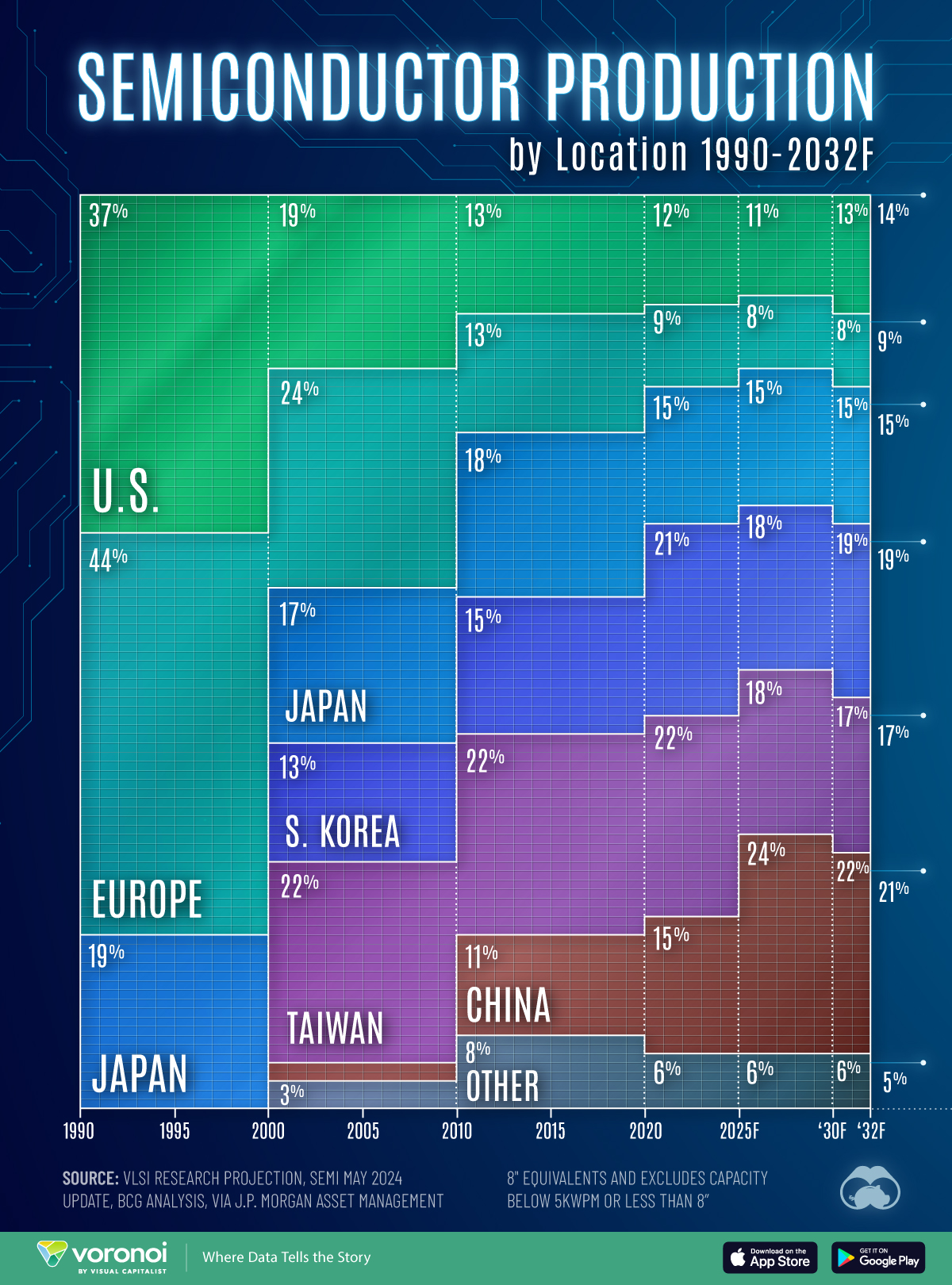
That seems a bit too simple. I saw one particular graph [0] once that really stuck with me illustrating just how decisively Europe was ejected from the semiconductor market. It takes more than just inaction to achieve results like that. In many ways it could be called an impressive feat that only the Europeans could achieve. 44% of production to 9% - losing a steady 1% of the market every year, largest to smallest player. No other region is even in a position to do that badly even if they tried.
It is possible. But that seems out of character for the Europeans, they're pretty consistent about going the distance to make absolutely sure that the next new thing doesn't happen in Europe.
It seems much more likely they had a suite of environmental, social and trade policies carefully calibrated to move semiconductor manufacturing somewhere else.
Part of it is simply the Euro being too strong. Taiwan has a (deliberately) undervalued currency that makes exports a lot more competitive, the EU does not.
It's a super simple strategy with profound effects but somehow still very underappreciated
>when they could have simply driven the few kilometers over to Eindhoven and bought an ASML machine for "Silicon Saxony"
That's not at all how it works. You're talking as if you're buying a plug-and-play Xerox copy machine that you can just unbox and start printing copies of your work and make money.
Buying the latest EUV machines doesn't get you the latest nodes and economically viable yields.
Intel, Samsung also have the latest ASML machines that TSMC has and yet they haven't caught up to TSMC because there's a lot more to semi manufacturing that just the machine itself.
If Germany just buys an ASML machine it would be an expensive paperweight without the process know-how that engineers at TSMC have amassed over the decades in order to get the most economically competitive yields.
It is so absurd to think that an investment in even the most uncompetitive fab while one has currently none is uneconomical.
Even if this fab is 3 times more expensive then other ones, the result of not having one will tank the entire economy and GDP of a nation if things go bad.
We speak here about trillions of damage while a fab costs only a few billions.
> Even if this fab is 3 times more expensive then other ones, the result of not having one will tank the entire economy and GDP of a nation if things go bad.
That's hogwash. Sorry. Human society won't simply stop working just due to the lack of 2nm chips.
There are plenty of chip manufacturers around the world, including EU ones. Taiwan only has the quasi-monopoly over the cutting edge process.
What are you talking about? There's a lot of fabs in Europe, just on much older nodes than Taiwan, US and Japan or even China have.
>We speak here about trillions of damage
Where did you get the trillions from?
>a fab costs only a few billions
Billions just to build, but then who's gonna foot the bill for running it, if the fab is not economically competitive to those from Taiwan and Japan, at EU domestic wages, EU environmental regulations and lacking knowhow supply chains that needs to be built up in the EU? The taxpayers again?
The German government (meaning the taxpayers) are still subsidizing energy costs to keep manufacturing from collapsing or leaving the country altogether because it's not internationally competitive anymore.
So how much more of the private sector should the taxpayers subsidize before we take a look at ourselves in the mirror that everything is FUBAR and that endless taxpayer funded subsidies(aka corporate welfare) are just disguising the endemic rot while not actually fixing the problem?
The only forward facing government that actually had a drive to change anything useful for the future broke apart with internal squabbles, with a big part of it by the market liberals torpedoing things left and right. And now we're back to a government of stand still, like we did the almost two decades before.
Not sure what you're talking about. The last "forward facing" government was about 50y ago, the last one at least driving meaningful reforms almost 25y ago. To me it seems the more Europe got integrated, the more Germany lost the plot.
This standstill mostly started happening when the capitalism took hold too deep and wide, look at Sweden and its golden age that lasted until all the restrictions on capitalism were silently removed.
While capitalism is a good model, it needs to be kept balanced, restricted..
Shareholder primacy is ruining everything, too much influence in politics from too many external sources.
If every time you’re shown an inkblot you see right wing talking points materialize in front of your eyes, it may be time to take a break from social media.
Bringing up net zero in a thread about semiconductor manufacturing is a complete non sequitur. Fabs run on electricity which is quite easy produce without emitting any CO2.
They may be but that doesn’t make them wrong. I don’t keep track of what everyone on any “side” tall about and how many percentages do what. That’s noise. The arguments are valid regardless of who says them.
The US has done a lot of unsavory things. But this comment is just disingenuous.
For example, discounting Ukraines unwillingness to simply accept foreign rule by the country that brought them Holodomor as purely based on American propaganda and arms sales is either delusional or Russian propaganda.


For servers at work, I tried running Fedora. The idea was that it would be easier to have small, frequent updates rather than large, infrequent updates. Didn't work. App developers never had enough time to port their stuff to new releases of underpinning software, so we frequently had servers with unsupported OS version. Gave up and switched to RockyLinux. We're in the process of upgrading the Rocky8-based stuff to Rocky9. Rocky9 was released 2022.
reply