I think these examples still loosely fits the author's argument:
> There are some cases where big data is very useful. The number of situations where it is useful is limited
Even though there are some great use-cases, the overwhelming majority organisations, institutions, and projects will never have a "let's query ten petabytes" scenario that forces them away from platforms like Postgres.
Most datasets, even at very large companies, fit comfortably into RAM on a server - which is now cost-effective, even in the dozens of terabytes.
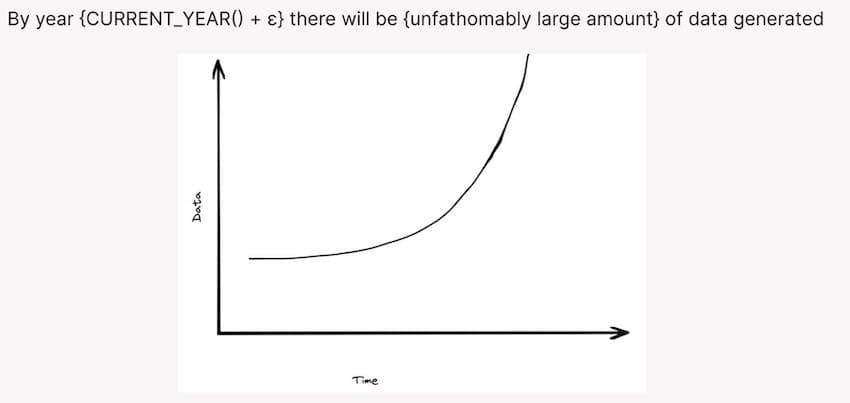
Big data is not only about storage size but also about processing e.g. RAM. In the next coming years the trend is that there will be more (read exponential) IoT sensor devices than we can ever imagine and the nature of their data will be mostly big data in the sense of size (storage) and the analysis (RAM). Just check the latest cars or EV cars, many of them have hundreds of sensor devices and these devices are already connected to the Internet.
Another upcoming example is the latest 5G DECT NR+ standards (the first non-cellular 5G), it will only fuels these massive accumulation of datasets and these monitoring sensor devices do not even get connected to the Internet (think of private factory networks) [1].
Apparently there are limited number of human using or having sensors but for non-human based devices the sky is the limit. For human based communication the data is very limited, we rarely communicate with each others and most of our data now is based on our intermittent media consumptions while streaming audio/video [2]. For IoT sensors devices, they mainly have regular and frequent interval sampling that probably in the ranges of every seconds, minutes, hours, etc. Some if not most of this data is not clean data, there are raw data, and raw data is inherently big and huge compared to the data, for example raw image data vs JPEG data, where the former can be several time bigger in size and processing requirements.
[1] DECT NR+: A technical dive into non-cellular 5G:
This is a quite good allegory for the way AI is currently discussed (perhaps the outcome will be different this time round). Particularly the scary slide[1] with the up-and-to-the-right graph, which is used in a near identical fashion today to show an apparently inevitable march of progress in the AI space due to scaling laws.
This was the big one for me too. The juxtaposed healthy versus unhealthy lungs resemble an uncooked chicken versus a roast chicken which was left in the oven for 30 minutes more than necessary.
The antismoking PSA that made the strongest impression on me, by far, was the one that showed a grandfather encouraging a baby to take a step. Eventually, the baby starts walking, and rushes over to the grandfather.
And through the grandfather, who fades to translucency.
It wasn't just me; that PSA made enough of a splash that it was called out on Friends.
I've tried to find that PSA in the past, but with no success. Once I asked a friend if they could find it, and the response was "Oh, I know exactly the one you're talking about. I won't help you look for it. I hate that commercial and I don't want to see it again."
I note that the second comment is "This commercial was what made my father stop smoking." It's interesting to think about the balance between disturbing the smoking audience so strongly that they stop, and disturbing the non-smoking audience so strongly that they complain about being exposed to your traumatic imagery and imperil your funding.
There have been some Oceanic anti-speeding ads that had the same effect on people, apparently. There's one where time freezes right before a collision and the person at fault apologizes for the little boy he's about to murder. There's one where the driver is talking to the ghost of his friend who died in a car crash. There's one where the grim reaper spins a roulette wheel every time a driver makes a mistake at an intersection. There was one where they rewind time, nudge the speedometer slightly lower, and resume normal time, and a fatal accident (pedestrian hit by car) turns into a bruised leg.
The UK has an age-based advantage in this metric. Oxford & Cambridge are nearly 1,000 years old. Once you take that into account, the stat becomes "of the top 8 universities (ex. Oxbridge), 2 are in the UK and 4 are in the USA". Imperial is very high quality institution, definitely the peer of Berkley/Yale. UCL normally isn't thrown into the top 10 though - it'd usually appear in the top 25.
Bologna cannot be faulted for not being able to capitalize on its age.
Northern Italy went through an awful lot of tumultuous history between 1450 and now that England didn't experience: it was cut up into lots of little fiefdoms, dominated by several external powers, and generally kept under constantly changing iron thumbs.
> I don’t think it’s any longer about access to capital
The link provided as proof for this comment is Wayve receiving a $1bn injection from Microsoft and Nvidia [1].
The $1bn raise is not the concern of a budding 23 year old graduate leaving Imperial/Cambridge/Oxford. They're looking at the first £100k capital to see them through the first few months. In the UK, the scene for the first capital injection is far weaker than in the US, which has an inevitable downstream impact.
Been a while since I was in this position but that first £100k used to be a cakewalk. SEIS made it almost a no-brainier for any high net worth individual to invest in startups.
and it still should, as I understand it. On a £100k investment that the business loses all of, the investor gets £75k (£50k tax relief + £25k-ish loss relief) back or something ridiculous, don't they? Makes me wonder how this hasn't made UK capital more readily flow
The challenge in the UK at the moment is connecting willing high net worth individuals with entrepreneurs. Even with the tax incentives, and the relatively good incubator-ish organisations like Eagle Hub, there's some enormous disconnect between viable ideas and timely capital to execute on them.
>Yes, there will be a need for more research in safety, for sure, but this is not something any company can do in isolation and in the shadows.
Looking through Antrhopic's publication history, their work on alignment & safety has been pretty out in the open, and collaborative with the other major AI labs.
I'm not certain your view is especially contrarian here, as it mostly aligns with research Anthropic are already doing, openly talking about, and publishing. Some of the points you've made are addressed in detail in the post you've replied to.
IPO announcements need to come from approved/authoritative organisations. This one is distributed by the UK's authoritative organisation - RNS news. In the other territories, IPO announcements also have to be made by authoritative organisations. RNS is approved in the UK, but not the other territories.
While he'll be giving up a lot of wealth, it's unlikely that any meaningful NDA will be applied here. Maybe for products, but definitely not for their research.
There's very few people who can lead in frontier AI research domains - maybe a few dozen worldwide - and there are many active research niches. Applying an NDA to a very senior researcher would be such a massive net-negative for the industry, that it'd be a net-negative for the applying organisation too.
I could see some kind of product-based NDA, like "don't discuss the target release dates for the new models", but "stop working on your field of research" isn't going to happen.
Kokotajlo: “To clarify: I did sign something when I joined the company, so I'm still not completely free to speak (still under confidentiality obligations). But I didn't take on any additional obligations when I left.
Unclear how to value the equity I gave up, but it probably would have been about 85% of my family's net worth at least.
Basically I wanted to retain my ability to criticize the company in the future.“
> but "stop working on your field of research" isn't going to happen.
We’re talking about NDA, obviously no-competes aren’t legal in CA
> Unclear how to value the equity I gave up, but it probably would have been about 85% of my family's net worth at least.
Percentages are nice, but with money and wealth absolute numbers are already important enough. You can leave a very, very good life even if you are losing 85% if the remaining 15% is USD $1M. And if not signing that NDA will help you landing another richly paying job + freedom to say whatever you feel it's important saying.
At some point in the future, economics textbooks will teach about "the programmer ouroboros". A group of high-skilled people who existed between ~1960-2040, whose collaborative and open approach to information sharing was ultimately used to render their own profession defunct.
You make that sound bad, but I would see it as a massive win. I don't want to spend my time solving small variations of problems that devs before me solved countless times. Call me overly optimistic, but I believe that if we can literally automate ourselves out of the whole profession, I it would leave us with the more interesting problems, even if they're just about "what to do with our time, now that all of our basic needs are taken care of by automation".
> now that all of our basic needs are taken care of by automation
An AI being able to consistently outperform us in recalling the syntax for switch statements, is a world away from "all of our basic needs being taken care of by automation". The former is going to take a few more weeks/months, while the latter is going to take a few more decades/centuries.
In the interim, there will be some winners, and many losers from this innovation. Wealth will concentrate significantly towards the winners, while the losers will be out of work with a valueless skillset, and their basic needs going unmet. While this may be true for most high-skill professions in the coming decades, there's a unique irony for programmers - who will be the losers, having invented and then fueled the engine of their own demise on behalf of the winners.
It's not necessarily a value-judgement based comment. It's just noting the irony, and highlighting that it's a specific genre of irony that economists absolutely salivate over.
> An AI being able to consistently outperform us in recalling the syntax for switch statements, is a world away from "all of our basic needs being taken care of by automation". The former is going to take a few more weeks/months, while the latter is going to take a few more decades/centuries.
Well then that may just refute your claim that the profession would become defunct by 2040...
> Call me overly optimistic, but I believe that if we can literally automate ourselves out of the whole profession, I it would leave us with the more interesting problems, even if they're just about "what to do with our time, now that all of our basic needs are taken care of by automation".
Haven't we been promised this for literally a century? We don't even have a four-day workweek.
You realize when you get automated out of your job, you need a new job? The "interesting problems" you'll be left with are hoping that you don't need to go to the ER after your health insurance ends
You’re posting on a site where many people think that for-profit employment will be replaced with UBI in the sense of a stipend which will free most people up to pursue their dreams and desires.[1] So 200+ years of for-profit employment and wealth extraction which created a very impressive wealth disparity until One Weird/Genius Policy proposal by Andre Yang/Musk will usher in the post-scarcity era.
[1] As opposed to something that will keep you alive but perhaps not give you any means of expressing or pursuing your interests. If UBI even becomes a thing.
> You’re posting on a site where many people think that for-profit employment will be replaced with UBI in the sense of a stipend which will free most people up to pursue their dreams and desires
Sure, but until you actually see evidence that this will become a reality instead of a pipe dream, you should be planning accordingly, right?
Even the most UBI optimistic people should expect there to be a very painful period of time where things are being automated and people are unemployed en masse which could last a long time before any kind of UBI is enacted
There's already UBI. It's called fake jobs. Programming has already mostly automated itself out of existence for a long time. Very few developers ever get the opportunity to write data structures and algorithms, because most of what they do is just slapping together glue code for existing libraries at cushy sinecures at places like Google, where PhDs are paid to write HTML and play air hockey. If the machine can write the HTML and glue too, then there won't be much left over about the job aside from the ideology and politics. People will be given positions not for their skill but for their loyalty to land owners. The only solution I feel is to use technology to make sure our brains continue to be smarter than the latest $300 graphics card.
How come is it a US only problem? Well, the way the problem is stated is US only, but everyone will need a new job to bring bread on their plate or pay other bills? Whether they live in the US or not. Is it not true?
You're not wrong - but healthcare is the concern here because it represents the risk of sudden, unexpected, and massive costs at the worst possible time. Whereas having to eat and pay rent/mortgage is a known and predictable cost we can plan and prepare for.
While the ACA filled a lot of gaps, it's still possible to find yourself without insurance and without any insurer who will take you on - or being unable to afford it (which is what unemployment tends to do to people...), especially if you're above the cut-off limits for state and federal aid.
As you know that is only one of the potential problems caused by unemployment. Pointing out a concrete, potential life-or-death problem gives more punch than just saying abstractly that there will be problems.
So the boring version: you will be left with the problem of a sudden loss of money as (concurrently) labor power vanes because LLMs don’t go on strike and you have no one to complain to since no one with any power has to care (see: LLMs don’t strike) that unemployed person #5468 today couldn’t pay their mortgage again and/or started on an opioid death-of-despair campaign.
You're getting hung up on an irrelevant detail and missing the point. The point is that one will still have bills to pay even after they don't have a job. That is not a US-only problem, that is a human existence problem.
Programmer's job isn't writing code - it's solving customer problems. And it's unlikely that customers will stop having (and creating new) problems.
"No job" is only a problem for someone who refuses to learn and move on. It's similar to having a child - first you have a job as a technician, then teacher, then mentor and lastly you are out of job until your customer makes you grandkids to care for, or something. ;-)
Put a programmer out on the street, and they'll be on LinkedIn in 5 minutes with a big "For Hire" sign on their profile, like 99% of other people.
The idea that programmers serve some higher purpose in society ("solving customer problems") that frees them from the whims of corporate restructuring or bad management is laughable. Pray tell, how many programmers employed by Google or Netflix are solving actual problems? As opposed to helping build a bigger competitive moat?
Customer in this situation is the corporation - it's not much different; someone pays for some result. And there's enough reasons to hire programmers even when they don't write any code (look at the amount of people FANG hire - programmers who actually write code are minority).
Jobs as we know them have only been around for 500 or so years. There have been other ways of living beforehand and I expect we'll be about to figure another way in the near future. The only real argument I see for keeping jobs around even when human labor isn't needed anymore is the protestant moralistic one, and I don't buy that one.
The abstract occupations of most people for all the thousands years of advanced society (marked by the ability to accumulate and hoard food or other kinds of wealth) have been marked by subjugation in service to some elite classes. Naturally some people are a bit concerned about their future and are not content to just stumble/bumble into the future and see what kinds of “ways of living” the powers that be have in store for them.
Automation doesn't replace human work, it just amplifies how much work can be done.
There is -plenty- of work out there that's currently not worth taking that will be suddenly worth it if you can code 100x faster than you can now. It might be for jimbob's landscaping company instead of google, but that hardly matters outside of your ego.
So the US folks will have a real problem rather sooner than later. Of course, we others as well, better start investing time in woodworking, mechanics, healthcare or agriculture...
But health insurance is easier if you’re getting paid (as are many other things including eating and rent/mortgage) is different from the idea that healthcare is tied to a job post-ACA.
I’m not totally seeing your point. Being paid allows you to spend more money. I agree with that statement.
Many countries have managed to separate healthcare coverage from your current employment status with better results and at lower costs than in the US. The US should learn from others solving problems better.
Also healthcare has been tied to work in the US since long before the ACA.
Is it not the ultimate goal of all human labor to progress past the need for certain menial jobs? It seems to just be the natural progression of technological advancement, not the rapture.
Nothing natural (as in inevitable) about it. The crossbow was put to widespread use because it was like a deskilled regular bow. Then muskets because they were even easier to train for.
> ... whose collaborative and open approach to information sharing was ultimately used to render their own profession defunct.
Before that happens, so many other professions shall then have been rendered totally obsolete. So many it'd have profound societal consequences. I understand the "me, myself and I" and the fear but programmers coding themselves into irrelevance is really the least of our concerns.



> There are some cases where big data is very useful. The number of situations where it is useful is limited
Even though there are some great use-cases, the overwhelming majority organisations, institutions, and projects will never have a "let's query ten petabytes" scenario that forces them away from platforms like Postgres.
Most datasets, even at very large companies, fit comfortably into RAM on a server - which is now cost-effective, even in the dozens of terabytes.