For cryptography it uses the ring-library which still relies on C-Code in many places. Additionally there is no API-stability (still v0.*) and the last official audit was 3 years ago.
The project has potential but isn't quite ready for prime time yet.
Importantly, that C code (and assembly) is in the guts of crypto primitives. Those tend to be a lot easier to test than higher level X.509 parsing code, which I think is all done in safe Rust.
But for sure, taking a dependency on RusTLS from C code isn't a "boring" choice, and I wouldn't pretend to be confident that that would all go smoothly for a big project.
Why put the commit message there then? You could just use a git-client that adds this text as description for commits. There is generally little use to store automatically generated content in databases, the input for generation should be enough.
Attack complexity High (chance for an attacker to get anything at all is very low), Availability None (you're not crashing any service that's running in the background) and Confidentiality Low (data leaked is not in the attackers control and not likely to be interesting).
Adds up to a score of 2.9
IF you can execute code this way (which is an IF) then it's way more severe than a 2.9, and you could absolutely do anything you want with the system (you'll be root).
Complexity High isn't about what an attacker gets, it's about whether or not any specific configuration must exist for the attack to happen. For instance, if an app that talks to several services over different file transfer protocols has a vulnerability in only the FTP component, and these are not under attacker control, that's Complexity High.
Mentioning Greenland ice sheet in this context is always a bit of a red herring.
It is important to note that in the language of these simulations no "overshoot" is included in the temperature trajectory. A 1.5°C global warming is talking about the long term (millenial timescale) stable temperature we reach after our little "experiment".
If we can "quickly" (a few hundred years) return to 1.0°C or even less warming, compared to pre-industrial levels, these tipping points have not actually happened yet. (https://www.researchsquare.com/article/rs-1418830/latest.pdf summarizes this very well)
Nico Wunderling shows that while for some systems (like the Amazon rain forrest) peak temperature (even over only a few years) is most important, for slower systems like the Greenland ice sheet the target, long-term temperature is most dominant.
Priotizing the most urgent matter should therefor lead us to talk about the quickly acting tipping points, often related to biological ecosystems. For those it is most important to actually stay below 2°C of warming. For the Greenland ice shield there is ample time after the year 2100 for us to prevent the worst.
Democracy is not a good in itself. Democracy reflects the will of the people and the honesty of members of administration. If either of those are shit so is the democracy.
A good estimate to gauge the societal investment needed to generate electricity in a certain way, is to look at its total cost in dollar/MWh. Wikipedia has a nice graphic prepared for just that: https://en.wikipedia.org/wiki/Cost_of_electricity_by_source#... (which ignores externalized costs like CO2 or nuclear waste)
You can see in there that nuclear has triple the cost compared to solar.
As we need to replace as much fossil-fueled power plants as possible and as quickly as possible, wasting ressources into building nuclear power plants sounds stupid.
Other interesting factors:
And how does that compare to the business-as-usual shutdowns of solar (every night, cloudy days, winter as a whole) which unlike nuclear are highly correlated between separate plants?
If storage is cheap enough then solar will be an important part of the mix. But unless you have the right geography for geothermal or hydro (which probably means flooding a bigger area than the chernobyl exclusion zone before you've even started, but leaving that aside), nuclear is still the only viable option for clean, reliable baseline power. It's not an either/or, we should be building both.
I heard somewhere that the base load of power is an mostly an outdated concern at this point. As more homes get solar and offload their excess power back into the grid during the the daytime. Reducing the baseload to negative.
You have to read these partisan pieces carefully. When they say "a mix of renewables and natural gas can x", they actually mean "natural gas can x" - but burning natural gas emits CO2. And a 30% wind grid in Texas worked out right until it didn't (the media blamed it all on lack of "winterization" which may be the immediate cause, but the fact is that the high wind mix meant the grid was having to work a lot harder and is one of the biggest underlying causes).
For all that article's efforts to quibble with definitions, the fact is that a grid that is all or mostly renewables (except for hydro and geothermal, which are great for the places that are suitable for them, but not available everywhere) will have blackouts. Lots of things can be demand-managed but lots of things can't. If you want electricity to be available 24/7 then the grid absolutely does need to "overpay" for generators that are available 24/7 (and sure, nuclear plants have unexpected shutdowns like anything else, but those outages are going to be uncorrelated with each other), and whether you call that "baseload" or some other term is neither here nor there.
Agreed. Natural gas is not a feasible alternative to coal and oil on its own as the greenhouse emissions are simply to high. However, a natural gas power plant that runs only when demand calls for it and renewables (+ stored renewables) are unable to supply is not an end of the world scenario (which our current climate trajectory certainly is).
I’m even hopeful of a future where these natural gas plants will have carbon capture employed. But you are right, as it stands natural gas power plant is not a solution to the climate crisis.
That is just to show that nuclear isn't a magical always-on power source that some of the pro-nuclear folks make it out to be. Also: we can install twice the capacity in MW for solar and still have money left over to put into a smarter grid or storage compared to nuclear.
Firstly, you talk about $ per capacity in MW, however solar capacity factor is 20%. Only use a levelized cost per MWh.
Secondly, solar needs storage which you think is trivial, but which turns out to be wayyyy more expensive than the solar panels. Some reports[1] only compare short-term (peaker generation) for storage. Nuclear is expensive, but battery storage is far more expensive to cover daily or longer load variation (non-peaker). That report mentions in a footnote a levelized cost of storage of crazy high $1613/MWh to $3034/MWh.
I strongly disagree with your point “we can install twice the capacity in MW for solar and still have money left over to put into a smarter grid or storage” because you appear to be making up numbers - what is your reference to sources?
You used MW in that comment - your new comment is not clarifying whether you made a mistake or what your actual point is.
LCOE is an averaged cost/MWh, which is absolutely inappropriate to use when discussing whether nuclear is expensive or not, because LCOE ignores usage patterns (which you obviously know, but are hand-waving away as “money left over”). From your Wikipedia link: “One of the most important potential limitations of LCOE is that it may not control for time effects associated with matching electricity production to demand” and “To ensure enough electricity is always available to meet demand, storage or backup generation may be required, which adds costs that are not included in the LCOE”.
Finally, almost any plot that uses “installed capacity” is deceptive by design: because capacity factors make solar/wind appear 5x better, which is not a trivial difference on a graph. Instantaneous capacity is usually not relevant (except during “peaker” loads).
The big con for a solar/battery grid isn't the cost, it's the raw materials. We need an absurd amount of copper/lithium/cobalt etc.. and we need to be mining orders of magnitudes more than we do now.
That is not a proven fact. We probably need more silicon for the solar cells. But there is nothing about lithium ion batteries which makes them our only good choice for storing energy from renewables. Gravity is probably our best energy storage at present, there is also nickle metal hydrade for home storage, and in the near future we are probably gonna be looking at molten salt batteries (e.g. calcium-antimony liquid-metal batteries) for large scale storage. We are probably only gonna need to mine the lithium and cobalt for our consumer electronics (including electric cars). For public transit systems that can’t connect to the power grid for some reason, there is always hydrogen fuel-cells.
So no, we are not going to be needing an absurd amount of any one mineral (except maybe silicon) as they all have alternatives which quite often are even better then lithium and cobalt.
Silicon is the second most abundant element in the Earth's crust. Pick up a random rock and it will average 26% silicon. There is absolutely not ever going to be a shortage of the element silicon.
But the storage costs for winter are on the order of 100x the power generation. Solar does not contribute to baseload, so it's just a waste of effort, talent, and resources.
No one is saying that they don't have problems. What they are saying is that they have less problems than the alternatives.
In your example: when there's clouds and the wind doesn't blow, what happens? Currently we burn coal, gas and petrol. This means that in order to accept hydro and solar as the main source of energy, we have to take fossil fuels along, as a backup. Unless we find a different backup.
You back up the entire grid with combined cycle plants burning hydrogen. Even if you hardly ever use them, that's affordable compared to running nuclear power plants.
Or you use some even cheaper (but more complex) combination of various storage solutions, transmission, and demand dispatch.
"when there's clouds and the wind doesn't blow, what happens?" Meteorologically speaking that won't happen over a large enough area like Europe or USA. When there's clouds there's always wind close by. It's also never cloudy over a whole continent (air has to come back down somewhere)
What is more interesting to me is asking the question based on first principles.
If you consider the global electricity and energy demand and wanted to meet it, what you produce the least amount of green house gases, use the least amount of land, require the least amount of mining.
If you actually do that nuclear wins easily witch suggest there is some other process at work that makes sure this is not translated into reality.
I was asking why land and mining are so all-important that minimizing either (or both, is that even possible simultaneously) is the relevant objective function here.
Land use is a cost. Mining is a cost. We minimize overall cost, not one specific thing that has a cost.
I will add that society is clearly happy with using land for that very low payoff activity we call "farming". The $/acre from PV is much higher than that from farming, you know.
I don't get the impression you've thought very clearly about all this.
Sentences that apparently mark cognitive distortion:
"The quality of our product is not acceptable yet.",
"I won't go to this meeting, because I feel nauseous.",
"Children should go to school."
I think this is trying to solve delivery inside cities. However, I don't see cities beeing clogged by parcel delivery services. Transportation of goods is more problematic on the inter-city level. But that's too far to build a tunnel.
What is causing troubles for cities seems to mostly be human traffic (that's why rush-hour is a thing) - for that subways could indeed be a solution.
Unless Switzerland's traffic is looking completly different from what I know from Germany of course?
All your questions can be answered with "Switzerland has a functioning railroad" (for public transport).
Compare the modal share between Zurich and Frankfurt [0]. 44% of travelers in the Frankfurt area use a private motor vehicle, whereas only 21% do in Zurich.
> However, I don't see cities beeing clogged by parcel delivery services.
Cities are clogged by any kind of vehicle period. Particularly delivery trucks will run into issues in the future as more and more European cities start enacting low emission zones/diesel bans inner-city [0], yet the overwhelming number of delivery trucks are diesel.
> Transportation of goods is more problematic on the inter-city level.
Inter-city has rail and lorries with trailers, both do not work inside the city where every extra vehicle leads to extra congestion due to the high density of everything.
> Unless Switzerland's traffic is looking completly different from what I know from Germany of course?
Berlin, Darmstadt, Hamburg and Stuttgart already have diesel bans and low-emission zones inner-city. In most bigger cities driving into the center is an exercise in frustration, not just due to congestion but particularly due to lack of parking spaces.
> Cities are clogged by any kind of vehicle period. Particularly delivery trucks will run into issues in the future as more and more European cities start enacting low emission zones/diesel bans inner-city [0], yet the overwhelming number of delivery trucks are diesel.
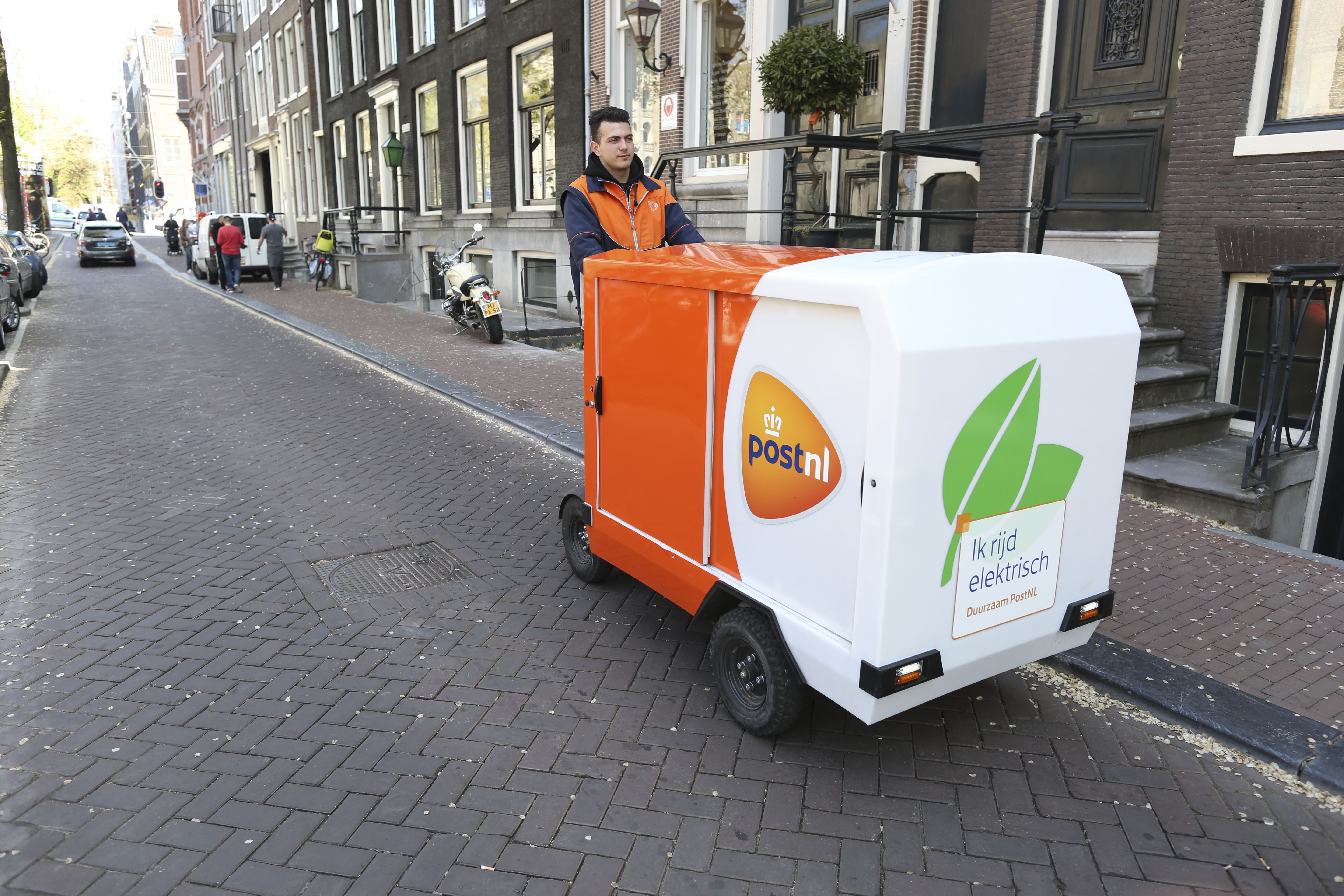
Here in the Netherlands, it seems electric delivery vans [1] and cargo bicycles [2] are becoming more and more popular.


The project has potential but isn't quite ready for prime time yet.