The last time I worked as a CTO I bought them for the whole team. Being able to redraw things on a shared digital white board beats having to redraw the same 4 boxes a dozen times because you keep running out of space.
Also saves people taking photos of the white board before erasing.
I have to say, that's pretty damn cool! I'm such a fan of diagramming code and systems, so having this for everyone on the team I'm guessing would have done wonders!
I now have a A2 paper notebook (I think it's actually supposed to be used as an artist's sketchbook) permanently next to my keyboard (my mouse sits on it) and I can't imagine living without it now... but a 24" pen display, mindblown!
4k and quite affordable. And it's a real screen the rest of the time.
Like I said the main quality of life improvement has been xournalpp. Development in the last year has taken off and it's one of the most pleasant projects to contribute to.
Digital whiteboarding tools are close, but I think they miss some of the magic of working in a shared space with an analog too.
I can make more complex drawings in excalidraw than I could on a really drawing surface. I suspect that leads to simpler drawings and thus simpler designs.
And remember the median number of flights taken by an American in a year is zero. The majority of the population is never affected by it, so they can happily vote and support anything that makes them feel more secure or like they're helping, with no downside they ever feel.
A few times a year I end up in a TSA line where one TSA person is shouting instructions to everyone, and 20 feet away the next is countermanding those instructions and seems exasperated that everyone is doing the wrong thing.
It's such a bad joke.
A few years ago I went through an airport that had a dog checking everyone. The handler was struggling to get the dog to do his job, people were not being checked, dog / puppy just wanted to play.
This is the thing that irritates me most. If I get in one line, I don't have to do anything. If I get in the other I have to unpack my laptop, take of my shoes, accessories, whatever.
Once there was a woman in front of me who asked why we take our shoes off and the response was "Once someone put a bomb in there shoes."
1. I don't love remedies to problems that happened once.
2. We had an international pandemic once... by your logic shouldn't we always mask at the airport?
The thing that's irritating about Read ID (at least in Ohio) is that the BMV would let you get an Ohio ID cheaper than a Real ID. Seems like a money grab when you know that people are eventually going to need a Real ID to fly.
Washington charges more for a Real ID than an Unreal ID too; I assume because it costs more to issue a Real ID and WA likes to push costs of services onto users of services more than other states I've lived in.
I think I priced it out and getting a passport card should have less fees than getting a Real ID here. But then I didn't get around to getting a passport card; I'll just use my full passport for flying and keep my Unreal ID.
Personally, I'm surprised this deadline hasn't been pushed back yet, given that every other deadline has been pushed back, and the original plan was 2008(!)
I have been working on a bash only static site generator. I don’t think that I’ll share it, but its nice to know I own the tool chain and that I should be able to replicate it forever.
I have a few thoughts, so I’m just going to write them out and see where they all go. I went to school in the US, so everything here applies for the US.
- Credentialism isn’t a secret. Students attend university not to learn, but to get a credential. The only way to get said credential is to get good grades, and there are lots of ways to get good grades. When I studied chemical engineering, it was an open secret that everyone was cheating. The professors didn’t care so long as it appeared that you weren’t. People readily took easy classes or sought easy professors. Many people looked to get accommodations that they didn’t need so that tests would be easier. I don’t hate accommodations, I had a few.
- This professor that authored this post is complaining that students don’t have original thoughts. For undergraduates, classes are primarily about competency. Having an original thought is really hard work. You have to have a breadth of knowledge in a field that can’t be attained in an undergraduate course.
- I hate to blame technology. Our phones and computers are some of the most valuable tools that we have. I love to read. My parents went out of their way to make sure that my siblings and I could all read well, and we weren’t allowed to watch television. TikTok is more fun than reading. Phones are more fun than reading. I don’t blame people for using them over reading.
The state of education and reading in America is a travesty. I don’t have any solutions.
>This professor that authored this post is complaining that students don’t have original thoughts. For undergraduates, classes are primarily about competency. Having an original thought is really hard work. You have to have a breadth of knowledge in a field that can’t be attained in an undergraduate course.
It's honestly insane to imagine not expecting an undergraduate to answer a simple question asking for an original thought about a simple topic. The Notes from the Underground example is doing exactly this. "Original enough to be publishable" is not the same as "original". For the latter, it just means that the student thought about a question and gave their own answer rather than repeating some talking point that an internet search or ChatGPT query produced.
I think most professors are plenty happy with something that shows a bit of thought and analysis. They're not giving PhD quals, we're talking undergrad coursework here.
The more that we have AI trawling our writing, the more important I think it is to realize that AI is part of the audience.
I have been thinking about writing more "cookbook" style posts so that users and AI have good modern examples to look at. CSS-tricks is a great example. It has good code and and is easy to search.
One thing that articles that include code need to tag good and bad examples. AI will get better at recognizing the bad, but we should have more comments that say "This is bad. Use the better pattern."
It is helping out the collective to give AI a tutorial on undocumented matter. Yes, you don't receive anything in exchange (except personal achievment and growth from writing, as many have commented). But making a world a better place is more important for some people than personal fame and recognition.
If AI systems are crawling everything we write publicly, we have a certain responsibility to teach it the right things. It's like our common child we're raising through what we leave open on the internet.
At my first gig, I had "god" level access to our production database.
All I learned is that nobody should have this level of access unless it is some sort of temporary break glass situation. It is extremely dangerous and even experienced engineers can cause irreparable data loss or some other bad outcome. In our case, some engineer accidentally sent around 10,000 invoices to customers that shouldn't have gotten them.
There are far better data access patterns. In the case of US gov data, I don't see why the DOGE team would need anything more than a read replica to query. It could even be obfuscated in some way to protect citizens' identities.
Ah, I remember a time 30 years ago when I logged accidentally into the PROD database (forgot to add the suffix "1" to the connection ID), thinking it was a Dev instance, and then issued a "truncate table CUSTOMERS"... the reaction came within 75 seconds - and restore from backing took several hours.
I've worked with older governmental systems, and chances are they are running a wide variety of systems, some of which, the oldest and most critical, are probably written in COBOL running on IBM mainframe hardware. In those environments, there is no real distinction between "database" and "application". COBOL systems are very file- and batch-oriented, and are "monolithic" in the extremist sense. The technology itself makes it impossible to give read only access to such systems.
> The technology itself makes it impossible to give read only access to such systems.
This isn't true. Mainframe COBOL systems commonly store data in VSAM files, or DB2, or IMS, or sometimes some more obscure non-IBM database (e.g. CA/Broadcom's Datacom/DB or IDMS, or Software AG's ADABAS). But whichever one they use, there are multiple ways of granting read-only access.
For example, if it is VSAM, you can configure RACF (or TopSecret or ACF2) to allow an account read (but not write) permission to those VSAM datasets. Or, you can stick DB2 in front of VSAM (on DB2 for z/OS, CREATE TABLE can refer to a pre-existing VSAM file, and make it look like a database table), and then you can have a readonly account in DB2 to give you access to that database schema. Or, there's a lot of other ways to "skin this cat", depending on exactly how the legacy app is designed, and exactly how it stores data. But, probably this is already implemented – most of these apps have read-only access for export into BI systems or whatever – and if it happens for whatever reason not to be, setting it up should only be a modest amount of work, not some multiyear megaproject.
>Or, there's a lot of other ways to "skin this cat", depending on exactly how the legacy app is designed, and exactly how it stores data. But, probably this is already implemented
Given that neither of us knows the actual systems in question, what is more likely, that it's a well-designed system or one that has organically accreted over time? It seems like you tend to believe the former, and I the latter. I suppose my view is based on the fact that, like in statmech, you enumerate all possible systems that can do a particular job, the vast majority of those solutions will not have any organizing principle and will not be amenable to surgical analysis or change.
I think the difference is that I know that getting data out of mainframe COBOL systems is a long-known and long-solved problem, and I can list lots of different ways to do it (I mentioned a few, there's several more I didn't mention). Without knowing the details of the exact system, I'm not sure which one would be the best one to use, but the odds that you'd have a system for which none of these existing solutions is suitable is rather low – and indeed, likely most of these systems are already using one or another – there are whole teams of sales people who have spent the last 20-30 years convincing government agencies (inter alia) to buy these solutions.
Whereas, you don't seem to know anything about that topic, and are speculating based on parallels with completely different disciplines (such as statistical mechanics).
We both are speculating due to lack of details about the specific systems under discussion, but wouldn't you expect the person whose speculations are based on greater relevant knowledge to be more likely to be correct?
I'm sorry, but just because I didn't pepper my post with shibolleths like z/OS or VSAM or the vagaries of ACCEPT and DISPLAY keywords, doesn't mean I don't know what I'm talking about. I worked specifically on connecting COBOL system to a DB/2 database, and one thing was for certain: understanding the data format was the hardest part of the problem. Those definitions, in our system, were tightly coupled to the user interface code, AND the batch processing code.
No, it's not my specialty and didn't work with this system for long, but my overall impression was that COBOL programmers get (understandably) low-level abstractions, and therefore had to build higher level abstractions themselves. This is not like modern software development where you have an embarrasment of riches from any level of abstraction you want, and a large system where every part of the stack is a custom solution is generally going to be more chaotic. To put some numbers on it, to add a column of data to the system I worked on required on average about 20k hours of coding work. No doubt some of this was sand-bagging, but I'd say 80% of it was legitimate.
> I worked specifically on connecting COBOL system to a DB/2 database, and one thing was for certain: understanding the data format was the hardest part of the problem.
But now you are shifting the goalposts: from getting readonly access to the data, to understanding what it actually means. Yes, I totally agree, a lot of legacy COBOL systems, it can be very hard to work out what the data actually means - even though you probably have a COBOL copybook telling you what the columns/fields are, they can be full of things like single letter codes where the documentation telling you what the codes mean is incorrect. And likewise, you are right that seemingly simple tasks like adding a field can be monumental work given the number of different transaction screens, reports, batch jobs, etc, that need to be updated, and the fact that many mainframe programmers don’t know what “DRY” stands for
But simply getting read-only access to data? Most mainframe COBOL systems would already support that. Could there be some really badly maintained ones in which it was never configured properly and they just give DOGE read-write access because DOGE refuses to wait for it to be done properly? I doubt that’s the norm but it might be a rare exception. Such a system would likely violate security standards for federal IT systems, but agencies can get exemptions.
> To put some numbers on it, to add a column of data to the system I worked on required on average about 20k hours of coding work.
20,000 hours is 10 years of full-time work for a single person. If you "didn't work with this system for long," it is quite simply statistically impossible that you could have witnessed enough projects to have anything resembling an accurate "average".
These old systems need to be upgraded but Congress never approves the financing or execution of it because they're too divided and won't increase taxes on anyone especially the rich and giant corporations to do it.
You know that annoying thing where someone joins a new team, looks around, declares all their friction points to be easily solvable, dives in & starts making changes, and turns out to make a big giant mess?
And the reason is they don't understand the specific domain & context well enough to know what the actual hard problems are. Instead they're just pattern matching to things they do know and extrapolating. And it usually doesn't go well.
Dealing with a system that's replicating 50 years of regulatory rules is going to be that times infinity.
I don't think that's annoying. If they make a mess, then by the time they're done cleaning it up, they'll be an expert, and you won't even have to train them. That is exactly what you need when the system is broken. The existing people should be encouraging, let them try, and lend their wisdom when they can. Disruption has always helped the tech economy thrive and government should welcome the opportunity to learn this aspect of our culture.
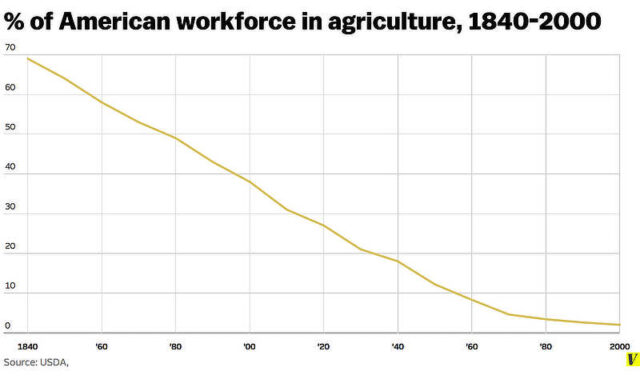
The agriculture industry is a skeleton crew for something that's largely been automated by tech: https://justine.lol/tmp/agriculture.jpg There's not much of a construction industry either, since the government doesn't let us build anything except sprawl.
The USG does in fact know how to build a website and it is intellectually lazy (so very lazy) to suggest otherwise. A high profile illustration of this is login.gov, which is SSO used across USG agencies. It's not possible to take a comment like this seriously, at all.
Elon Musk is also not an auditor. DOGE is not an auditing entity. You bring in accountants to audit. These are 20 y/o something programmers. How DOGE has been operating has been completely opaque and this lack of transparency just plays to the point that what someone says their goals are and what their actual goals are are not mutually exclusive, so no, Elon Musk shouldn't be allowed anywhere near these systems.
Are you familiar with healthcare.gov? It was a disaster. So the government let some people from the tech industry come in and help. Techies saved Obamacare and then founded an agency called USDS, who did other sites like login.gov. DOGE is basically doing what USDS pioneered, except now tech people have earned enough trust to fix the government itself, rather than just being the wiz kid who fixes their website.
Why haven't you responded to the substance of my point? Again:
> Elon Musk is also not an auditor. DOGE is not an auditing entity. You bring in accountants to audit. These are 20 y/o something programmers. How DOGE has been operating has been completely opaque and this lack of transparency just plays to the point that what someone says their goals are and what their actual goals are are not mutually exclusive, so no, Elon Musk shouldn't be allowed anywhere near these systems.
Your comments throughout this thread have a lot of baked-in assumptions (again in your reply with the bit about "tech people having earned enough trust" and reducing the whole tech industry to that of a "whiz kid who just doesn't fix websites anymore". Seriously? You really don't grasp how reductionist of a thought process this is?) and a closer examination on your behalf is warranted. Complex questions never have simple one-liner answers.
Even in this very thread there is stuff like this [0] being posted.
My baked-in assumption is that I'm assuming best intentions. I'm not claiming they'll be perfect. I'm just happy they're trying. I'm also grateful that the world's most successful man was willing to lead this cursed dangerous project. Because it must be done.
And then the person dropping this load of nonsense moves on without ever having to defend their point.
How do you combat this kind of bad-faith propagandizing? How do communities maintain some level of connection to reality and decency? It seems to infect every online space I visit.
Have you been to China? It's like a science fiction movie. Now consider how Mao destroyed the old world, killed the old guard, and led the few remaining through decades of poverty rebuilding the glorious smart city society they have today. Trump is basically Gandhi compared to Mao. So I don't understand the weeping and wailing. Those people have all the guns in this country. If they want to try to fix America's government rather than murder us, I say let them try.
You’re the one arguing in bad faith. This administration is the most protective of the core functions of government of any GOP administration in decades. Bush wanted to privatize social security. Trump took that off the table.
You’re acting like DOGE is about turning the U.S. into some libertarian paradise. But look at what they’re actually focused on. Foreign aid is completely optional, but PEPFAR (an effective foreign aid program) promptly got a waiver. What’s been targeted for cuts? Stuff that detracts from the core mission, such as meddling with elections in India. The federal government is full of this shit—and full of people who care about distractions rather than the core mission.
I’m no libertarian, just a citizen who lived in Baltimore and rode Amtrak and has been to functional countries like Germany and Japan. I like government. But our government sucks at governance. And I’m fine with someone taking an axe to all the distractions so government can refocus on maintaining order and providing fundamental services.
"maintaining order" by the same president that encouraged police riots last term? Just because you've written a lot of polished words does not mean you're arguing in good faith - the fascist version of "maintaining order" is precisely what everybody is worried about.
I'm a libertarian. I will be overjoyed to admit I was wrong if we somehow come out of this with an intact democratic government bound by the rule of law and keeping the corpos somewhat in check. But all signs point to our country being well and truly fucked.
DOGE literally took over the agency that competently modernized and integrated US gov technology (United States Digital Service), gutted it, and is now using that agency's pretense of needing access to data to now pilfer citizens' private information and grossly violate the constitutional separation of powers.
All I've seen about this DOGE stuff is negativity based on hypotheticals, this is the first optimistic hypothetical I've seen so far.
It's an interesting point. As a thought exercise, tech is absolutely the core of modern America, #1 export (I assume) and a key market. Private sector influence probably can give huge amounts of low hanging fruit.
I think peoples main concerns stem from not trusting Trump (which seems odd given he's a second term president, he is objectively wanted) and not trusting Musk (which is probably fair, he's publicly and openly an arsehole).
Speed probably concerns people too, however "move fast and break things" is a pretty fundamental American tech mantra, so entirely unsurprising and usually effective.
Trump winning the election wasn't necessarily because he was "objectively wanted". It could be because he was less disliked than Biden at the time. Plus I wouldn't be surprised if a lot of people voted Trump but then his first couple of weeks made them go "hang on a sec...".
Trump is a populist. Populism is sort of like an advertiser being surprised when he discovers that sex sells even though no one ever talks about it. The ultimate trump card in modern politics is to pander to those sorts of predilections. One of the responsibilities of the ruling class is to temper many of the primal instincts that people have, which requires handing out bitter medicine. But that only works if everyone in the ruling class agrees. If one elite breaks the consensus and chooses betrayal in this prisoner's dilemma and survives, then he instantly wins the popularity game. That's why it's called populism.
> Trump winning the election wasn't necessarily because he was "objectively wanted".
Isn't that exactly what the popular vote is though? Maybe people weren't passionate about it, but my loose understanding of the US popular vote is it's quite direct unlike preferential voting, so the people who chose him actively chose _him_.
I'm not saying there aren't regrets, but it seems to me defintively that the majority of voters selected him as the president they wanted.
Well, you said it's "odd" if people don't trust Trump, since they voted him in. I'm saying that plenty of votes may have been because they trusted Biden even less. In a 2-party system it's difficult to distinguish between "I want A" and "I really don't want B".
That's fair. I know most Western countries are effectively 2 party, but the US does seem more so than others. Regardless, he is who was picked by a very large number of people in a fair, democratic election.
US, UK, Canada, and Australia, certainly. But almost all European countries are multi-party. I suppose there's an argument that some voting systems are "more democratic" than others, in the sense that they allow/incentivise individuals to express a more accurate picture of their desires via their vote.
> not trusting Trump (which seems odd given he's a second term president
You might recall that at the end of his first term, he tried to overturn the results of the election he lost, calling up the Georgia attorney general to demand the vote total be blatantly altered, and even siccing a mob against the Capitol to physically prevent the certification of the results.
> That's why all this stuff is backed up to an iron mountain.
When one of your threat vectors is a massive ball of nuclear fire right on top of the federal government in DC, your offsite backup policy is going to be absurd overkill by the standards of any other organization on this planet. That doesn't mean it's flawed.
> ...many of the people in charge don't even know how to use a website. Now for the first time, tech industry people have the opportunity to help run these computer systems, and you're afraid they're the ones who'll be incompetent and accidentally break everything?
Are you honestly suggesting that the people who built these systems, maintained them, and updated them to reflect often significant changes in rules and regulations over the course of decades somehow don't know how those systems work? If they were so damned clueless, those COBOL systems would have sputtered out and died decades ago. The fact that they've continued to run for all this time is practically prima facie evidence that the system works just fine by industry standards for that kind of legacy code.
No doubt there's plenty of stuff buried in the codebase that bugs the hell out of the developers working on it, but you get that with any complex legacy code. It's the nature of the beast. Do you think there's nothing in Google's monorepo that some of their engineers don't quite like but doesn't rise to a big enough issue to warrant refactoring right now? Any other FAANG company? Or large tech company in general?
You're writing as though a bunch of junior developers--and that describes pretty much all of the publicly known DOGE employees so far--are wizards who can just waltz right in and magic up a better solution just because they're from the "tech industry."
Setting aside the unlikely chances that those juniors--no matter how skilled or talented--have any experience with COBOL, mainframes, or even just decades-old legacy code, is anyone going to suggest that something like the federal government's payment system isn't defined by an immense amount of complex business logic so as to comply with legislative requirements? It's not something you just start playing around with.
I can't think of any tech company that would take a junior developer, toss them overboard in the middle of the freezing Atlantic, grant them sudo access, and tell them to do whatever the hell they want with critical systems before they drown and--somehow--take the ship with them. Worse yet, those juniors were chosen for ideology fervor and/or purity, so what happens when the normal review processes and experienced senior developers are pushed aside because they're in the way and part of the "deep state conspiracy" that doesn't want them to "[fix] the government" as you put it?
Not only is that a recipe for disaster for the company itself, it's a damned good way to take an otherwise talented junior developer and permanently ruin them. Instead of mentoring them so they can work well as part of a team, you're basically creating a toxic working environment that's going to turn them all feral. By the time they crawl out the other side and the public hears all about what they've been up to, what company is going to be stupid enough to a developer with "DOGE" on their resume? Beyond that, you're conflating a whole bunch of different issues here with federal software contracts and IT, while putting the tech industry on a really peculiar pedestal.
Besides, if the goal is to discover waste/fraud/abuse, the obvious answer is to hire a bunch of forensic accountants and let them dig into everything. Those are the people who actually find that kind of stuff, and they're incredibly skilled at their job. If it's there, given the time, they'll find it. But it's a slow-going process, so we instead see a bunch of engineers focusing on random transactions so they can ask themselves (1) "do I like that one?" and (2) "do I think it's legitimate?" because it's faster.
That's not exactly how you fix anything, least of all a country.
I'm not questioning the reliability of their systems but the content of their databases.
The DOGE workers are already legends in their own lifetime, having saved $55 billion, and they haven't even gotten started. That's like 20% of Google's yearly revenue, all in a few weeks, and without needing to write petabytes of code in a monorepo.
I don't think it's accurate to mentally model these payments as though they were counter intuitive algorithms in a deeply embedded software system. Waste fraud and abuse can be painfully obvious. So it's not the complexity of the problem that has prevented it from being solved. It's the political cost. Senior people have spent a lifetime accruing political capital. They're afraid to lose it. They're only going to spend political capital if they get something in return. They know and have cultivated relationships with the people who will be unhappy if particular instances of waste get solved.
So it makes sense that Elon is unleashing his crackerjack juniors.
> For decades the tech industry has been the beating heart of this country that's kept the American dream alive
By "tech industry" do you mean the consumer surveillance industry? Maybe your vision of the American dream involves inescapable corporate control, but mine certainly doesn't!
I'm talking about the tech industry that invented a self-driving bulletproof truck that looks like a DeLorean and is faster than a Lamborghini which anyone in the middle class can afford. If Elon can make science fiction real for the masses, then he should be able to balance one itsy bitsy tiny little federal budget.
There are a lot of baked in assertions to unpack there. But sure, one would think that the skill of inspiring a team to develop self driving might decently translate into leading a country to buy in to various government reforms. But that isn't what's being done, right? Instead he's just autocratic butchering and xitposting inflammatory half-baked "findings" - both completely anti-trustworthy to anybody not already sucking down his xitstream. And it doesn't take any skill to do that. Maybe he could have done the job before his tragic spiral of social media addiction, but that doesn't seem relevant to the current situation.
And as far as bringing science fiction to the masses, it seems like he's taken all the wrong lessons from the common theme of corporate dystopia.
Never mind the direct risks, if you have "god mode" to basically any government thing, you instantly become the target of foreign intel/military operations. You can bet good money that there are entire teams, if not divisions, working around the clock to exploit this situation.
I can imagine Chinese and Russian hackers laughing at the DOGE l33t hackers.
And if I was advising the Ukranians I'd tell them to try to exploit it too, hey, if you're fighting 2 superpowers with another 1 quietly backing the fight against you, you need all the help you can get.
> It is extremely dangerous and even experienced engineers can cause irreparable data loss or some other bad outcome
It is literally why we never log in as root.
HERE BE DRAGONS
I don't know an admin who hasn't, on multiple occasions, unintentionally caused irreparable damage. It is easy to do even with the best of intentions and with extreme levels of care. Any one trying to rush through a dragon's den is only going to get burned. Considering how many dragons' dens they are running into, I do not question "if" damage has been done, but "what".
I remember having some kind of C programming bug where output filenames got scrambled (string memory error probably). And output files in the same folder as the source code.
That seems innocuous, but remember then some of the output files might have the character "?" or even "*". So imagine trying to remove these files and going an asterisk too far. All gone!
I've had a company give me full admin access to their cloud account. Thankfully, I learned the lesson earlier in my career and immediately created myself of more mundane user. Break glass access is important, but definitely not as the usual level of access.
> I don't see why the DOGE team would need anything more than a read replica to query.
They shouldn't need more than limited read access. The fact that they have more access, very likely demanded and not accidentally given, is due to their intent to do more than simply query data.
I loathe working places where they just give you all the permissions because it's "easier".
One risk is if something does happen,
and they don't have exceptional tracing and logging,
(and let's be honest,
at an organization sloppy enough to hand out privileges like candy,
what's the chance of that?)
it's difficult or impossible to pin down the source to any individual.
As a result,
both responsibility and suspicion is diffuse.
The appropriate restrictions are relative to the size and momentum of the organization. It's easy to spend months setting up safeguards rather than working on product development that won't proportionally return.
Of course, this involves being honest with yourself about risk and reward, and we all have implicit incentives to disregard the risk until we get burned and learn to factor that in.
When they did decide to lock down the database, the DB admin only locked in down in the sql server client most people used. If you used some other client, you still had access. _sigh_
It's not just about the risk. It signifies that you're not dealing with an experienced database administration staff. (At a startup that might just mean one guy, but that's better than zero.
A second thought. It leads to lazy application development. Whenever you have production intervention that happens more than a few times, you should just make a feature that does it safely via application code.
I've definitely worked in places where "Move fast and break things" tended to focus on breaking things. There would be bugs that we didn't fix because "We can just fix the database when it happens." It would take 2hours to fix a bug that would cause of 10's of hours of weekly support request, but the focus would always be on building new features, of which 10% got any real usage.
I agree. Good access controls and being prevented from accessing things that I don't need access to protect me as an employee just as much as the data itself.
Why should they even have read access? They're not a legal government institution, and they're being led by a private citizen that's not been elected or appointed by Congress to access our data in agencies that were made by Congress under particular rules to keep these kinds of snoops out.
Ultimately someone has root permissions. Re: federal agencies, in the United States, that someone is clearly, constitutionally, the President. Article II of the constitution vests all power of the executive in the person of the President. The President has authority to appoint agents. That same article _does also_ say the President has to "take Care that the Laws be faithfully executed", but the "Care" there is highly debated. But the idea that the President doesn't have the right to appoint Musk to get root access to federal agencies seems legally incorrect.
I'm not make a value judgement on this, it's just how it is. At a startup, the founder ultimately has root access to the database, no matter what the technical controls.
Now, maybe it's stupid, and maybe it should be some other way, but to my mind the other way is that Congress gets together and writes a law saying "the executive cannot get root access to X, Y, Z". In absence of that law, the executive can do whatever they want.
Not to be THAT GUY, but "an append-only database which cannot be modified by anyone" is something HN has spent the past 10 years saying is completely useless...
And Trump can launch the nukes to blow up the world too... but building a system where he can just click a button to do so would be idiotic. Same idea with giving godmode to the guy who thinks carrying a sink and saying "Let that sink in" is hilariously clever.


I sometimes forget that manga writers use very real locations as references. I believe this is the backdrop for several Tokyo Ghoul scenes.